Paved with Roses (Irving and Clara Shapiro's Wedding Story)
- Format
- letter
- Category
- Stories
- Subcategory
- Irving Shapiro
- Places
- Auschwitz concentration camp
- Poland
- Germany
- Miedzyrzec, Poland
- Neustadt-Holstien, Germany
- Bergen-Belsen displaced persons camp
- Data URI
- soh.sto003.00023.xml
PAVED WITH ROSES
October 12, 1945....They could hear the clickety-clack of the wheels riding on rails that were not as old as they were tired of the fighting, the bombs and the cargoes of death, the transport of the victims of the "final solution".
The transports no longer existed. The death camps were cold and silent. Some were being dismantled, others remained intact, mute witnesses to man's ability to sink to levels of depavity never before thought possible. They also remained a reminder that man can also rise to umimagined heights when his courage, will and fortitude are tested to the limit.
Standing in the open coal car, bracing themselves against the motion, they looked out at the black, bomb-scarred landscape that at times seemed to express all the hapless, sad inconceivable insanity of war, abandoned buildings, wrecked and deserted vehicles, shattered trees, fields overgrown with weeds, defeated people wrapped in rags and then, suddenly, a tranquil farm that seemed unaware a war had been fought.
They tried to reach for a reality that had eluded them for more than five years. In the world they had once known, the world of mother, father, brothers, sisters, grandparents, synagogues and comfortable Polish homes, there present journey would have seemed as bizarre as the open jaws of a crematorium, but both those worlds were behind them; gone forever. Their only reality was in the present, in each other.
 2
2
They had been married the day before in the City Hall at Neustad-Holstien by the German Mayor of the city. After all they had been through the act of marrying was a testimony of faith that touched the soul, but for Irving and Clara it was not enough.
They were Jews. They had suffered through years of physical and mental abuse because they were Jews. If they were to build a world out of the literal ashes of their former lives they had to re-new their faith, re-establish their sense of self and rejoin the world. To them that meant being married by a Rabbi in a religious ceremony.
In the war-raveaged world of a defeated Germany, occupied by Allied troops, populated by a beaten citizenry, released victims of the death camps, the remnants of the German army, the SS camp guards and the former Nazi officials who set policy, it was difficult to bring order out of the chaos.
The SS and former Nazis presented a peculiar problem. The
Allied troops who freed the camps were not prepared for the sights
that greeted them. The human skeletons with hollow, haunted eyes
touched them deeply. As human beings they were embarrassed and
ashamed and they reacted by doing everything possible to relieve
the suffering of the victims. They gave the survivors anything
that was within their power to give and turned their backs when
those seeking vengeance scoured the countryside for the SS and the
Nazis who were trying desparately to hide their identities. This
was easier for the Nazis than it was for the SS. The Nazis could
adopt an air of sweet innocence and slip into his pre-war, pre-Hitler
 3
image, but for the SS it was not as easy. Just as circumscion was
a sure sign that a man was a Jew and a tattoo on the arm a sure
sign that a person had been in Aushwitz, the death head tattooed
under the armpit proved a man had beenn SS.
3
image, but for the SS it was not as easy. Just as circumscion was
a sure sign that a man was a Jew and a tattoo on the arm a sure
sign that a person had been in Aushwitz, the death head tattooed
under the armpit proved a man had beenn SS.
The only Rabbis in Germany were military chaplains and the nearest to Neustad-Holstien was at Bergen-Belsen. When they boarded the coal car Irving was wearing shoes borrowed from one man, a shirt borrowed from another and trousers lent him by a third. Clara wore a black skirt and a red blouse, but by the time they reached Bergen-Belsen it really did not matter. Despite the blankets they had wrapped about themselves for protection against the wind and cold they were so covered with coal dust that they were black from head to toe.
Because of the conditions, the fact that the country had been divided into military zones controlled by Americans, Russians and British troops and the poor conditions of the rails and the rolling stock, trains moved only during the day, and even then the movement was sporadic.
After two days and two nights they reached Bergen-Belsen. They
went to the chaplains office to be married in a religious ceremony
by a British chaplain. Before they did Irving traded a stranger
cigarettes for a wedding band that turned out to be brass rather
than gold, but even that did not dim their enthusiasm. With the
few friends who had travelled with them from the DP camp at Neustad
they stoped strangers until they had a minyon, the ritual gathering
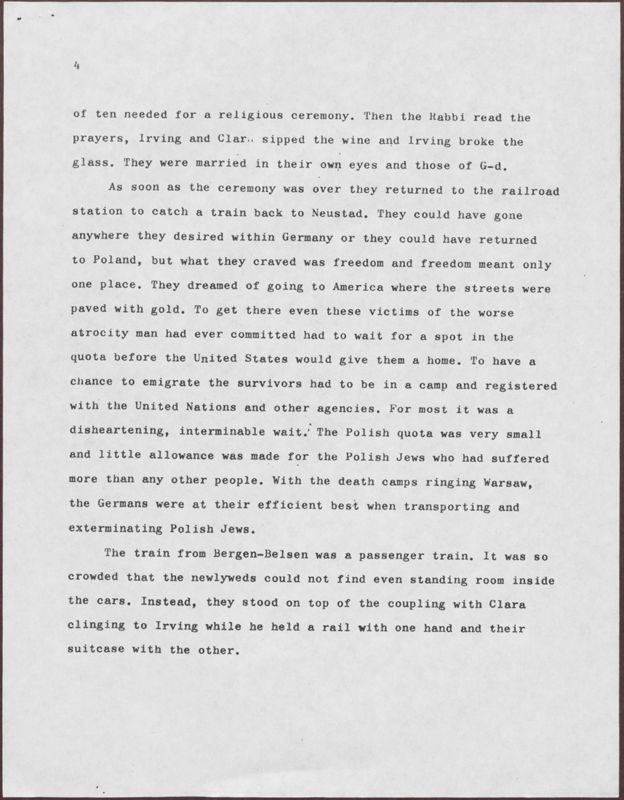 of ten needed for a religious ceremony. Then the Rabbi read the
prayers, Irving and Clara sipped the wine and Irving broke the
glass. They were married in their own eyes and those of G-d.
of ten needed for a religious ceremony. Then the Rabbi read the
prayers, Irving and Clara sipped the wine and Irving broke the
glass. They were married in their own eyes and those of G-d.
As soon as the ceremony was over they returned to the railroad station to catch a train back to Neustad. They could have gone anywhere they desired within Germany or they could have returned to Poland, but what they craved was freedom and freedom meant only one place. They dreamed of going to America where the streets were paved with gold. To get there even these victims of the worse atrocity man had ever committed had to wait for a spot in the quota before the United States would give them a home. To have a chance to emigrate the survivors had to be in a camp and registered with the United Nations and other agencies. For most it was a disheartening, interminable wait. The Polish quota was very small and little allowance was made for the Polish Jews who had suffered more than any other people. With the death camps ringing Warsaw, Germans were at their efficient best when transporting and exterminating Polish Jews.
The train from Bergen-Belsen was a passenger train. It was so crowded that the newlyweds could not find even standing room inside the cars. Instead, they stood on top of the coupling with Clara clinging to Irving while he held a rail with one hand and their suitcases with the other.
 5
5
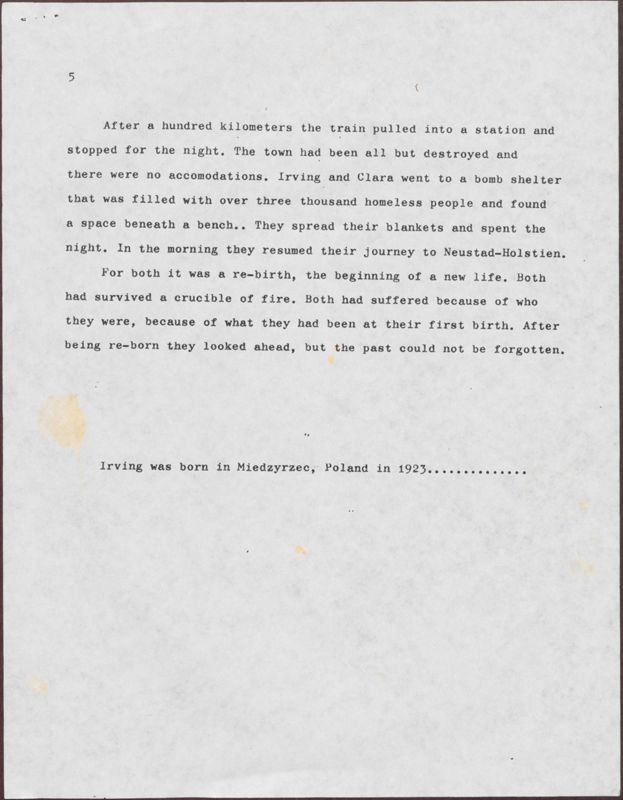
After a hundred kilometers the train pulled into a station and stopped for the night. The town had been all but destroyed and there were no accomodations. Irving and Clara went to a bomb shelter that was filled with over three thousand homeless people and found a space beneath a bench.. They spread their blankets and spent the night. In the morning they resumed their journey to Neustad-Holstien.
For both it was a re-birth, the beginning of a new life. Both had survived a crucible of fire. Both had suffered because of who they were, because of what they had been at their first birth. After being re-born they looked ahead, but the past could not be forgotten.
Irving was born in Miedzyrzec, Poland in 1923..............