Death Camp Came to Life, Saturday, April 9, 1994
- Date
- Creator
- Kelly, Michael
- Format
- newspaper
- Category
- Stories
- Subcategory
- Grossman
- Data URI
- soh.sto010.00217.xml
Death Camp Came to Life
The cantor at Beth El Synagogue in Omaha sang the mournful wail in memory of the 6 million.
"Exalted, passionate God," he sang in Hebrew as heads bowed, "grant perfect peace . . . to the men, women and children of the House of Israel who were slaughtered and suffocated and burned to ashes."
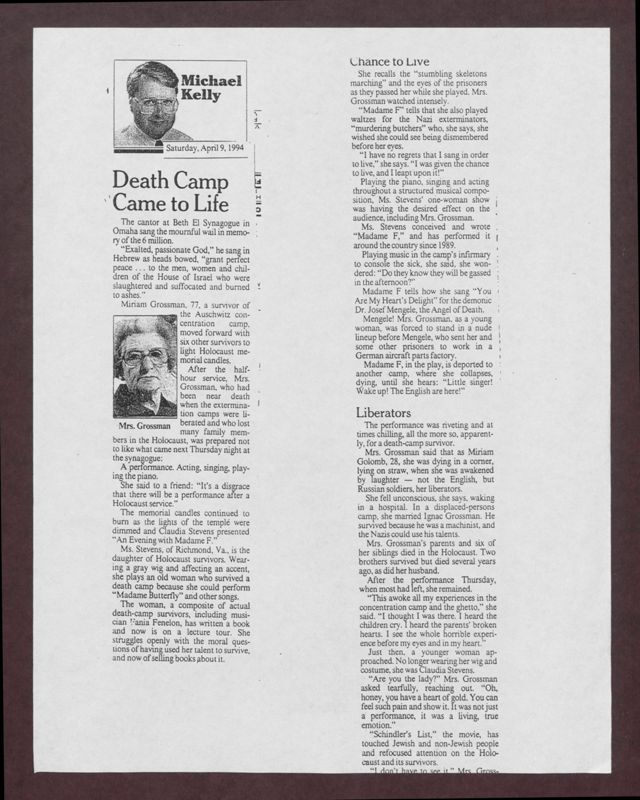
Mrs. Grossman
Miriam Grossman, 77, a survivor of the Auschwitz concentraion camp, moved forward with six other survivors to light Holocaust memorial candles.
After the half-hour service, Mrs. Grossman, who had been near death when the extermination camps were liberaatd and who lost many family members in the Holocaust, was prepared not to like what came next Thursday night at the synagogue:
A performance. Acting, singing, playing the piano.
She said to a friend: "It's a disgrace that there will be a performance after a Holocaust service."
The memorial candles continued to burn as the lights of the temple were dimmed and Claudia Stevens presented "An Evening with Madame F."
Ms. Stevens, of Richmond, Va., is the daughter of Holocaust survivors. Wearing a gray wig and affecting an accent, she plays an old woman who survived a death camp because she could perform "Madame Butterfly" and other songs.
The woman, a composite of actual death-camp survivors, including musician Fania Fenelon, has written a book and now is on a lecture tour. She struggles openly with the moral questions of having used her talent to survive, and now of selling books about it.
Chance to Live
She recalls the "stumbling skeletons marching" and the eyes of the prisoners as they passed her while she played. Mrs. Grossman watched intensely.
"Madame F" tells that she also played waltzes for the Nazi exterminators, "murdering butchers" who, she says, she wished she could see being dismembered before her eyes.
"I have no regrets that I sang in order to live," she says. "I was given the chance to live, and I leapt upon it!"
Playing the piano, singing and acting throughout a structured musical composition, Ms. Stevens' one-woman show was having the desired effect on the audience, including Mrs. Grossman.
Ms. Stevens conceived and wrote "Madama F," and has performed it around the country since 1989.
Playing music in the camp's infirmary to console the sick, she said, she wondered: "Do they know they will be gassed in the afternoon?"
Madame F tells how she sang "You Are My Heart's Delight" for the demonic Dr. Josef Mengele, the Angle of Death.
Mengele! Mrs. Grossman, as a young woman, was forced to stand in a nude lineup before Mengele, who sent her and some other prisoners to work in a German aircraft parts factory.
Madame F, in the play, is deported to another camp, where she collapses, dying, until she hears: "Little singer! Wake up! The English are here!"
Liberators
The performance was riveting and at times chilling, all the more so, apparently, for a death-camp survivor.
Mrs. Grossman said that as Miriam Golomb, 28, she was dying in a corner, lying on straw, when she was awakened by laughter - not the English, but Russian soldiers, her liberators.
She fell unconscious, she says, waking in a hospital. In a displaced-persons camp, she married Ignac Grossman. He survived because he was a machinist, and the Nazis could use his talents.
Mrs. Grossman's parents and six of her siblings died in the Holocaust. Two brothers survived but died several years ago, as did her husband.
After the performance Thursday, when most had left, she remained.
"This awoke all my experiences in the concentration camp and the ghetto," she said. "I thought I was there. I heard the children cry. I heard the parents' broken hearts. I see the whole horrible experience before my eyes and in my heart."
Just then, a younger woman approached. No longer wearing her wig and costume, she was Claudia Stevens.
"Are you the lady?" Mrs. Gorssman asked tearfully, reaching out. "Oh, honey, you have a heart of gold. You can feel such pain and show it. It was not just a performance, it was a living, true emotion."
"Schindler's List," the movie, has touched Jewish and non-Jewish people and refocused attention on the Holocaust and its survivors.
"I don't have to see it," Mrs. Grossman said. "I feel it in my veins."