Helen Manheimer Shoah Foundation Testimony
- Date
- Format
- testimony
- Category
- Stories
- Subcategory
- Testimony
- Repository
- USC Shoah Foundation
- People
- Nachman, Ben
- Fish, Esther
- Sugihara, Chiune, 1900-1986
- Fish, Miriam
- Fish, Leib Yitzhak
- Manheimer, Helen
- Hanan
- Fish, Masha
- Haviva
- Kripke, Myer S.
- Batya
- Revzuse
- Manheimer, Herman
- Ella
- Manheimer, Lory
- Places
- Siberia, Russia
- Tucson, Arizona
- Vilijampolė (Slobodka), Kaunas
- Khabarovsky Raion, Siberia
- Israel
- Austria
- Germany
- Vilnius, Lithuania
- Poland
- China
- Moscow, Russia
- Russia
- Vladivostok, Siberia
- Brooklyn, New York
- Shanghai, China
- Kobe, Japan
- San Francisco, California
- Austin, Texas
- Kaunas, Lithuania
- Lithuania
- Japan
- New York, New York
- Curaçao
- Pearl Harbor, Hawaii
- Leningrad, Russia (St. Petersburg)
- Omaha, Nebraska
- Manhattan, New York
- Data URI
- soh.sto000.00076.xml
- Note
- https://www.youtube.com/watch?v=CEInpyWKJdI
From the collection of the USC Shoah Foundation
Interviews are from the archive of the
USC Shoah Foundation - The Institute for Visual History and Education
For more information:
https://sfi.usc.edu
 Ben Nachman
Would you like to have a glass of water here in case you want to drink?
Helen ManheimerGet a glass of water right watch out don't trip. Yeah, don't trip on the wire. It's a little bit warm here, we didn't put on the air conditioning, but it's okay. Watch it Herman.
Ben NachmanYeah, be careful.
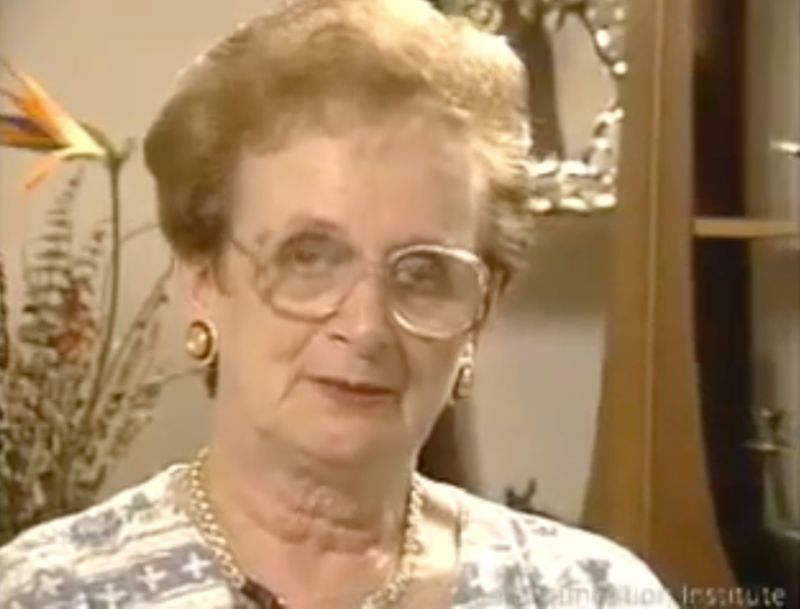
Ben NachmanJune 13th 1996 interview with survivor Helen Manheimer, M-a-n-h-e-i-m-e-r. Maiden name Fish, F-i-s-h. My name is Ben Nachman N-a-c-h-m-a-n. Interview is being conducted in Omaha, Nebraska in English. Can you give me your name, please?
Helen ManheimerIt's Helen Manheimer.
Ben NachmanAnd how do you spell your last name?
Helen ManheimerM-a-n-h-e-i-m-e-r.
Ben NachmanAnd where were you born?
Helen ManheimerIn Kaunas, Lithuania.
Ben NachmanWhat year?
Helen Manheimer1923, May 5th.
Ben NachmanAnd how old are you today?
Helen ManheimerI'm 73.
Ben NachmanMrs. Manheimer, can you tell me a little bit about growing up in Kaunas?
Helen ManheimerYes. All right Yes. Alright, um, my parents were in business in Kaunas, actually, they were in Vilijampolė, which was a suburb of Kaunas. My father was very well to do. We owned a large grocery store, retail, wholesale, bakery, paper factories, sanatorium, other businesses, apartment houses. When the Russians just came in, in 1939 I believe, oh in 1940 everything was taken away. And they had to move in with my grandpa. Meanwhile, I got, there was a rumor that there were being, that visas were being given by the Japanese consul in Kaunas.
Ben NachmanBut can you tell me more about growing up as a child?
Helen ManheimerAs a child, yes. I attended a Hebrew high school. From the primary grades to graduating. I was one year at the university, until it... The Russians occupied it. We had a very nice life all my relatives lived around us. My grandfather and my grandmother from both sides, and my uncles and my aunts and, it was a very rich Jewish life. As a matter of fact, my grandpa had his own minyan in his house. After my grandma died they would, have, say, Kaddish and have a minyan for a whole year and it developed into a little synagogue and my father would go every Shabbos there, you know. So it was a very rich Jewish life.
Ben NachmanHow large a population was in Kaunas?
Helen ManheimerKaunas had like, two-hundred-thousand people. The whole country is three million.
Ben NachmanHow many Jewish people lived there?
Helen ManheimerThey were um... Oh I would say at least fifty-thousand, as far as I can remember. There were three Hebrew high schools. There was one Yiddish high school. The Jewish children all of them attended the Hebrew high schools not the Lithuanian schools. Uh There was never a desire to be in a Lithuanian school, only in a Hebrew school. And uh, it was a very rich Jewish life it had the yeshivas all the rabbis and, they had the The Slobodka Yeshiva. Which was the main thing for the, for the scholars to to study there. They studied all the time. So it was a very nice Jewish life in Lithuania.
Ben NachmanDid you live primarily in a Jewish neighborhood?
Helen ManheimerYes, and no. Part of it was Jewish and part of it was Polish. And um, I didn't experience any antisemitism while I was living in Lithuania. My parents had a nice rapport with our customers, they were very helpful to them. They helped them out financially, and there was, there was no problem. Til, I understand, after what happened.
Ben NachmanDid you have an opportunity to learn the Lithuanian language?
Helen ManheimerYes, in high school we took Lithuanian. We took uh, English, we took German. But the the language, the main language spoken in the high school every - I finished Realgymnasium - was Hebrew. Every subjects, except the foreign languages, were discussed in Hebrew. So there was there was a and also there was a, there was a wonderful feeling being surrounded with Jewish students and it made you feel great.
Ben NachmanDid you have any brothers or sisters?
Helen ManheimerYes, I had, I'm the oldest, I have two younger sisters, one passed away in Israel. And my other sister Esther is in Israel with a family. Immigrated here from from Russia.
Ben NachmanIn growing up, did you have any opportunity to deal with the non-Jewish population?
Helen ManheimerYes, all our customers in our store were non-Jewish. And we had a wonderful rapport with them. There was never any disagreements, my father was very helpful, very kindhearted. Carried many people on his books. In Europe, there was no cash or checks. You carry the people on the book so they would have an easier time to survive. There was no- all- most of our employees were gentile. We had no problems. As far as I can see the experience.
Ben NachmanDid most of your immediate family live in Kaunas at this time?
Helen ManheimerYes, right, most of them- it's actually not Kaunas, it is, in Lithuanian it's Vilijampolė, and in, and in Yiddish was Slobodka. Right across the Niemen river was the suburb of Slobodka. And that's where we were.
Ben NachmanDid you have any occasion to travel growing up?
Helen ManheimerNot outside the country, just in different cities.
Ben NachmanDid you have any family living in other cities in Lithuania?
Helen ManheimerYes, we had other cities. Yeah, we used to go in the summer, we'd go and visit them. Yeah.
Ben NachmanHow did you go to visit?
Helen ManheimerBy bus. Yeah, people didn't have many cars at the time. So went by bus to visit them for the summer for a few weeks.
Ben NachmanAnd you say economically, economically your family...?
Helen ManheimerMy father was the richest man. One of the richest men in Lithuania.
Ben NachmanDid you he- hear or see any differences in the people as the war began?
Helen ManheimerWell, I wasn't actually in the war, you see I was in Lithuania... two or three weeks after the Russians took it over. And then we moved in with my grandfather, and my father had to give up the keys to the store to all the businesses to the apartment houses we were just non existing and moving with my grandpa, and that's when we heard the rumors that the Japanese consul was giving Visas, you know, and I was the one the fortunate what got one.
Ben NachmanDid your grandfather live in the same area?
Helen ManheimerYeah, the grandfather use to, that's right. Both grandparents one that died. Yeah.
Ben NachmanWhen they confiscated your father's holdings-
Helen ManheimerYes?
Ben NachmanDid they reopen them?
Helen ManheimerThey took him over the store was going like it was, everything, the rent was coming to the government. Was all nationalized was not nothing belonged to us anymore.
Ben NachmanWas your father compensated in any way?
Helen ManheimerNo, nothing whatsoever. Nothing. He was a, none... He was as a matter of fact, they didn't want to see him, you know, it was it was terrible.
Ben NachmanDuring this period had they begun to deport any of the people?
Helen ManheimerNo, not this, it's two weeks after I left for Japan. Where are my parents? They had to give a list of the rich people in Lithuania. And my father was on the list and in the middle of the night the way I understand. They rounded them up on trucks told them 10 minutes to take their belongings and they shipped them. And they took him to Kaunas to the station. And then they separated the men from the women. So my father was sent to do rail, and my mother was sent to Siberia to Khabarovsky Raion far deep in Siberia with my two sisters.
Ben NachmanDid your parents hear from one another during this period?
Helen ManheimerNo, nothing. Nothing. My father lost his mind. And he was shot by a Russian guard. And my mother and two sisters were were sent to to Siberia in Khabarovsky Raion in a very remote village. And that's where they gave them a little hut and that's where they lived. It was a very very bad situation.
Ben NachmanWhat kind of work does your mother and sisters have to do?
Helen ManheimerThey had to - my sis, my sister tended sheep, and many times was afraid to be attacked by wolves, she told me. And my mother, I don't know what chores she had to do there. There was, It was a terrible survival. I found out through a postcard, through somebody, that I was inquiring a lot from the Jew- from the Lithuanian immigrants and they told me that my parents were deported to Siberia. They were looking for me and I was looking for them and they gave me the address from Khabarovsky Raion. So I started right away to send out packages through Intourist. That's was organization where you paid up the duty here, for something like a 100, 150 dollars, just duty and send the packages to them and that's how they survived. They would barter all the canned goods and things for something they needed there, you know. And I understand the mud was so deep there, that when I sent them once boots, they fell apart in the mud. And then my middle sister Esther developed Typhus and she was taken by horse and buggy to a nearest hospital. And she survived. She's the one who's in Israel now, but she has a problem because since she came back from Siberia, she suffers from Arthritis. She has now I think Parkinson's. So it affected her bones, the cold is unbelievable there. So then my relatives in Russia, I had two uncles, engineers in Leningrad. Or B- Borovichi. It's 120 miles from Leningrad. And they found out in my mother's plight and my sister's. And they try to do all kinds of things to get them out from Siberia. So after five years they succeeded. And when my mother and my sisters came back to Lithuania, things were very bad for them. Some of the people tried to threaten them, that they will report them to the authorities, that they're not allowed to be In Vilnius, that's the city they came back to. And they will be deported again. So actually my mother was hiding. So finally they decided to go back to my relatives in Russia in Bardicher. And that's where my mother passed away. She's buried there, and my sister Esther was there too.
Ben NachmanWhat year was that that they returned to Lithuania?
Helen ManheimerI would believe, they were five years in Siberia, they were deported in '41, so... they would have been maybe 5 maybe '45. Around that time.
Ben NachmanHad the war ended by this time?
Helen ManheimerYeah, the war ended by this time. Yeah, they were all back in Russia.
Ben NachmanDid they have any occasion to go back to Kaunas?
Helen ManheimerNo, never. They were frightened. They were frightened at people threatening them. So as much they my relatives in Bardicher said you better come back here and stay with us.
Ben NachmanThey were threatened by the Lithuanians?
Helen ManheimerNot Lithuanians and some other people too that we will report you, you have no business being here, you were former capitalists, you know, and it was better to get out from there. Much better.
Ben NachmanNow you mentioned, Mrs. Manheimer, that you uh were there only about three weeks after the Russians arrived?
Helen ManheimerRight, yeah right.
Ben NachmanWhat were you doing at that time?
Helen ManheimerNothing, being with my grandpa, trying to apply for the visa.
Ben NachmanWere you still a student at that time?
Helen ManheimerYeah a student at university. My father said I should get out from there. I should get out as much- I was already 18, past 18. He says you get out, try to get out.
Ben NachmanDid you have any idea where you would like to go at that time?
Helen ManheimerWell, I was I had relatives in the United States. So, uh my relatives, you know when I arrived in Japan, I wrote to them and they sent me affidavit to come. So, uh my relatives, you know when I arrived in Japan, I wrote to them and they sent me affidavit to come.
Ben NachmanWhat did you do then in Lithuania to... secure passage out?
Helen ManheimerWell, my father paid for my passage in American dollars. A thousand dollars, and my mother gave me a lump sum first in case I needed money there, you know to,to help me out. And that's why I was able to take the train. There was a lot of other refugees leaving Lithuania most are from Poland, from the yeshiva many would d- they escaped from Poland to Lithuania and when the Russians came and we heard the Germans are coming so they, they also secured visas. And became on the train and, they also had, they were on the train with me from Kaunas to Vladivostok.
Ben NachmanCan you tell me, how you went about getting this visa to leave Lithuania?
Helen ManheimerWell, I went over to there was a lot of group of people. And I brought my passport and he put a stamp and he got me and I got a visa.
Ben NachmanDo you recall who this person was that you saw?
Helen ManheimerI can't remember, so many years. It was a bunch, a lot of people there. A lot of people.
Ben NachmanWas, was this the uh American embassy that you went to?
Helen ManheimerNo, that was the Japanese. The Japanese gave the transit visas for 30 days to japan. And then you had to have a destination to Cura- Curaçao. It's a colony some place but it it, I didn't have to because after 30 days I already had papers to leave Japan for the United States. My, my relatives had made the pap- got me the...
Ben NachmanDid you have the papers to come to the United States before you left Lithuania?
Helen ManheimerNo, no. I got my papers in Japan. I mean I I got my visa in Japan and the reason I got my visa fast is because I was on the Lithuanian quota, not the Polish, it was empty. No one was applying to leave and that's why I got it got it right away, in a few days.
Ben NachmanDo you recall the name of the man at the uh, Japanese embassy that was issuing these visas or the stamps to go to Japan?
Helen ManheimerI can't remember. I can't remember. I know Sugihara was the ambassador. There was somebody helping him.
Ben NachmanDid you get to meet Mr. Sugihara?
Helen ManheimerNo no, I didn't.
Ben NachmanDid you see him?
Helen ManheimerNo, I didn't I don't think I saw him.
Ben NachmanHad he instructed the members of the consul to issue transit visas?
Helen ManheimerYes, everything, yes. Everybody that came got a visa. And as a matter of fact the Japanese government wouldn't let the people in because they had to have a destination. You see so so they made, we made all up, Curaçao, we'll then go to Curaçao you know. And that will be our destination, but that wasn't even that- it was just a matter to escape. He saved the life of like six thousand people.
Ben NachmanWere you the only member of your family that was able to right do this?
Helen ManheimerRight, I told my dad, maybe my sister should go too, but no he said you just go. My parents were so bewildered they didn't know what they were doing. It was, we knew something, a tragedy will happen very soon and it was just a way to escape.
Ben NachmanDo you recall when this was?
Helen ManheimerI think it was I came in 1941. The way I can remember was July 1940.
Ben NachmanHad the Germans already attacked Poland by this time?
Helen ManheimerYeah, they have attacked there were people running away from Poland to Lithuania.
Ben NachmanHad you heard anything about what was going on in that war?
Helen ManheimerYou mean in Poland?
Ben NachmanYes.
Helen ManheimerHorrible stories. First was Austria. And then it was Poland. And then I don't know who was next but then became the three Baltic states.
Ben NachmanDid you notice any interruption in Jewish life during the period you were in Lithuania?
Helen ManheimerNo, not at all.
Ben NachmanThere were no changes?
Helen ManheimerNo changes. My grandpa went to to services every day does certain synagogue, there were no changes. But there was a fear. A terrible fear, uncertainty what is going to happen.
Ben NachmanCan you describe that trip that you took across Russia?
Helen ManheimerWell, I first I came with a group of uh Polish refugees to Moscow. And we stayed in the Intourist Hotel, overnight. And then we took the train to Vladivostok with a lot of stops on the way. On the way to Vladivostok. The stops were very, they were very heartbreaking. There was nothing to eat, the stations all smelled from cabbage. People were hungry coming to the train asking for bread. It was very very very sad. And the food in the in the train was good. I don't know how the other refugees were able to to pay for the train because my father paid for me in dollars. And we had three different berths, you know the upper, lower and... Then we came to Vladivostok and we stayed in the hotel for a few days. It's a very hilly city very cold. As a matter of fact, I met met a man there, a Jewish man who was in Lithuania and his wife was deported in Siberia and he was trying to get them out from Siberia. And then after a few days, there came a small fishing boat and took us from Vladivostok to Kobe.
Ben NachmanWas that a long trip?
Helen ManheimerNo, it was just a day. I was very sick on it. I stayed in the lower part the lower berth. Was very, I was throwing up all the time was very bad, but when we came to Japan it was like a sunshine sunny quiet nice. And the Jewish community in Japan, there was white Russian people, they had a small Jewish community center and they took care of us. We all got a little allowance for every week. And there was a family Russian Jewish people who cooked and we would go there every day for lunch. Pay maybe a a yen or something, you know, so we were all waiting there way to get out from Japan and go to the United States.
Ben NachmanDuring that railroad trip that you took how were you treated by the Russian people?
Helen ManheimerIt would they were very nice because I didn't see many Russian people, was all immigrants in that in the uh in the train. There was no problem, there was a lot of caviar to eat on the on the train and there was no, you know, it's such a long trip 10 days. Takes, you know, it takes a lot out of it.
Ben NachmanWere you with any friends at all?
Helen ManheimerYeah I knew, I had some people I knew that made it nice.
Ben NachmanAny relatives at all?
Helen ManheimerNo relatives, but it made it nice, you know, I had some, some nice people I knew from Lithuania but went on it to some Polish refugees and that helped us. We were like a little family, we watched over one another.
Ben NachmanWas it a Japanese ship that you used to go from Vladivostok to Kobe?
Helen ManheimerYes, was a Japanese, yeah, I think it was like a fishing vessel. I don't know a small one. Very rough very rough, you know. But I tell you when we arrived in Kobe, it was like a sunshine, you know. I was wearing boots, and I remember I had that long coat with a lot of foxes on it from Lithuania. And it was so warm there I had to take everything off, you know.
Ben NachmanWhat time of year was it that you arrived in Kobe?
Helen ManheimerI arrived in Kobe. I can't remember. I arrived- I- see I came to United in July 1941. I can't even recall the month I came. It was very cold in Russia. It was very very cold. Extremely cold, that's why I wore my boots and my everything, you know.
Ben NachmanDo you recall how long you stayed in Japan?
Helen ManheimerI stayed in Japan, was supposed to stay a month. But I stayed in Japan at least a few months, til my relatives sent the affidavit. Most uh when the, when Pearl Harbor started most of the refugees went to Shanghai. They were they were transferred to Shanghai, but I was the lucky one to get out.
Ben NachmanHow were you treated by the Japanese people?
Helen ManheimerVery nice very nice no complaints. They didn't distinguish between a Jew and a and uh, we were all Caucasian to them. They didn't distinguish. They were very nice very sweet very accommodating. Some other guy I made friends with a importer of pearls and he was such a nice man. And we would talk and very nice. I, I didn't have any bad experience. Because at that time Japan already was in a, made a pact with Germany and they wanted them to to persecute the Jewish people but they didn't know was Jewish not as long as they were Caucasian. They were all the same to them. No, I have no complaints about the Japanese. Very nice.
Ben NachmanWhat kind of quarters did you live in when you were in Kobe?
Helen ManheimerI lived by a gentile Russian family upstairs in a little room. And I paid them with what I had, you know. You know what whatever I had a little money with the the uh... See the Russian the Jewish community center was supported by the Joint, and the Joint was helping us, so they were giving us a little money. So I paid my room, you know.
Ben NachmanWhat did you do to occupy your time while you were in Japan?
Helen ManheimerOh we were hanging out in the Jewish community center. Going to the different stores. We have never seen department stores. You know, I mean Lithuania have big stores, but not like that and going around, looking around. You know, I mean just walking and that's about all.
Ben NachmanWas it a cultural shock for you to go into a different... element than you'd been in in Lithuania?
Helen ManheimerNo, it wasn't a cultural shock at all. It wasn't it was a very pleasant, Japan is very it was very relaxing to me. You know, it was quiet the people don't, they sit on the bus, they don't talk much to you. You know, they're they're very quiet and they're very polite and then they have those baths where you go you sit there you soak yourself you pour water over you, you know. Very pleasant. There was no problem, no problem. I was just worried about my family. Terrible worry.
Ben NachmanWere you trying to make contact with your family at this time?
Helen ManheimerYes, and that's why I found out where they were. Through a postcard from somebody who knew me from Slobotkaå. He said your parents were deported. Told me all about my dad and everything they knew. Um, hum, yeah.
Ben NachmanHow long were you in Japan before you were given papers to go to the United States?
Helen ManheimerI think it was like two or three months. We had to wait for the affidavit to arrive and then had to get processed, you know. So that's why I was I can't remember is it two months, is it three months. I can't remember.
Ben NachmanWas your money holding out for you?
Helen ManheimerNot much, not much, not at all. I if not the Joint I could have never made it. There was, there was no income, you know. My parents uh paid for my trip and I had a little money left but that went away, you know. So it was tough.
Ben NachmanWas there a large number of the immigrants at that time in Japan?
Helen ManheimerYou mean the white Russian Jewish people?
Ben NachmanYes.
Helen ManheimerI would say there were like maybe... A hundred families, all very well to do, all in the import business and export business. Yes. They were nice. We didn't associate much with them. There was uh, there was not much association. Except that one family would cook for us.
Ben NachmanDid you have a language barrier?
Helen ManheimerUh, well, I don't speak Japanese and there was one woman who originally came from Austria, I don't know how she ended up in Lithuania and from Lithuania she got a Visa also by the Japanese consul and she came also to Japan and she was giving English lessons. So I took English lessons from her like for a Yen, you know, she was teaching a group of people English. Yeah.
Ben NachmanWas there any discussion while you were in Japan of the consul in Lithuania?
Helen ManheimerNo nothing, nothing, there was nothing. There was nothing the things came later on. People realizing how he has saved the lives of people just by little piece of paper. I mean he was a hero under all the hardship from the uh, Japanese government which he received. And they denied all the time don't give out transit visas. Don't give out. He gave it. He wanted to save the people's lives.
Ben NachmanHow did you leave Kobe to come to the United States?
Helen ManheimerWell, I went on the last boat, you see there was already problems with the Japanese government and the American government and Pearl Harbor. And you see there was the- we were the last boat, on the Tatuta Maru. Leaving Japan for the United States. We were in the middle of the ocean, when it came a telegram that Pearl Harbor was attacked. Then there was a decision should they go back to Japan or should they go back to San Francisco? Well, the decision luckily was made to go back to go to San Francisco, and that's where we all landed in San Francisco. But the Jewish uh a Jewish uh delegation met us and got us quarters and food and we stayed there. Til our farther destination.
Ben NachmanDo you recall that trip? that boat ride?
Helen ManheimerThe boat ride, the Tatuta Maru? Yeah, it was a, it was a nice boat, but I was sick all the time on it. I I can't travel and I was I didn't eat anything. I was I was sick I was laying downstairs. And I was sick, you know til we came to San Francisco. We were very worried that we will have to return, because Pearl Harbor was already attacked. But I don't know who made the decisions they'd let the boat come to San Francisco, so that's how it came.
Ben NachmanWas the crew a Japanese crew?
Helen ManheimerYeah Japanese crew, all Japanese. We had no mistreatment from them.
Ben NachmanYou were treated well?
Helen ManheimerYeah we were treated well, had no complaints. No we were treated well. Right, we were treated well. And then we landed in San Francisco.
Ben NachmanAnd can you tell me uh who met you?
Helen ManheimerThey met us, all us people on the boat. We were met by a Jewish delegation from the Jewish Community Center. Some of them spoke Yiddish because our English wasn't too good and they-
Ben NachmanInterview with Mrs. Helen Manheimer. Mrs. Manheimer you were saying that you were met by a delegation when you arrived in San Francisco.
Helen ManheimerThey were Jewish people who belong to the Jewish community and they met us coming out from the boat and took us to hotel, talked to us, sat with us while we ate. We were all newcomers and didn't know our way around. So they stayed with us. I mean they made us comfortable.
Ben NachmanDid you communicate with them easily?
Helen ManheimerYeah. Yeah, I communicated. See my English wasn't good at that time and we spoke in Yiddish. Some young woman but spoke a little Yiddish and we communicated. Right. And I believe they gave us money to take the Greyhound bus to New York where my relatives lived. They paid for one way. I remember it was a very long trip. It was like six days that time to New York and I remember my legs were all swole, I could barely walk. I'm sitting so long in the bus.
Ben NachmanHow long were you in San Francisco before you left for New York?
Helen ManheimerI think we were like two days there. We stayed, we recuperated from the boat. We stayed there, and then they took us on buses.
Ben NachmanWhen we first met Mrs. Manheimer, you were telling me about the, students from the-
Helen ManheimerThe Mir Yeshiva.
Ben NachmanYes.
Helen ManheimerThey, they were very nice, very nice.
Ben NachmanDid they leave Lithuania with you?
Helen ManheimerYea they left, they they were no from Lithuania, they they were from Poland. And they escaped from Poland to Lithuania 'till the Russians came. You see, and they all got transit visas too and that's why we all came on the...
Ben NachmanAlso from Sugihara?
Helen ManheimerYeah from Sugihara. It's the only one.
Ben NachmanDid they travel with you to the United States?
Helen ManheimerSome yeah, most of them did. Yeah. Some traveled to Brooklyn, you know, we lost touch. But they were very nice. They were very kind. They were, I was a young girl, they were very helpful. You know, they still observed their their dietary laws even on the boat, we'll just eat a hardboiled egg and bread you know. They were very nice people, very nice.
Ben NachmanWhen you arrived in New York, did you have family there?
Helen ManheimerYeah, I arrived in New York. I had some relatives and I went to live with my relatives and worked for somebody in the millinery store, I remember I don't know, and stayed with them for a while.
Ben NachmanDuring this time, were you trying to make contact with your family?
Helen ManheimerI already knew about my family. And I tried to help them, you know, with whatever I could, you know. So I knew about the war.
Ben NachmanDuring the war years, were you able to communicate with them?
Helen ManheimerNo, not much. Not much at all.
Ben NachmanDo you think they had any idea where you were?
Helen ManheimerYeah, they thought I would be in the United States. I have a feeling they knew I would be in the United States. It is so long ago. I can't remember who wrote me that card about my parents, you know. I just, I can't recall, but I did get a card.
Ben NachmanWas this from someone in Kaunas?
Helen ManheimerIn Kaunas, yeah. He said, I can tell you, your parents are in Khabarovsky Raion, your mother and your two sisters. And then from my mother, I found out also what happened to my dad too. Also, I found out from that man he heard too what happened to my dad. When was it that you were able
Ben NachmanWhen was it that you were able to reestablish contact with your parents, with your family?
Helen ManheimerWell, when I arrived in the United States after a while, I started to send letters and they would send me back. Took a long time for a letter to reach in Siberia. It was very long, yeah. And later on, I started to send parcels to them to help them survive.
Ben NachmanObviously, when you were in the United States, you were starting to hear some of the stories of what took place in Europe?
Helen ManheimerYes, I did. It was terrible.
Ben NachmanDid you have any idea of what happened to the- other than your immediate family?
Helen ManheimerWell, you know, my mother wrote me one of the letters. She said she was in contact. It was a Russian family who had a bakery close to our house in Lithuania. And we were good friends with them. They used to do business with us through our store. And they wrote my mother in Lithuania, no, in Siberia and told her that you have missed the worst genocide in your life. We think that you're better off in Siberia. What went on with the Jewish people in Lithuania was so cruel, such a, the cruelty, the killing, it's a total genocide. She said, you are better off that you were in Siberia. That was a letter from our gentile, Russian gentile friend who wrote to my mother in Siberia. Yeah.
Ben NachmanDid you ever learn exactly what happened to some of your family?
Helen ManheimerWhat happened to some of my family, what I think is my grandpa and my uncle and my aunt were shot by the Germans. And my, my, my other grandma was shot too. My youngest mother's brother, Hanan was his name and his wife, Batya, they gave the child to a gentile couple, a customer of theirs. They had a yard good store. By the way, that girl survived. She lives now in Israel. She's married. She has a son. She's a grandmother. My uncle Hanan was to the last day in the ghetto. And he died of Typhus. He survived to the last day. By the way, the ghetto was in Slobodka. All the Jewish people from Kaunas had to come to Slobodka. And that's where the ghetto was. And the ghetto was where my father had all his apartments, his properties. I know the name of the streets. That's where the ghetto was. Yeah.
Ben NachmanThis, your mother's brother-
Helen ManheimerYeah Hanan.
Ben NachmanYou said they gave their child up to a gentile couple.
Helen ManheimerYeah.
Ben NachmanDid they survive the war?
Helen ManheimerMy, my uncle Hanan? No, the last week of the, when they liquidated the ghetto, the last week he died of Typhus, he and his wife. That's, there daughter, Haviva, was returned to my uncle, my uncle, what came back from Siberia to Lithuania. He escaped to Siberia. And he was, she was returned to them. But there was nobody left anymore.
Ben NachmanThis was after the war?
Helen ManheimerAfter the war right. He, as a matter of fact, they, my two uncles and their families leave by the railroad out of Kaunas. And when they heard that the Germans are coming, they escaped with it on the train all the way to Siberia. And with their families, and that's how they survived.
Ben NachmanDid they know where this child was being kept?
Helen ManheimerThey must have known because the, the gentile people knew exactly where to return the child. They contacted the Friedman family and they knew exactly where to return her. She was returned to my uncle.
Ben NachmanAnd this, and they raised her.
Helen ManheimerYeah.
Ben NachmanDid they immigrate to Israel?
Helen ManheimerYes, they immigrate to Israel. They passed away there. They have two daughters Yeah. A son passed away too. Yeah. They immigrate to Israel.
Ben NachmanAs the war started to wind down and then we saw the end of the war, did you then start to make some arrangements with your mother and your sisters?
Helen ManheimerYou see, I wrote to my mother in Vilnius. Then they came to Bredica. They moved to And my sister Esther got married there. My sister is now in Israel. My mother had cancer and she was taken to Moscow in the hospital and they found out the cancer was in her stomach so they couldn't do much. And she passed away and is buried in Bredica. It's 120 miles from Leningrad. My sister Esther's husband comes from Bredica. He took excellent care of my mother. And that's how I was in contact with them, finding out what happened.
Ben NachmanSo when the war ended, from the time you had left home to go to Japan, you hadn't seen your mother again?
Helen ManheimerNo nothing. The only time I saw my mother when I said goodbye. Nothing, none. I saw, I was twice in Israel, I saw my youngest sister, Masha, who passed away. I didn't get a chance to see Esther yet. She's been three years in Israel. Didn't have a chance to see her.
Ben NachmanIs she a fairly recent immigrant to Israel?
Helen ManheimerYes, three years. Three going on four. She and her husband and her daughter. My daughter Lory was last year in Israel and got to meet my sister and her family.
Ben NachmanSo you haven't seen your sister?
Helen ManheimerNo, I talked to her by phone. I call her. You know, Herman's condition. I can't leave him, you know, to travel. I mean, it's a long ride. It's a long travel. Twelve hours on the plane. But I talked two weeks ago on the phone.
Ben NachmanBut two sisters did survive the war along as with your mother?
Helen ManheimerYes. I'm the oldest and two sisters. My youngest sister died of bone cancer. And I attributed it all to the terrible cold weather in Siberia. That's why they used to send the criminals there. The cold is so it's unbelievable. The body cannot take it. It ruins your bones.
Ben NachmanWhen you were pretty well settled and the war ended, what kind of work were you doing in New York?
Helen ManheimerOh, I had I had different jobs, you know, I had sales jobs. I worked in a stock room. You know, I, as a matter of fact, I was once, one of my cousins, his wife was a Hebrew teacher. She was from Israel. And I suggested since I speak fluently Hebrew, if I can get a job, but they didn't they didn't encourage me. I didn't know what to do, you know. So I I mean, I could have been earning a nicer living, easier livelihood, but they didn't encourage me. It's only when I came to Omaha and I I talked to Rabbi Kripke and told him my background that he suggested I start teaching.
Ben NachmanAnd where did you meet your husband?
Helen ManheimerI met my husband in New York, in Cafe Vienna. It's where all the immigrants came. Yeah. See he's from Austria and I'm from Lithuania. We all used to meet there, you know.
Ben NachmanCan you tell me about your family now, Mrs. Manheimer?
Helen ManheimerAbout my sister?
Ben NachmanNo your immediate family, your children.
Helen ManheimerMy, I have 5 children and you want their names where they live? I have two daughters living in Tucson, Arizona. I have one son living in Austin. I have one son living with us and I have a daughter living in Manhattan, New York.
Ben NachmanAnd how many grandchildren do you have?
Helen ManheimerWe have 4.
Ben NachmanIs there a message you would like to leave for your grandchildren?
Helen ManheimerI tell you, yes, I do. That hate is evil and try to get along with your fellow man. Life is so temporary and do good to each other. Don't cheat, be honest, be kind. And that's about all. My youngest sister, my youngest daughter, actually, is obsessed with the Holocaust. She has any book on it. She reads a lot, she watches. I can't. I couldn't even see Schindler's List. It would upset me. I take it so personal. I can't, I can't do it.
Ben NachmanMrs. Manheimer, I'd like to thank you for giving us the opportunity to hear your story and wish you only the best.
Helen ManheimerThank you, thank you, I'm more than happy to do it.
Ben NachmanMrs. Manheimer, can you tell me about this photograph?
Helen ManheimerYes that was the photograph of my grandpa, Revzuse, and my grandma, Ella. I can't recall the time when it was taken. Do you want me to tell you about my grandpa, his life?
Ben NachmanYes.
Helen ManheimerHe was a ultra-Orthodox man. He had eight children. He had seven sons and one daughter. And very good father. And my grandma, Ella, as far as I recall, was a very devoted mother. As you can see on the picture, she's wearing a sheitel. Her hair is shaved off and she has a wig. That's what the Orthodox Jewish people used to wear, shave off their hair and wear a wig. He went three times a day to the synagogue in the morning, in the afternoon, and at night. The only synagogue he attended on Shabbos was in his house, but he would walk a man in his 80s, three times a day, maybe two miles each time. And he owned a cold storage place. He would sell ice. And also in his front room, he would take peasants who came to Kaunas from the surrounding areas. And they would sleep on the floor in his place and pay him a few lit. But he at one time told me, I want you to marry a Yeshiva bocher. It would make me so happy because he wanted the family should continue in the Orthodox way to live Orthodox. So he is in my memory. I have his picture in my bedroom all the time, and I look at him. It makes me very sad how tragically he lost his life. He was shot. My grandma died many years before that. So it is sad, but I love to look at him.
Ben NachmanIs he the grandfather that you lived with after you left your home?
Helen ManheimerYes he is the grandfather, we had a big house. Yes, and we lived with him. Yeah, we stayed with him. And I remember whenever I had an argument with my parents over something, I would come to his house. He had extra bedrooms. I would stay there with him. He was, he was my, my favorite grandpa.
Ben NachmanCan you tell me about this photograph?
Helen ManheimerYes that's a photograph of my family. On the right is my father, Leib Yitzhak. On the far left is my mother Miriam. I am in back of my father. To my left is my sister Esther, and between my mom and my dad is my sister Masha, the youngest.
Ben NachmanAnd you told me that your mother passed away in Berdyechev.
Helen ManheimerBerdyechev, yeah.
Ben NachmanAfter the war.
Helen ManheimerRight, she passed away in Moscow, but they took her and buried her in Berdyechev. Yes.
Ben NachmanAnd your sister, one sister, is living in Russia at this time?
Helen ManheimerNo. One sister in Israel and Masha passed away.
Ben NachmanDo you remember when this picture was taken?
Helen ManheimerOh, that was when I was in high school, in the Real gymnasium. I must have been 14. 14, and I'm now 73. So, 60 years. 60 years. 60 years.