Lester Bruns Shoah Foundation Testimony
- Date
- Format
- testimony
- Category
- Stories
- Subcategory
- Testimony
- Repository
- USC Shoah Foundation
- People
- Bruns, Harlow Joseph
- Bruns, Lester
- Bruns, Geraldine
- Retzlaft, Vickie Lynn
- Hoffman, Harlan
- Gates
- Bruns, Marvin Edward
- Bruns, Delia Marie
- Crownover
- Kearns, Sharon Mae
- Burleson
- Hitler, Adolf, 1889-1945
- Bruns, Dan
- Heesacker, Jerene Doris
- Karp, Miriam
- Jannes, Judy Ann
- Buehlers
- Bruns, Gerald Eugene
- Bruns, Wayne Daniel
- Entwhistel, Katherine Marie
- DiNacola, Dan
- Places
- Camp Robinson, Arkansas
- Rushville, Nebraska
- Fort Logan, Denver
- Nuremberg, Germany
- Fürth, Germany
- Haguenau, France
- Berchtesgaden, Germany
- Camp Kilmer, New Jersey
- Worms, Germany
- Ardennes
- Munich, Germany
- Dachau, Germany
- Austria
- Washington, US
- Schweinfurt, Germany
- Germany
- Gambsheim, France
- Denver, Colorado
- New York, US
- Rhine River
- Nancy, France
- Hallein, Austria
- Norway
- Russia
- Dachau concentration camp
- Rain, Germany
- Donauwörth, Germany
- Culbertson, Montana
- Harz Mountains, Germany
- Strasbourg, France
- Ferndale, Washington
- Knoxville, Tennessee
- Marseille, France
- Würzburg, Germany
- Indiana, US
- Hamburg, Germany
- Camp Gruber, Oklahoma
- Linz, Austria
- Moder River, France
- Leavenworth, Kansas
- Data URI
- soh.sto000.00110.xml
- Note
- https://www.youtube.com/watch?v=Zzq8s-DCKvQ
From the collection of the USC Shoah Foundation
Interviews are from the archive of the
USC Shoah Foundation - The Institute for Visual History and Education
For more information:
https://sfi.usc.edu
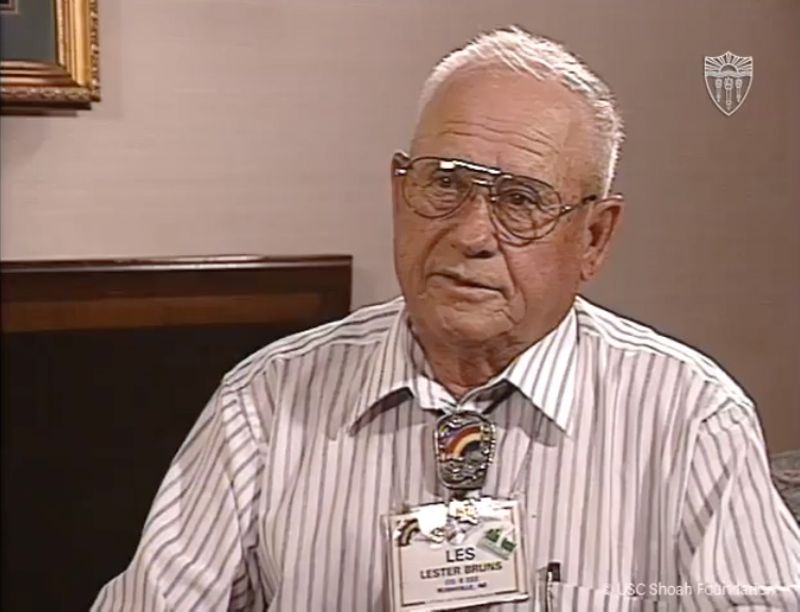 Miriam Karp
I, after I do this and I kneel down beside him, okay. All right, if you could hold that and I'm going to read it.
Miriam KarpThe date is July 10th, 1997. The interviewee is Lester Bruns, name at birth was Bruns. The interviewer is Miriam Karp. The city is Knoxville, Tennessee in the United States of America. And the interview is being conducted in English.
UnknownOk, tapes rolling.
Miriam KarpMy name is Miriam Karp. I'm conducting an interview with Lester Bruns. In Knoxville, Tennessee, the United States of America on July 10th, 1997. Name and the spelling of your name.
Lester BrunsLester Bruns, L-E-S-T-E-R, B-R-U-N-S.
Miriam KarpDo you have a middle name?
Lester BrunsYes, Eugene, E-U-G-E-N-E.
Miriam KarpAnd do you go by Lester or any other names?
Lester BrunsBy Les.
Miriam KarpHave you ever had any other nicknames?
Lester BrunsNo. That's the only nickname I had.
Miriam KarpAnd where were you born?
Lester BrunsIn Rushville, Nebraska. You asked where I was born?
Miriam KarpAnd how do you spell that?
Lester BrunsR-U-S-H-V-I-L-L-E. And Nebraska N-E.
Miriam KarpAnd when were you born?
Lester BrunsJuly 22nd, 1924.
Miriam KarpAnd how old are you now?
Lester BrunsI am 73.
Miriam KarpAnd what was your father's name?
Lester BrunsDan Bruns.
Miriam KarpAnd where was he born?
Lester BrunsIn Rushville, Nebraska.
Miriam KarpWhat about his parents?
Lester BrunsHis parents. I don't know where they were born. If they came over from Germany or if they were born in the U.S.
Miriam KarpAnd what did your father do?
Lester BrunsHe was a farmer/rancher.
Miriam KarpWhat kind of farming?
Lester BrunsWell, wheat farming and cattle ranching.
Miriam KarpHow big was the ranch?
Lester BrunsIt was 1,380 acres. Grassland ranch.
Miriam KarpWhat about the number of cattle?
Lester BrunsA hundred head of cows and a hundred head of yearlings that he run.
Miriam KarpWhat kind of cows were they?
Lester BrunsHereford.
Miriam KarpWhat kind of man was your father?
Lester BrunsHe was about the same size of man as I am. I guess I don't know just what you mean by that.
Miriam KarpWhat was your relationship like with your father?
Lester BrunsIt was real good. We didn't spend too much time away from the ranch because in those days we didn't travel very far. It was kind of an area where there wasn't a heavy population. North of Rushville, Nebraska.
Miriam KarpWhat was your mother's name?
Lester BrunsDelia. Delia Marie Bruns.
Miriam KarpWhat was her maiden name?
Lester BrunsTiensvold.
Miriam KarpAnd where was she from?
Lester BrunsShe was from... she was born at Rushville, Nebraska, but her ancestry was Norway.
Miriam KarpAnd did you have sisters and brothers?
Lester BrunsYes. I had... there were six of us in the family, three brothers and two sisters.
Miriam KarpAnd what are their names?
Lester BrunsThe oldest brother was Wayne, Harlow, and Marvin. Marvin was younger than I was. Sisters was Katherine and Jerene. They were both younger than I. Four boys and two girls.
Miriam KarpAnd what was your religious background?
Lester BrunsLutheran.
Miriam KarpAnd how important was religion in your family?
Lester BrunsIt was quite a strict religion. We had a religious family.
Miriam KarpIn what ways was it strict?
Lester BrunsWell, I guess I didn't mean strict. I mean, we had religion and we knew, was taught it and knew it.
Miriam KarpHow often did you attend church?
Lester BrunsAt least twice a week. And twice a week, twice a month. Once every two weeks.
Miriam KarpAnd where was the church?
Lester BrunsOur ranch was so far from town, the weather conditions and everything, made it, whether we could go or not.
Miriam KarpHow long would winters last there?
Lester BrunsWinters was usually started in fall, November to March. They were quite long. But they varied a lot. Some could be mild winters and some worse and that.
Miriam KarpWhat do you remember about a particularly bad winter when you were growing up?
Lester BrunsSince I got home from the war, I think the worst winter that I can remember was '49. It killed a lot of livestock. We had to have contractors come in with bulldozers to open things, roads, and get to buildings and people.
Miriam KarpWhat kind of responsibilities did you have on the farm when you were a child or as you were growing up?
Lester BrunsGoing after the milk cows, milking cows and feeding hogs. And we had small fields where we raised feed for the cattle and livestock.
Miriam KarpAnd how old were you when you first started helping out?
Lester BrunsWell, I was six years old, I think, when I started doing chores and being responsible for things.
Miriam KarpWhere did you go to school?
Lester BrunsIt was about a mile and a half from the ranch. We rode ponies to the school. I can't think of the name of the school. Plain View, I believe it was.
Miriam KarpHow many years did you go there?
Lester Bruns'Til I went through the 8th grade.
Miriam KarpAnd then in the 8th grade, where did you go?
Lester BrunsTo the Rushville, town of Rushville High School.
Miriam KarpAnd how many kids were in your class, do you think?
Lester BrunsIn the high school class, forty-some, forty-five, I think.
Miriam KarpWhat would you do when you weren't helping out on the farm or going to school? What kinds of activities were you involved in?
Lester BrunsBaseball, fishing, quite a little hunting.
Miriam KarpWhat did you hunt for?
Lester BrunsCoyotes and rabbits and squirrels. We lived along a creek. The name of the creek was Pat Creek. Plenty of water flowing through there.
Miriam KarpWhat did you think about growing up on a farm and ranch?
Lester BrunsI liked it. Plenty of activity most of the time, things to do.
Miriam KarpAnd what did you think you were going to do when you grew up?
Lester BrunsWhen I quit high school, I thought I was going to keep on farming and ranching. But I was called into the war instead, I guess.
Miriam KarpAnd when was that? What was the date you were drafted?
Lester BrunsIn May of 1944.
Miriam KarpAnd where did you go at first?
Lester BrunsWent to Denver, Colorado. Logan, Fort Logan, Denver, Colorado. From there to Camp Robinson, Arkansas.
Miriam KarpHow long did you stay in Denver?
Lester BrunsOnly a few days. And then to Camp Robinson for six months training.
Miriam KarpAnd what kind of training did you receive there?
Lester BrunsIt was ordnance, hauling freight, and equipment in the service.
Miriam KarpAnd what was your rank when you finished that training?
Lester BrunsIt was private. The training was interrupted at D-Day time of June the 6th. The camp was transferred into all-infantry. After that, it was straight-infantry training.
Miriam karpAnd where did you go from Arkansas?
Lester BrunsI went from Arkansas to Camp Gruber, Oklahoma. And that's where the 42nd Division was being formed.
Miriam KarpAnd how long were you there?
Lester BrunsFrom August, right there in August. I was there until November of '44.
Miriam KarpAnd what was your rank at the end of November?
Lester BrunsPrivate.
Miriam KarpAnd what battalion were you in at that point?
Lester BrunsI was in the 2nd Battalion of the 222nd Regiment of the 42nd Division.
Miriam KarpAnd where did you go after Camp Gruber?
Lester BrunsWent to Camp Kilmer, New Jersey. And we was alerted to be shipped overseas. We loaded on transport ships to be shipped across on Thanksgiving Day of 1944 in November.
Miriam KarpYou remember the name of the ship?
Lester BrunsThe B. Alexander.
Miriam KarpAnd what was it like for you after living on an isolated farming ranch to travel to all these different places for training?
Lester BrunsIt was different. I mean, it was nothing you couldn't put up with or anything like that, but it was surely different, yes.
Miriam KarpWhat about meeting all those new people?
Lester BrunsYes. It was being transferred and everything. You always had to adjust to new people wherever you went, new soldiers, or make new friends, and then you'd be transferred again.
Miriam KarpWhat did you miss about home?
Lester BrunsWell, I'd never been away from home, so I missed it all, I guess.
Miriam KarpDid you correspond with people at home with your family?
Lester BrunsYes, with my own immediate family and, of course, the other uncles and aunts who lived nearby.
Miriam KarpWhat was your opinion about going to war and going overseas?
Lester BrunsWell, I just thought it was a thing that we knew it was bad enough that all had to be done, so we was prepared to go do it.
Miriam KarpWhat did you know about the war by the time you left?
Lester BrunsI didn't know. I knew at D-Day that it entered the continent of Europe, and there was plenty of war left to be done, is all I knew.
Miriam KarpAnd where did you go when you shipped out? Where did you land?
Lester BrunsIn Marseille, France. It was 7th of December, 6th or 7th of December from Thanksgiving Day until the first part of December.
Miriam KarpWhat was the crossing like?
Lester BrunsThe crossing was there were no storms or any bad weather interference. It was in a convoy. We had several times when small intercepting boats would move through with alert warnings of submarines, but nothing happened at that time.
Miriam KarpWho were your friends on the ship?
Lester BrunsThe immediate friends was, you want 'em by name?
Miriam KarpIf you want, if you remember.
Lester BrunsI remember last names. Crownover, Gates, Burleson, Buehlers. There was five or six of us that was kind of hung together.
Miriam KarpAnd where were they from?
Lester BrunsWashington, Indiana, New York. I just don't remember all.
Miriam KarpWhat did you think about seeing the ocean?
Lester BrunsWell, it was a large body of water, yeah. The ship traveling through the water was smooth. It was such a large transport ship that it wasn't rough or anything like that.
Miriam KarpAnd what, what was at Marseille when you got there?
Lester BrunsWhat was it like in Marseille? It was cold. We moved from Marseille port up to a higher mountain, and it was stormy and cold and windy. We lived in pup tents for a few days before we was transferred deeper into the continent.
Miriam KarpAnd where did you go when you were transferred?
Lester BrunsTo the area near Strasbourg. Christmas Day we was in what was known as the Maginot Line was kind of a dug-in place. That's where we spent Christmas. And we wasn't to talk to anybody we didn't know because we were being infiltrated with espionage.
Miriam KarpWere you aware of any instances of infiltration?
Lester BrunsNo. I wasn't.
Miriam KarpWhat other kind of orders did they give you about talking to people or contact with civilians?
Lester BrunsWe wasn't to talk to anybody if we didn't know them because of the infiltration at that time.
Miriam KarpAnd how long did you stay there?
Lester BrunsJust a few days, and then we went on to Strasbourg area.
Miriam KarpAnd how long did you stay there in Strasbourg?
Lester BrunsOnly a few days again, we was.
Miriam KarpWhat was going on there at the time?
Lester BrunsWe was just billeted, and nothing was going on war wise, and then we was called to Gambsheim.
Miriam KarpAnd approximately when would that have been when you moved to Gambsheim?
Lester BrunsWe moved to Gambsheim 5th of January. We didn't know we was going into battle. We was ordered to take Gambsheim the next morning. It had been January 6th. But we did take it, but their counterattack took us back out again.
Miriam KarpWhat was that battle like, your first battle?
Lester BrunsIt was unbelievable. It was terrible with artillery and 88 shells. And I was blown unconscious, so I didn't get to go through all of it.
Miriam KarpWhen was that? When did that happen?
Lester BrunsWith an 88 shell hitting close by. When I came to some troops had drug me to a rock wall, and there was another soldier there that was wounded. He gave me his rifle, and I went on and joined them again. Went into the town. Got clear down 'til we could see the Rhine River. When the counterattack hit us, next orders was to return to where we started that morning. Which we did; it was along the canal.
Miriam KarpWhat were your casualties like in number?
Lester BrunsI don't know the number, but there was quite heavy casualties, yes.
Miriam KarpAnd what was your reaction to that first day of fighting and getting wounded?
Lester BrunsWell, I didn't know. When we got back to the canal, Crownover said my face was all black. I got a tin plate, and I could see that it was kind of like powder burn. It was really black. Then I had no memory of anything until I was on the Moder River, which was almost two weeks later. I don't think I went to any medical center or anything. I don't have no recollection of an area there.
Miriam KarpWhere were you when you were moved to the Moder River? What town was near where you were?
Lester BrunsHaguenau.
Miriam KarpAnd how long did you stay there?
Lester BrunsWe was, I remember being on patrol at the Moder River the 20th of January, and the 25th, it was the Ardenne's attack there.
Miriam KarpCould you describe what happened during that attack?
Lester BrunsIt was artillery again. Several of them was captured. I was one of them that got out.
Miriam KarpHow did you manage to escape?
Lester BrunsMy squad sergeant said that we're surrounded, we have to get out of here. As we turned to go, I heard some hollering of surrender, so I went into, it was wooded area, I went into the wooded area. I went a little ways, and I ran on to a sergeant that handled mortars. He was blind, and his face was kind of torn up. He was blinded, so he hung on to me, and I moved to the rear where I knew the kitchen came from. Right on to a TD tank back there, and a lieutenant that was in charge there took the wounded, took the wounded to go on to the jeep, and the rest of us wasn't willing to get on the tank, and we went to take an intersection back that we had lost. Again, we lost. They shot us off the tank or didn't hit us, but I mean, opened fire and we lost a tank, but I got on out. I was one of them that got out of E company. E company was 140 strong at the beginning of the battle, and it was 37 the last I knew.
Miriam KarpWhat happened to the people who were captured?
Lester BrunsOne of my friends in Ferndale, Washington has told me about it. He said it was, they marched them real hard and strong, and him and another kid finally managed to escape just before the war ended. They captured most of our company that night. Killed, wounded and captured.
Miriam KarpAnd what did your company do after that?
Lester BrunsMoved back to an area near Nancy, France, and was there for, I think, two weeks or more while replacements came in and built the company back up.
Miriam KarpAnd then where were you sent?
Lester BrunsTo the, to relieve the 45th Division at the Harz Mountains.
Miriam KarpAnd what did you find when you got there?
Lester BrunsIt was online again, just running patrols into the Harz Mountains, and no, we didn't get any attacks there til the time that we was ordered to attack to go forward, and that was March 15th.
Miriam KarpAnd when did the attack come on March 15th?
Lester BrunsIt was our orders to proceed and recapture territory, or I guess the final drive through to the end of the war. We never stopped after that.
Miriam KarpAnd how long were you in the Harz Mountain region?
Lester BrunsTo cross the Harz Mountains, I think it was a week or more. Supplies was brought even to follow us through by mule and donkey. And we traveled by foot, of course.
Miriam KarpHow cold was it?
Lester BrunsIt was snow on the ground, and it wasn't below zero, but it was like 20 degrees, and snow and wet. Cold.
Miriam KarpAnd where did you go from there?
Lester BrunsFrom the Harz Mountains. Our trip was clear on through. I don't know exactly where we went, but we crossed the River Rhine at Worms, Germany. We was moved up and crossed over a pontoon bridge. The area was already taken and put back into action after we crossed the Rhine. The route went through Würzburg. I think that was the 4th of April. You can't keep track of dates very well. I mean, I couldn't because I was just going all the time, night and day. Crossed the river at Würzburg with the 2nd Battalion Rangers, volunteers, and we crossed ahead of the division to make a bridgehead. It was just all the way. Every town seemed like we had to fight for.
Miriam KarpAnd what about losses in those battles?
Lester BrunsLosses. All along there was plenty of loss. It was at Würzburg. We crossed in the night, moved up a short distance, like five blocks, and then was called back to the river so P-47 dive bombers could come in and take out an armored division. We was running into a German armored division. And after that bombing, we moved forward again.
Miriam KarpWhat were the results of the bombing? What did you see?
Lester BrunsPardon?
Miriam KarpWhat did you see of the results of the bombing?
Lester BrunsThey done only artillery guns. It was there and the tanks that they spotted. They done real good of destroying them.
Miriam KarpAnd then from there, where did you go, from Würzburg?
Lester BrunsTo Schweinfurt, which was a ball-bearing factory. And then from there to, every place seemed like we had some loss and some fight. I mean, at Fürth and Nuremberg, we went through there. Then we was loaded on to a tank division. It was the 20th armored. And we were supposed to take a bridge intact at Donauwörth. We lost some tanks and some troops there at that. And we didn't get the bridge intact. It blown up when they seen us, when we approached it. That's usually where it usually went, I guess. Even the one at Würzburg, we were to take a bridge intact there, too. But they blew it before we could get to it.
Miriam KarpWe're going to stop here for tape-break.
Miriam KarpWhat were the incidents up until that time where you felt most in danger, or most threatened, you personally?
Lester BrunsWhere I felt most in danger of.
Miriam KarpWhat do you recall?
Lester BrunsThe Würzburg, when I went through Würzburg, was the most, I think, I don't know just how to, it was all the time, so I just don't know how to answer that.
Miriam KarpWere there some specific times where you were most in danger that you can remember?
Lester BrunsNo, it was, we just had to fight our way all the time.
Miriam KarpWhat did you think about as you were fighting?
Lester BrunsIt seemed like I was so full of fear I just fight back, I just, I didn't think about anything but fighting back.
Miriam KarpWhat about the rare times where you got to rest or got some sleep?
Lester BrunsIt was, we were allowed to rest for from 10 to 30 minutes at a time, and we wouldn't leave until the next person with us was leaving with us. So, because we was so played out, we would just fall asleep, you know. Everybody would, was called to go, nobody left, 'til he left his only closest personnel would go with him. That's the way they rested. Then they went after Donauworth, when we rode the armor in there, we lost that bridge. But they started shuttling then with trucks, and weapons carriers would move some troops forward, and then they'd walk and then move some other troops forward, keep shuttling back and forth. By then I was squad leader, and I got replacements in my squad as we crossed the river at Donauworth. But before that day I lost some of them from running into machine gun fire and small arms fire. We got to the town of Rain, which is not too far from the Dachau concentration camp. From there we moved up to the concentration camp of Dachau.
Miriam KarpWhat did you know about Dachau before you got there?
Lester BrunsI didn't know anything about it. I just knew that whenever we hit resistance at the camp on the 28th of April, it was a concentration camp there. We would take it at daylight in the morning.
Miriam KarpAnd had you heard that there was a concentration camp there?
Lester BrunsYes. When we was fired upon or hit resistance, they said there was a concentration camp there, we would take it in the morning.
Miriam KarpWhat did you think that meant, concentration camp?
Lester BrunsI didn't know. A prison, I thought it was just a prison, but I didn't know it was a concentration camp, I thought it was a prison.
Miriam KarpAnd where were you when you started hitting resistance?
Lester BrunsWe was on a roadway going towards the camp, or the prison was ahead of us.
Miriam KarpAnd could you see it from where you were?
Lester BrunsNo. It was dark, or almost dark, and small arms fire was real heavy. We had to take it in the dark or wait til daylight and go. And our orders was to wait til daylight.
Miriam KarpHow long did the firing go on before you were given orders to wait until daylight?
Lester BrunsNot a long time, it was like fifteen minutes, and we was told to wait til daylight.
Miriam KarpAnd what happened during the night?
Lester BrunsIt was quiet during the night, we just had to find protection if there was a ditch or anything like that. We was along the roadway, so we just waited along the edge of the roadway with orders to start out again at four o'clock in the morning.
Miriam KarpHow many men do you estimate were with you then?
Lester BrunsI had my own squad with me. I know my twelve men were there.
Miriam KarpAnd what happened at four in the morning?
Lester BrunsThe orders was to go, and we never run into any more resistance. We went right into the gate.
Miriam KarpAnd what did the gate look like?
Lester BrunsIt was an iron steel gate, broke in the middle and folded both ways. Quite tall gate.
Miriam KarpWhat was surrounding the gate on either side of it?
Lester BrunsConcrete walls, concrete walls.
Miriam KarpAnd how tall were they?
Lester BrunsLike ten foot, I would say.
Miriam KarpAnd who was at the gate when you got there?
Lester BrunsThere was nobody at the gate until the guys was opening up or getting into it.
Miriam KarpAnd who opened it up?
Lester BrunsMy leader, who was leading me in the squad. I was a squad leader, and I had scouts ahead of me. But there was inmates from the inside was working from the inside, too. As the gate opened up, there wasn't very many inmates there, but they just looked bewildered. And the stink and the stench was terrible, too. To the right of the gate was some gas chambers. But they was in prison clothes and stripes, and they was coming down to that area from around there, I guess.
Miriam KarpHow did you know that the buildings to the right were gas chambers?
Lester BrunsI guess maybe I didn't know immediately at the time, but they was dug into a wall. Maybe I wasn't right. Maybe they weren't gas chambers, but it sure looked like it to me.
Miriam KarpWhat did it look like that made you think it was gas chambers?
Lester BrunsIt was several just arched like that, one against the other like that. And some of them was standing open, just a cement chamber is what it was.
Miriam KarpAnd what was inside the chamber?
Lester BrunsNothing. I mean, you could see the concrete and whatever back in there.
Miriam KarpWas there anything around the chamber, on the ground or near there?
Lester BrunsThere were several doors, several lengths of them, but to be around them, I don't know.
Miriam KarpAnd what did the people look like, the inmates who came up to you when you went in the gate?
Lester BrunsThey was in striped clothes, gowns, and they just looked bewildered. There was a terrible smell inside the camp.
Miriam KarpWhat kind of smell?
Lester BrunsI don't how well you'd explain it, it was stinking. The stench was terrible. It wasn't clean there at all.
Miriam KarpWhat did you see as you looked out at the camp?
Lester BrunsI wasn't inside of the camp any farther than, well, probably less than a block when we was ordered to move on.
Miriam KarpWho gave that order?
Lester BrunsThe company commander, Dan DiNacola.
Miriam KarpWhen the people came up to you after you got into the gate, what kind of condition were they in?
Lester BrunsThey were in poor condition. I mean, they looked bewildered, dumbfounded, or whatever. I don't know how to explain it, but they just, they acted like they were scared of us or didn't act like they didn't know what we were. Maybe they thought we were more Germans or something. I don't know.
Miriam KarpWhat about their physical condition?
Lester BrunsPoor, very poor. Skinny.
Miriam KarpIn what way?
Lester BrunsThin and feeble-looking. Yeah, they was in real poor condition.
Miriam KarpWhat kind of age range would you estimate the prisoners were that you saw?
Lester BrunsProbably in the forties. I think probably in the forties.
Miriam KarpMen and women and children, too?
Lester BrunsI remember mostly men. I didn't see any children. I didn't see the railroad cars that held bodies and stuff like that. I didn't see any of that.
Miriam KarpHow long do you estimate you were in the camp?
Lester BrunsI think 20 minutes or less.
Miriam KarpAnd during those 20 minutes, what did you do? Where did you go in the camp?
Lester BrunsWe didn't go any farther than a block. It must have been less than 20 minutes cause we didn't. . . The prisoners seemed to be coming down, coming out, kind of showing up out from places around there. And we didn't go any farther in than that. Our company commander said, rear echelon can take care of this, and our objective is Munich.
Miriam KarpHow many prisoners would you estimate came towards you while you were there?
Lester BrunsI would say right at the gate area there was eight or ten, and then before we left, I imagine there was 15, 20.
Miriam KarpDid they ask for anything?
Lester BrunsNo.
Miriam KarpAnd was anything given to them?
Lester BrunsNo, not that I know of.
Miriam KarpWere you aware of anyone communicating with them?
Lester BrunsNo.
Miriam KarpWhat were your thoughts when you saw these prisoners?
Lester BrunsI wondered if it was a prison camp, why they were treated like this, or why they would look like this. I mean, it was unclean, and it was, and they looked really in need of food and everything.
Miriam KarpWhat was your understanding of what a prison camp was like?
Lester BrunsI didn't know there was a concentration camp. I just thought it was a prison.
Miriam KarpAnd what would that have been like according to what you thought it should be like?
Lester BrunsWell, I knew it shouldn't have them in that kind of condition. They should at least be fed.
Miriam KarpAnd where did your company go after you left Dachau?
Lester BrunsIt went to Munich, Munich, Germany.
Miriam KarpAnd what happened in Munich?
Lester BrunsWe didn't hit any more resistance from Dachau to Munich. To the right of us, I know there were some units over there that we could hear the battles going on, but our own unit didn't hit any more resistance. And as we entered Munich, the road we entered on was all had white flags was all out. No resistance in our area. But we did run on to American and British prisoners. They wanted our weapons. They knew guards they wanted to get, and they also was surprised, too, that we rolled in there at that time, I guess. They was under guard yet that morning.
Miriam KarpWhile you were still at Dachau, what about the Germans at Dachau? What did you see of them?
Lester BrunsThe guards? I didn't see any German guards. I didn't see any SS troops. I didn't see any German guards.
Miriam KarpAnd when you got into Munich, what did you hear about Dachau?
Lester BrunsNothing. I don't think they knew. The prisoners we liberated didn't know anything about it. And the Germans themselves, the company commander, usually tries to get in a small town. It's the Burgermeister. He gets all the information he can right away. He got information that there was a Nazi leaving. A Nazi informant, or not a Nazi informant, but a Nazi upstairs Nazi that was leaving from the airport. Our orders then was to go to the airport, which we did and we, I think we run onto the plane that was leaving with him because we tried to bring it down a small arms fire without doing that either.
Miriam KarpSo what happened to that plane?
Lester BrunsIt got away. It left. And it had a Nazi official on it, so the civilians said in Munich.
Miriam KarpDo you happen to know that Nazi's name?
Lester BrunsNo, I don't.
Miriam KarpWhat about other attempts to catch Nazis?
Lester BrunsThat was the only one I was involved in. And through the company commander questioning civilians, they reported that this Nazi was leaving. So we went to the airport, but we wasn't in time.
Miriam KarpAnd where did you go from the airport?
Lester BrunsWe didn't go back into the city of Munich. We stayed out in the airport area. And then we went from there to Hallein. I think the name of it was Hallein. And this was the 29th by the 5th of . . . We was taken into some mountainous area to try and get some resistance taken out. And we was at Hallein whenever the war ended, May the 5th, officially. And we was at Hallein whenever the war ended, May the 5th, officially. Which was, it still wasn't ended, because they didn't know it was ended. I mean, they fought for a few days even after that.
Miriam KarpAnd when you left Hallein, where did you go?
Lester BrunsHallein, I can't. Hallein wasn't very far from Berchtesgaden. From Hallein we went to the backside of Berchtesgaden. Hitler's hideout, hideout or mansion, but it had already been liberated.
Miriam KarpWhat did you see there?
Lester BrunsWe was to the backside. We seen the elevators and the . . . dug - or whatever was into the side of the mountain. We seen where that was, but there was no Nazis or anything there left anymore, or any German troops.
Miriam KarpAnd then after that, after Berchtesgaden?
Lester BrunsThe war was declared over, and I think that we was working out of Hallein. Whenever we went to Berchtesgaden, we went from Hallein up there and back to Hallein. And the war was over. And outside of running patrols into mountains, into areas, not mountains, but into areas, so we called it resistant pockets or something like that.
Miriam KarpWhat was your involvement in those resistance pockets?
Lester BrunsWe would usually travel by jeep with three or four guys in it to go to—it wasn't ever very far either— to go back and try to pick up some where they thought there could be some resistance. They also tied fine wire across the road so that the jeeps had to have steel poles put up in the front of them to clip them wires so the personnel running the jeeps wouldn't get hurt.
Miriam KarpDid any of those forays that you were on find resistance groups?
Lester BrunsNo. I never found any. We had to keep looking for them.
Miriam KarpAnd how long did that go on after the war ended?
Lester BrunsOh, not real long. I think near a month, about a month.
Miriam KarpAnd then where did you go?
Lester BrunsThen we went to Linz, Linz, Austria. And we were stationed there for . . . until they started setting up occupation duty for all of them. I was in occupation until June of '46.
Miriam KarpAnd what were your duties?
Lester BrunsIn occupation? Mostly guarding along at Linz. Russians had a territory across the river from us and we was on one side and they was on the other. And it was . . . They had highways, ferries, and railroads there. All personnel crossing between areas was checked.
Miriam KarpWhat kind of contact did you have with the Russian army?
Lester BrunsNothing outside- I couldn't talk to guards that could speak some English or otherwise. They'd come across to our side. I never did go across to their side. They'd come across not in any enemy force, just friendly force, friendly wise.
Miriam KarpAnd when did you ship out to go home?
Lester BrunsI got home in June. In June of... It must have been the last of May. I don't remember exactly. Last of May, 1st of June of 1946 from Hamburg, Germany. Went by rail to Hamburg and loaded on ship there.
Miriam KarpAnd when were you discharged from the army?
Lester BrunsIn June of 1946 from Leavenworth, Kansas.
Miriam KarpAnd where did you go from Leavenworth?
Lester BrunsStraight home to the ranch.
Miriam KarpWhat was your rank at the time of discharge?
Lester BrunsStaff sergeant.
Miriam KarpWhat was it like to be home again?
Lester BrunsIt was something I'd tried to do for a long time, I guess. Even occupation, I was disinterested in and I wanted to go home. But it went by points and time involved. And I was one of the younger ones and went out of high school into the army. I didn't get home for a year after the war was over.
Miriam KarpWhat had changed while you were gone?
Lester BrunsWhat had changed? There had been quite a little change, yes. The automobiles weren't very available because there wasn't any. It was all the war effort.
Miriam KarpAnd when you got back home?
Lester BrunsThey were still using the same ones. Fuel was rationed and sugar was rationed.
Miriam KarpWhat other changes had happened while you were gone?
Lester BrunsMy sisters had gotten on through school and was teaching school instead of going to school. I guess I don't know of any big changes, no. What kind of adjustment was it for you to- Seemed like, seemed like that, the war had been over... For a year and I was in occupation and it wasn't like going home. The war was just over. It was a thing of the past almost already. I did notice that. It wasn't a hooray. Your home was a hooray. It was all over already.
Miriam KarpHow were you treated when you came back home?
Lester BrunsReal good. Not as no hero, nothing like that because everything was over a year past.
Miriam KarpWhat kind of adjustment was it for you to come back from the war?
Lester BrunsWell, I just went home to the ranch again and there was plenty there for me to do. So it wasn't a big adjustment for me, no. I just went back to helping them and going from there.
Miriam KarpHow old were you when you came back?
Lester BrunsJune of 46, I was 22... 21, yeah.
Miriam KarpHow much did you talk about your war experiences with the people back home, with your family?
Lester BrunsNot very much. I mean it seemed like they didn't like to ask and I didn't, it was hard to talk then. I've been able to talk better since we've been going to the reunions, division reunions.
Miriam KarpWhen did you start going to the reunions?
Lester BrunsIn '88 in Denver.
Miriam KarpWhy do you think you started going to the reunions?
Lester BrunsOne of them from the company talked me into going and I just thought it was all right and kept on going. I had contact with them before by mail or letter.
Miriam KarpWhat kinds of things would people talk about at the reunions?
Lester BrunsAt first they talked of some of the war experiences, but it isn't mentioned a lot anymore. I think that's a part that helped, though, probably. Dragging it out and hashing it over again.
Miriam KarpWhat did you find out about Dachau at the reunions?
Lester BrunsAt the reunions. Most of them seemed to have pretty much the same idea. Except the 45th division was in Dachau too, but it must have been after we were there. I think after some reunion and some conversation between the two units, it was decided that the 42nd was ahead of them there. I know nobody was ahead of us. I do know that.
Miriam KarpDid you get married when you went back home?
Lester BrunsYes.
Miriam KarpWhen was that?
Lester BrunsIn '48.
Miriam KarpAnd what is your wife's name?
Lester BrunsGeraldine.
Miriam KarpWhat was her maiden name?
Lester BrunsGeraldine Cech.
Miriam KarpAnd how did you meet her?
Lester BrunsI think we was at one of the little old dances there in Rushville when we met.
Miriam KarpWhat did she know about your experiences in the war?
Lester BrunsNot, at that time, nothing. But I mean we've talked a lot about it since. I have the Bronze Star for going with the Rangers into the Würzburg. And the 222nd Infantry has bronze star with a cluster for being a unit going through the Ardennes. The whole unit.
Miriam KarpDo you and your wife have children?
Lester BrunsYes.
Miriam KarpAnd what are their names?
Lester BrunsSharon, Gerald, Vickie and Judy - have four. I have three great grandsons already.
Miriam KarpHow many grandchildren do you have?
Lester BrunsThree. There's all newborns just this last year. One born just before we came to the reunion now. Fourteen grandkids, have a big family.
Miriam KarpAnd where do most of them live?
Lester BrunsMost of them live in Nebraska and one in Montana of our own four children in our home area, except the one boy who lives in Culbertson, Montana.
Miriam KarpWe're going to stop here for a tape change.
Miriam KarpLester Bruns, tape 3. We were talking about your family, your grandchildren, great-grandchildren. Have you talked to them about what you did in the war, your grandchildren?
Lester BrunsNo, I guess I haven't. I haven't really talked to them, no.
Miriam KarpHow do you think the war affected you and your life afterwards?
Lester BrunsI guess I don't know of any ill effects. It seemed like I didn't go out and talk about it a lot, but I don't know if I kept it locked in or what. But I don't know of any ill effects, no.
Miriam KarpHow do you think that the things you saw around you during the war affected how you thought about the world?
Lester BrunsI don't know. I don't think people can believe it unless they do see it or get into it, that things can be that bad. I mean like a dictator like Hitler had to be stopped. I guess there still can be if it isn't under control somewhere.
Miriam KarpWhat did you find out about the Holocaust after the war?
Lester BrunsAfter the war, the camp was kept as a museum. Part of it was destroyed and part of it was kept so people could go back and always know what had happened and what did happen. Otherwise, they wouldn't believe it either, I don't think. I mean, it don't seem like.
Miriam KarpDid you ever go back to the camp, to Dachau?
Lester BrunsYes.
Miriam KarpWhen was that?
Lester BrunsIn '93, I went back with the groups in the division.
Miriam KarpWho sponsored that trip?
Lester BrunsOur division hung a plaque on the wall just inside of the gate that we went in. I mean, that's still part of the museum, or museum or whatever, that they saved.
Miriam KarpAnd what was it like for you to go back to Dachau?
Lester BrunsOh, it seemed more alive when I went back than I did before. I knew how bad it was from before and it showed up there that they saved it so people would know, but went through there.
Miriam KarpWhat was your employment after you got back and you got married? What kind of work did you do?
Lester BrunsI still did farming and ranching. When I got married, I moved on from the home ranch to the ranch of my father-in-laws, run it until we bought it. And now we've sold it to our children, so it's still home.
Miriam KarpWorking on a ranch, how long are your days, your working days?
Lester BrunsIn the season, busy season, run from like 12 hours or more, then you have slack seasons where you can have more time off if you want. Not too much to do at all. It's kind of seasonal to keep it going.
Miriam KarpAnd what do you do during the slack seasons?
Lester BrunsMostly fishing, some hunting, and we do a lot of traveling, too. I've traveled a lot. We have a motor home. It takes up time that way.
Miriam KarpWhere do you go?
Lester BrunsWe try to go, in the winter, we go to Arizona, but other than that, we just go different areas of the country we haven't been, and acting like a tourist.
Miriam KarpWhat do you like about traveling?
Lester BrunsAll the different things they have to do for the tourists, and of course the scenery like that, different trips and stuff. I've been to Canada salmon fishing. I guess we've been around quite a bit.
Miriam KarpAnd now that you've sold the ranch or given the ranch to your children, how do you occupy your time?
Lester BrunsWe live in town. We only live five miles from it, so we go out there and help them until we're in the way, then we leave and decide someplace to go again or travel to. In Black Hills, South Dakota, we spend quite a little time up there just traveling.
Miriam KarpWhy do you think it's important to talk about your wartime experiences?
Lester BrunsWhy? I try to let it be known that it's no good, I guess.
Miriam KarpWhat's no good?
Lester BrunsWar is no good, and the experiences, they were bad enough, so it should be known, I guess, how the things go.
Miriam KarpIs there anything that you would like to add?
Lester BrunsI don't know of anything, no. It's about all I can remember about it.
Miriam KarpThank you very much.
Lester BrunsThank you.
This is my wife, Geraldine. I met her in 1946 after I got home from the war, and she's been keeping me going ever since. We're going to have our 50th anniversary next April.
Geraldine BrunsHe was in uniform when he came home. That was the first time I saw him.
Lester BrunsYou want to tell them anything more about me? Please don't.
Geraldine BrunsWe've been farming and ranching for 46 years on the same farm. Now we've sold it to our family. We have 14 grandkids and three great-grandsons. That's our family.
Lester BrunsThat's me on the left and Harlan Hoffman, my assistant squad leader on the right. Lester Bruns and Harlan Hoffman. The photo was taken in Austria in 1945.
Lester BrunsThis is a picture of Harlan Hoffman on the right and myself on the left. My name is Lester Bruns, taken in Austria at the town of Hallien in 1945.
Lester BrunsLester Bruns, this is a German jet plane captured during the war along the Autobahn in the year 1944. Lester Bruns, the picture was taken at home in the USA in the year 1943.