Letter from Irving Harris to Mitch Sherman
- Format
- letter
- Category
- Stories
- Subcategory
- General
- People
- Wolfe, Martin
- Hitler, Adolf, 1889-1945
- Sherman, Mitch
- Harris, Irving
- Roosevelt, Franklin D. (Franklin Delano), 1882-1945
- Data URI
- soh.sto000.00168.xml
 Dear Mitch:
March 28, 1990
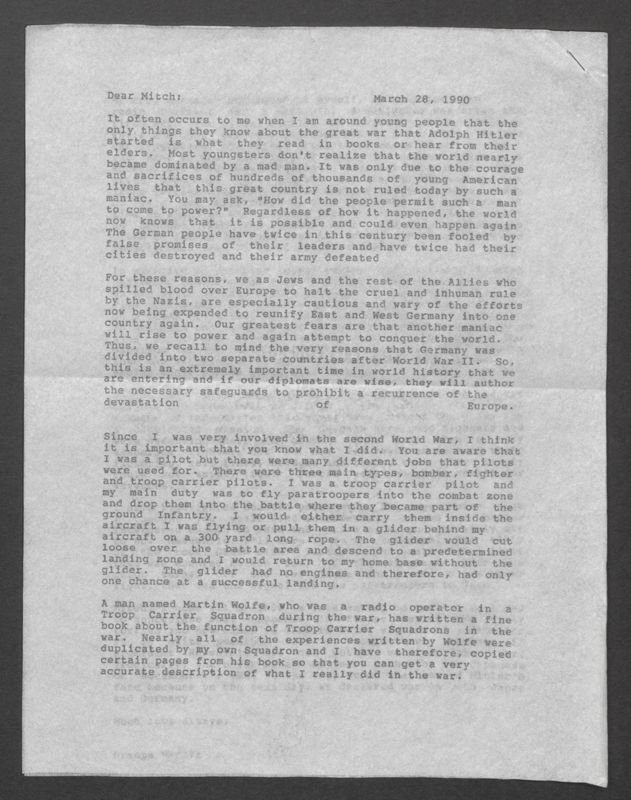
Dear Mitch:
March 28, 1990
It often occurs to me when I am around young people that the only things they know about the great war that Adolph Hitler started is what they read in books or hear from their elders. Most youngsters don’t realize that the world nearly became dominated by a mad man. It was only due to the courage and sacrifices of hundreds of thousands of young American lives that this great country is not ruled today by such a maniac. You may ask, "How did the people permit such a man to come to power?" Regardless of how it happened, the world now knows that it is possible and could even happen again. The German people have twice in this century been fooled by false promises of their leaders and have twice had their cities destroyed and their army defeated.
For these reasons, we as Jews and the rest of the Allies who spilled blood over Europe to halt the cruel and inhuman rule by the Nazis, are especially cautious and wary of the efforts now being expended to reunify East and West Germany into one country again. Our greatest fears are that another maniac will rise to power and again attempt to conquer the world. Thus, we recall to mind the very reasons that Germany was divided into two separate countries after World War II. So, this is an extremely important time in world history that we are entering and if our diplomats are wise, they will author the necessary safeguards to prohibit a recurrence of the devastation of Europe.
Since I was very involved in the second World War, I think it is important that you know what I did. You are aware that I was a pilot but there were many different jobs that pilots were used for. There were three main types, bomber, fighter and troop carrier pilots. I was a troop carrier pilot and my main duty was to fly paratroopers into the combat zone and drop them into the battle where they became part of the ground Infantry. I would either carry them inside the aircraft I was flying or pull them in a glider behind my aircraft on a 300 yard long rope. The glider would cut loose over the battle area and descend to a predetermined landing zone and I would return to my home base without the glider. The glider had no engines and therefore, had only one chance at a successful landing.
A man named Martin Wolfe, who was a radio operator in a Troop Carrier Squadron during the war, has written a fine book about the function of Troop Carrier Squadrons in the war. Nearly all of the experiences written by Wolfe were duplicated by my own Squadron and I have therefore, copied certain pages from his book so that you can get a very accurate description of what I really did in the war.
 2
2
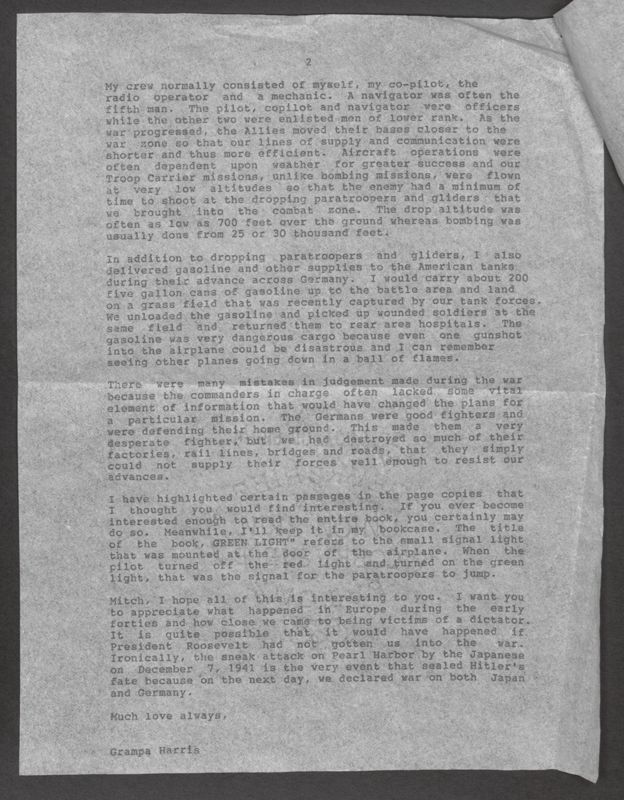
My crew normally consisted of myself, my co-pilot, the radio operator and a mechanic. A navigator was often the fifth man. The pilot, copilot and navigator were officers while the other two were enlisted men of lower rank. As the war progressed, the Allies moved their bases closer to the war zone so that our lines of supply and communication were shorter and thus more efficient. Aircraft operations were often dependent upon weather for greater success and our Troop Carrier missions, unlike bombing missions, were flown at very low altitudes so that the enemy had a minimum of time to shoot at the dropping paratroopers and gliders that we brought into the combat zone. The drop altitude was often as low as 700 feet over the ground whereas bombing was usually done from 25 or 30 thousand feet.
In addition to dropping paratroopers and gliders, I also delivered gasoline and other supplies to the American tanks during their advance across Germany. I would carry about 200 five gallon cans of gasoline up to the battle area and land on a grass field that was recently captured by our tank forces. We unloaded the gasoline and picked up wounded soldiers at the same field and returned them to rear area hospitals. The gasoline was very dangerous cargo because even one gunshot into the airplane could be disastrous and I can remember seeing other planes going down in a ball of flames.
There were many mistakes in judgement made during the war because the commanders in charge often lacked some vital element of information that would have changed the plans for a particular mission. The Germans were good fighters and were defending their home ground. This made them a very desperate fighter but we had destroyed so much of their factories, rail lines, bridges and roads, that they simply could not supply their forces well enough to resist our advances.
I have highlighted certain passages in the page copies that I thought you would find interesting. If you ever become interested enough to read the entire book, you certainly may do so. Meanwhile, I 'll keep it in my bookcase. The title of the book, "GREEN LIGHT" refers to the small signal light that was mounted at the door of the airplane. When the pilot turned off the red light and turned on the green light, that was the signal for the paratroopers to jump.
Mitch, I hope all of this is interesting to you. I want you to appreciate what happened in Europe during the early forties and how close we came to being victims of a dictator. It is quite possible that it would have happened if President Roosevelt had not gotten us into the war. Ironically, the sneak attack on Pearl Harbor by the Japanese on December 7, 1941 is the very event that sealed Hitler’s fate because on the next day, we declared war on both Japan and Germany.
Much love always, Grampa Harris