Report on Displaced Persons Program in Omaha, April 15, 1950
- Date
- Format
- document
- Category
- Stories
- Subcategory
- General
- Data URI
- soh.sto000.00170.xml
asked for 26 assurances
April 15, 1950
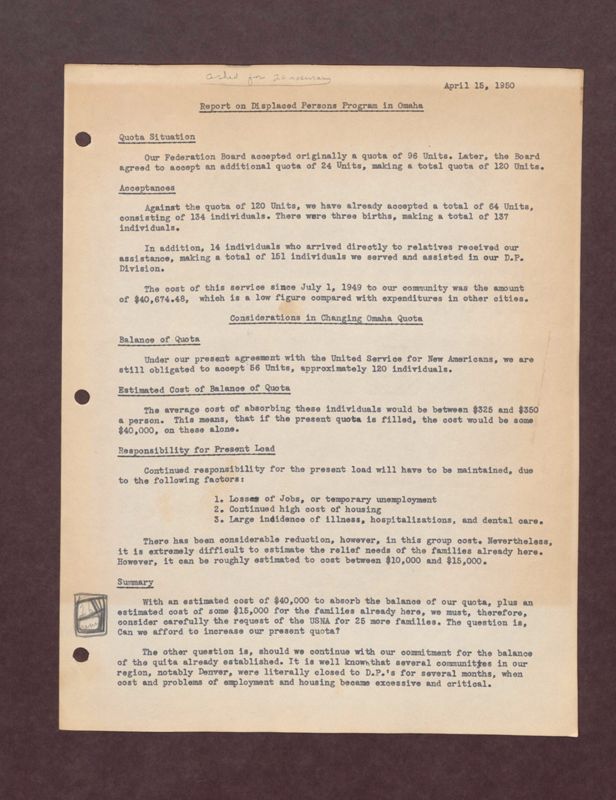
Report on Displaced Persons Program in Omaha
Quota Situation
Our Federation Board accepted originally a quota of 96 Units. Later, the Board
agreed to accept an additional quota of 24 Units, making a total quota of 120 Units.
Acceptances
Against the quota of 120 Units, we have already accepted a total of 64 Units,
consisting of 134 individuals. There were three births, making a total of 137
individuals.
In addition, 14 individuals who arrived directly to relatives received our
assistance, making a total of 151 individuals we served and assisted in our D.P.
Division.
The cost of this service since July 1, 1949 to our community was the amount
of $40,674.48, which is a low figure compared with expenditures in other cities.
Considerations in Changing Omaha Quota
Balance of Quota
Under our present agreement with the United Service for New Americans, we are
still obligated to accept 56 Units, approximately 120 individuals.
Estimated Cost of Balance of Quota
The average cost of absorbing these individuals would be between $325 and $350
a person. This means, that if the present quota is filled, the cost would be some
$40,000, on these alone.
Responsibility for Present Load
Continued responsibility for the present load will have to be maintained, due
to the following factors:
1. Loss26 [?]