Letter from Adolf Abraham Fackenheim and Gerda Oppenheimer to Alfred and Käte Speier, February 10, 1939
- Date
- Format
- letter
- Category
- Stories
- Subcategory
- Hanna Rosenberg Gradwohl
- Repository
- Archives & Special Collections, University of Nebraska-Lincoln Libraries
- Collection
- Rosenburg Family Papers, MS 0638
- People
- Hirschfeld, Alice Eckmann Lorch
- Speier, Alfred
- Speier, Eva
- Oppenheimer, Arthur
- Rosenberg, Ludwig
- Fackenheim, Adolf Abraham
- Kargers
- Lorch, Ernst
- Livneh, Eliezer (Liebenstein)
- Heilbrun, Trude
- Fackenheim, Johanna (Anna)
- Grünfeld, Annemarie Fackenheim
- Eckmann, Egon
- Fackenheim, Ida
- Ruge
- Oppenheimer, Henriette (Henny)
- Fackenheim, Trude
- Gradwohl, Hanna Rosenberg
- Eckmann, Heinrich
- Fackenheim, Emilie
- Oppenheimer, Michael (Micha)
- Oppenheimer, Uriel (Uri)
- Oppenheimer
- Fackenheim, Julius
- Fackenheim, Siegfried
- Eckmann, Erich
- Eckmann, Tilly
- Falkensteins
- Eicker
- Eckmann, Reni
- Eckmann, Alwin
- Oppenheimer, Gerda
- Fackenheim, Karl
- Rosenberg, Ilse Speier
- Speier, Käte
- Places
- Hamburg, Germany
- Penney Farms, Florida
- Jaffa, Palestine
- Australia
- German South Africa
- Karlsruhe, Germany
- Czech Republic
- Eisenach, Germany
- London, England
- New York
- Jerusalem, Palestine
- Weimar, Germany
- Rodges, Petah Tikvah, Palestine
- Haifa, Palestine
- Brazil
- Munich, Germany
- Kassel, Germany
- Tel Aviv, Palestine
- England
- Germany
- Suez Canal
- Leipzig, Germany
- South America
- Buchenwald concentration camp
- Philadelphia, Pennsylvania
- Mühlhausen, Germany
- Palestine
- Berlin, Germany
- Subject
- Ne'ilah
- Shomrim
- Gafirim
- Tanakh
- Purim
- Tu BiShvat
- Youth Aliyah
- Mizrachi
- Data URI
- soh.sto005.00892.xml
- Sender(s)
- Fackenheim, Adolf Abraham
- Oppenheimer, Gerda
- Sent from
- Ein Harod, Palestine
- Recipient(s)
- Speier, Alfred
- Speier, Käte
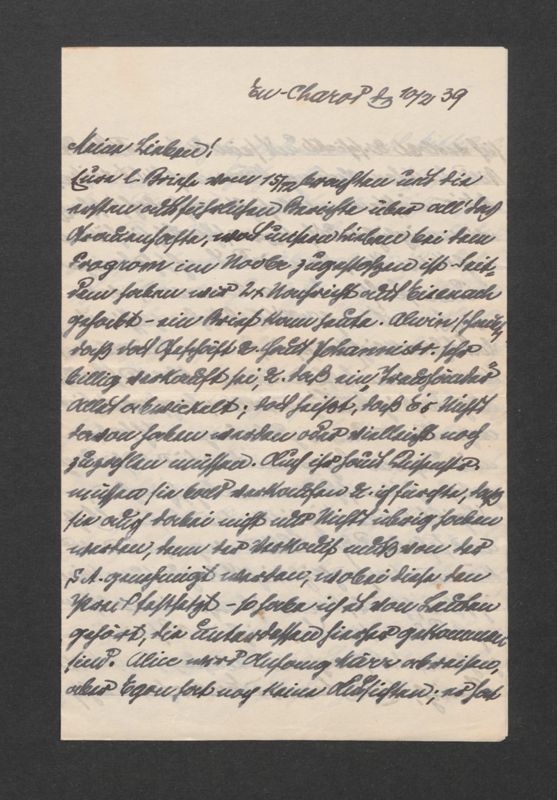 En-Charod dn 10/2/39
Meine Lieben!
En-Charod dn 10/2/39
Meine Lieben!
Eure l. Briefe vom 15/12 brachten uns die
ersten ausführlichen Berichte über all' das
Grauenhafte, was unseren Lieben bei dem
Progrom im Novber zugestoßen ist. Seitdem
haben wir 2x Nachricht aus Eisenach
gehabt—ein Brief kam heute. Alwin schrieb,
daß das Geschäft u. Haus Johannistr. sehr
billig verkauft sei, u. daß ein "Treuhänder"
alles abwickelt; das heißt, daß E's Nichts
davon haben werden oder vielleicht noch
zuzahlen müssen. Auch ihr Haus Luisenstr.
müssen sie bald verkaufen u. ich fürchte, daß
sie auch dabei nicht nur Nichts übrig haben
werden, denn der Verkauf muß von der
S.A. genehmigt werden, wobei diese den
Preis festsetzt—so habe ich es von Leuten
gehört, die unterdessen hierher gekommen
sind. Alice wird Anfang März abreisen,
aber Egon hat noch keine Aussichten; er hat
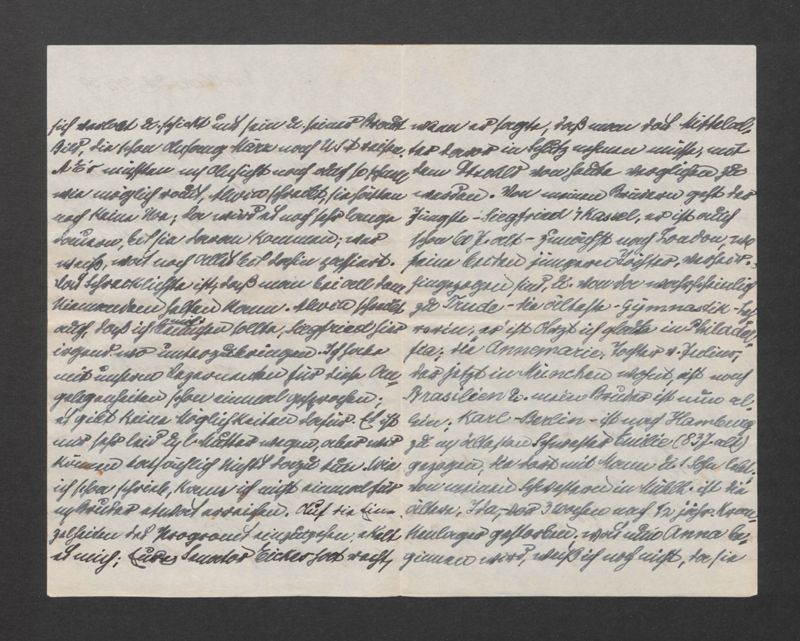 sich verlobt u. schickt uns sein u. seiner Braut
Bild, die schon Anfang März nach USA reisen.
AE's müssten m. Ansicht nach auch so schnell
wie möglich raus, Alwin schreibt, sie hätten
noch keine Nos[?]; da wird es noch sehr lange
dauern, bis sie davon kommen; wer
weiß, was noch alles bis dahin passiert.
Das Schrecklichste ist, daß man bei all dem
Niemandem helfen kann. Alwin schreibt
auch, daß ich mich bemühen sollte,
Siegfried hier irgend wo unterzukriegen. Ich habe
mit unserem Dezernenten für diese
Angelegenheiten schon einmal gesprochen;
es gibt keine Möglichkeiten dafür. Es ist
mir sehr leid i.[?] l. Mutter wegen, aber wir
können tatsächlich nichts dazu tun. Wie
ich schon schrieb, kann ich nicht einmal für
m. Brüder etwas erreichen. Auf die
Einzelheiten des Progroms einzugehen, ekelt
es mich; Euer Senator Eicker hat recht
wenn er sagte, daß man doch das Mittelalter
davor in Schutz nehmen müsse, mit
dem Stand von heute verglichen zu
werden. Von meinen Brüdern geht der
Jüngste—Siegfried i. Kassel, er ist auch
schon 60 J. alt—zunächst nach London, wo
seine beiden jüngere Töchter, verheir.,
hingezogen sind, u. von da wahrscheinlich
zu Trude—die älteste—Gymnastik–Lehrerin;
er ist Arzt ich glaube in Philadelphia;
die Annemarie, Tochter v. Julius,
der jetzt in München wohnt, ist nach
Brasilien u. mein Bruder ist nun allein;
Karl—Berlin—ist nach Hamburg
zu m. ältesten Schwester Emilie (83 J. alt)
gezogen, die dort mit Mann u. 1 Sohn lebt.
Von meiner Schwestern in Mühlh. ist die
ältere, Ida, von 3 Wochen nach 12jähr.
Krankenlager, gestorben; was[?] nun Anna
beginnen wird, weiß ich noch nicht, da sie
sich verlobt u. schickt uns sein u. seiner Braut
Bild, die schon Anfang März nach USA reisen.
AE's müssten m. Ansicht nach auch so schnell
wie möglich raus, Alwin schreibt, sie hätten
noch keine Nos[?]; da wird es noch sehr lange
dauern, bis sie davon kommen; wer
weiß, was noch alles bis dahin passiert.
Das Schrecklichste ist, daß man bei all dem
Niemandem helfen kann. Alwin schreibt
auch, daß ich mich bemühen sollte,
Siegfried hier irgend wo unterzukriegen. Ich habe
mit unserem Dezernenten für diese
Angelegenheiten schon einmal gesprochen;
es gibt keine Möglichkeiten dafür. Es ist
mir sehr leid i.[?] l. Mutter wegen, aber wir
können tatsächlich nichts dazu tun. Wie
ich schon schrieb, kann ich nicht einmal für
m. Brüder etwas erreichen. Auf die
Einzelheiten des Progroms einzugehen, ekelt
es mich; Euer Senator Eicker hat recht
wenn er sagte, daß man doch das Mittelalter
davor in Schutz nehmen müsse, mit
dem Stand von heute verglichen zu
werden. Von meinen Brüdern geht der
Jüngste—Siegfried i. Kassel, er ist auch
schon 60 J. alt—zunächst nach London, wo
seine beiden jüngere Töchter, verheir.,
hingezogen sind, u. von da wahrscheinlich
zu Trude—die älteste—Gymnastik–Lehrerin;
er ist Arzt ich glaube in Philadelphia;
die Annemarie, Tochter v. Julius,
der jetzt in München wohnt, ist nach
Brasilien u. mein Bruder ist nun allein;
Karl—Berlin—ist nach Hamburg
zu m. ältesten Schwester Emilie (83 J. alt)
gezogen, die dort mit Mann u. 1 Sohn lebt.
Von meiner Schwestern in Mühlh. ist die
ältere, Ida, von 3 Wochen nach 12jähr.
Krankenlager, gestorben; was[?] nun Anna
beginnen wird, weiß ich noch nicht, da sie
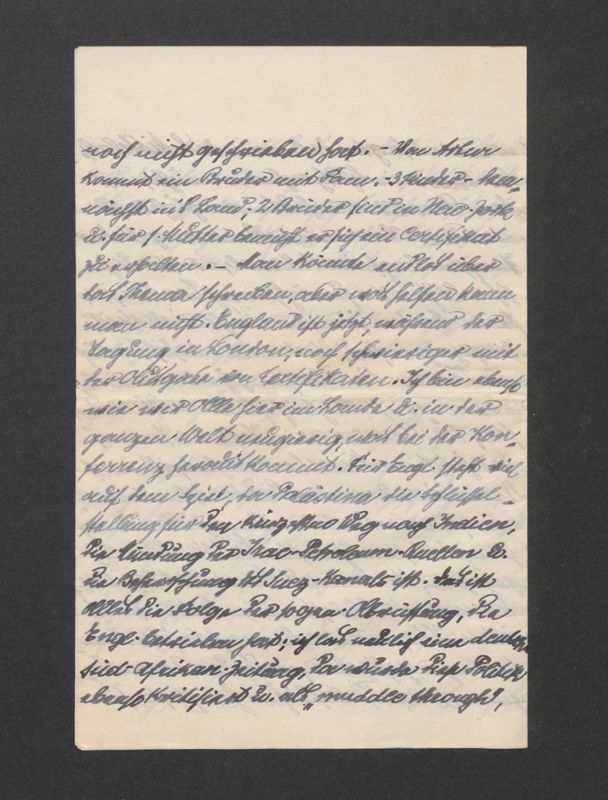 noch nicht geschrieben hat.—Von Arthur
kommt ein Bruder mit Fam.—3 Kinder—
demnächst ins Land; 2 Brüder sind in New-York
u. für s. Mutter bemüht er sich ein Certefikat
zu erhalten.—Man könnte endlos über
das Thema schreiben, aber was helfen kann
man nicht. England ist jetzt, während der
Tagung in London, noch schwieriger mit
der Abgabe von Certefikaten. Ich bin ebenso
wie wir Alle hier im Lande u. in der
ganzen Welt neugierig, was bei der
Konferrenz heraus kommt. Für Engl. steht viel
auf dem Spiel, da Palästina die
Schlüsselstellung für den kürzesten Weg nach Indien,
die Mündung der Irak-Petroleum-Quellen u.
die Beherrschung des Suez-Kanals ist. Das ist
Alles die Folge der sogen. Abrüstung, die
Engl. betrieben hat; ich las neulich eine deutsch-
Süd-Afrikan. Zeitung, da wurde diese Politik
ebenso kritisiert u. als "muddle through"
noch nicht geschrieben hat.—Von Arthur
kommt ein Bruder mit Fam.—3 Kinder—
demnächst ins Land; 2 Brüder sind in New-York
u. für s. Mutter bemüht er sich ein Certefikat
zu erhalten.—Man könnte endlos über
das Thema schreiben, aber was helfen kann
man nicht. England ist jetzt, während der
Tagung in London, noch schwieriger mit
der Abgabe von Certefikaten. Ich bin ebenso
wie wir Alle hier im Lande u. in der
ganzen Welt neugierig, was bei der
Konferrenz heraus kommt. Für Engl. steht viel
auf dem Spiel, da Palästina die
Schlüsselstellung für den kürzesten Weg nach Indien,
die Mündung der Irak-Petroleum-Quellen u.
die Beherrschung des Suez-Kanals ist. Das ist
Alles die Folge der sogen. Abrüstung, die
Engl. betrieben hat; ich las neulich eine deutsch-
Süd-Afrikan. Zeitung, da wurde diese Politik
ebenso kritisiert u. als "muddle through"
 was wohl so ähnlich wie "Schlamperei" bedeutet,
bezeichnet.—Na, wir werden sehen, was
herauskommt; auf jeden Fall sind wir
hier sicher.—Ich erhielt in diesen Tagen
zwei originelle Briefe, den einen von
Trude Heilbrun a. Mühlhausen; sie teilt
mir mit, daß sie Geschäft u. Haus am 1/10
verkauft habe, daß ihr Sohn Heinz hier in
Haifa sei u. seit 14 Jahr die Handwerker¬
schule am Technicum besuche, daß sie nun
ganz allein sei u. so schnell als möglich
hierher wolle; sie schreibt, daß ihr einziger
Wunsch Palästina sei: "Könntest du, l. A, mich
nicht als deine Frau anfordern, ich gehe auch
mit in den Kibbutz u. melke Kühe!" "Was
hast du Angst? Ich tue wir nichts Böses als deine
Frau!" - Und damit ich sehe, ob mir meine
zukünftige Braut auch gefällt, schickt sie gleich
ihr neuestes Bild.—Was sagt Ihr dazu? Ich
habe ihr geantwortet, daß es so nicht geht, da
was wohl so ähnlich wie "Schlamperei" bedeutet,
bezeichnet.—Na, wir werden sehen, was
herauskommt; auf jeden Fall sind wir
hier sicher.—Ich erhielt in diesen Tagen
zwei originelle Briefe, den einen von
Trude Heilbrun a. Mühlhausen; sie teilt
mir mit, daß sie Geschäft u. Haus am 1/10
verkauft habe, daß ihr Sohn Heinz hier in
Haifa sei u. seit 14 Jahr die Handwerker¬
schule am Technicum besuche, daß sie nun
ganz allein sei u. so schnell als möglich
hierher wolle; sie schreibt, daß ihr einziger
Wunsch Palästina sei: "Könntest du, l. A, mich
nicht als deine Frau anfordern, ich gehe auch
mit in den Kibbutz u. melke Kühe!" "Was
hast du Angst? Ich tue wir nichts Böses als deine
Frau!" - Und damit ich sehe, ob mir meine
zukünftige Braut auch gefällt, schickt sie gleich
ihr neuestes Bild.—Was sagt Ihr dazu? Ich
habe ihr geantwortet, daß es so nicht geht, da
 ich eine Frau, die noch nicht meine Frau ist, nicht
anfordern kann: sie solle sich von Heinrich
Eckmann als Pflegerinn für Tilly
mitnehmen lassen, die nach den Operationen
die sie durchgemacht hat, sicher eine Hilfe
gebraucht. Aber ich erhalte gestern einen
Brief von A E's, in dem Eu. Mutter schreibt
daß Tilly's Befinden so schlecht sei, daß man
täglich mit ihrem Ableben rechnen muß.—
Jedenfalls habe ich über den Brief mal
wieder herzl. gelacht.—Der andere Brief
ist von einem Schulfreund m. Br. Julius,
von einem ehemal. evangel. Pastor Ruge,
der vor ca. 45/50 Jahren nach Amerika
gegangen ist u. Lector d. französ. Sprache
in Penney Farms (Florida) ist. Ich habe ihn
vor m. Abreise einmal in Mühlhausen
getroffen, wo er zum ersten Mal wieder
zu Besuch war. Er möchte gern über Dtschld
hören, was man nicht in den Zeitungen
liest, da ihm Julius, mit dem er in
Briefwechsel stand, immer nur antwortete, daß
es ihm glänzend ginge. Auch aus anderen
Briefen u. Zeitungen, die er aus Dtschld
bekommt, wird ihm Nichts klar; "Jeder
fürchte anscheinend die Zensur usw; was
sie am meisten interessiere, darüber
schreibt niemand etwas!"—Und von hier
möchte er gern persönliche Erfahrungen
kennen lernen. […] Ich werde ihm
sehr ausführlich antworten. Er soll über
Dtschld alles erfahren, was ich weiß u.
auch über hier, werde ich ihm Einiges
schreiben, was für ihn neu sein wird.
ich eine Frau, die noch nicht meine Frau ist, nicht
anfordern kann: sie solle sich von Heinrich
Eckmann als Pflegerinn für Tilly
mitnehmen lassen, die nach den Operationen
die sie durchgemacht hat, sicher eine Hilfe
gebraucht. Aber ich erhalte gestern einen
Brief von A E's, in dem Eu. Mutter schreibt
daß Tilly's Befinden so schlecht sei, daß man
täglich mit ihrem Ableben rechnen muß.—
Jedenfalls habe ich über den Brief mal
wieder herzl. gelacht.—Der andere Brief
ist von einem Schulfreund m. Br. Julius,
von einem ehemal. evangel. Pastor Ruge,
der vor ca. 45/50 Jahren nach Amerika
gegangen ist u. Lector d. französ. Sprache
in Penney Farms (Florida) ist. Ich habe ihn
vor m. Abreise einmal in Mühlhausen
getroffen, wo er zum ersten Mal wieder
zu Besuch war. Er möchte gern über Dtschld
hören, was man nicht in den Zeitungen
liest, da ihm Julius, mit dem er in
Briefwechsel stand, immer nur antwortete, daß
es ihm glänzend ginge. Auch aus anderen
Briefen u. Zeitungen, die er aus Dtschld
bekommt, wird ihm Nichts klar; "Jeder
fürchte anscheinend die Zensur usw; was
sie am meisten interessiere, darüber
schreibt niemand etwas!"—Und von hier
möchte er gern persönliche Erfahrungen
kennen lernen. […] Ich werde ihm
sehr ausführlich antworten. Er soll über
Dtschld alles erfahren, was ich weiß u.
auch über hier, werde ich ihm Einiges
schreiben, was für ihn neu sein wird.
Die Beschäftigung mit diesen Briefen
hilft mir über ein paar Abende hinweg
u. lenkt die Gedanken von dem
Alltäglichen ab.—Ich überlese eben Eure l. Briefe
noch einmal u. da fallen mir Eure
Glückwünsche für das neue Jahr auf; davon hatten
 wir vollständig vergessen. Man macht ja
hier sonst auch nicht viel aus Sylvester,
aber die Deutschen gratulierten sich
u. feierten auch in kleinen Kreisen. Dieses
Jahr war gar Nichts los. Bei Euch feiert
man wohl allgemein? So ähnlich wie
in Dtschld?—Hier hat man bei den
Kindern mit den Vorbereitungen für
Purim—dem hiesigen Karneval—
begonnen u. kürzlich war das erste
Frühlingsfest—noch ehe es Frühling ist—der 15. Schevat,
"das Geburtsfest der Bäume," das ist der
Tag, von dem man sagt, daß der Saft
steigt u. die Bäume wieder wachsen.
Die Feier besteht darin, daß die Kinder
mit Musik u. Gesang nach einem
ausgewählten Platz ziehen u. jedes Kind ein
Bäumchen pflanzt. Man macht für dieses
Fest in den Städten eine besondere Reklame,
weil dort die aus West-Europa bekannten
wir vollständig vergessen. Man macht ja
hier sonst auch nicht viel aus Sylvester,
aber die Deutschen gratulierten sich
u. feierten auch in kleinen Kreisen. Dieses
Jahr war gar Nichts los. Bei Euch feiert
man wohl allgemein? So ähnlich wie
in Dtschld?—Hier hat man bei den
Kindern mit den Vorbereitungen für
Purim—dem hiesigen Karneval—
begonnen u. kürzlich war das erste
Frühlingsfest—noch ehe es Frühling ist—der 15. Schevat,
"das Geburtsfest der Bäume," das ist der
Tag, von dem man sagt, daß der Saft
steigt u. die Bäume wieder wachsen.
Die Feier besteht darin, daß die Kinder
mit Musik u. Gesang nach einem
ausgewählten Platz ziehen u. jedes Kind ein
Bäumchen pflanzt. Man macht für dieses
Fest in den Städten eine besondere Reklame,
weil dort die aus West-Europa bekannten
 Festfeiern eigentlich wenig jüdisch seien,
während der Baum-Geburtstag ein Rest
der Verbundenheit der Juden mit dem Land
ist u. von keinem anderen Volk gefeiert
wird.—Heute Abend berichtet eine Frau,
die von hier aus in Deutschland war, um
die Jugend-Alijah, d. h. die Auswanderung
der Jungen u. Mädel im Alter von 15–18
Jahren, zu organisieren über ihre
Erfahrungen u. Erlebnisse einen Vortrag.
Wir haben vor einem halben Jahr schon 60
solche jungen Leute, die meisten sind aus
Oestreich, aufgenommen u. erwarten
jetzt nochmal 60, von denen 9 schon hier
sind. Es ist schwierig, die Auswanderung
schnell zu bewerkstelligen, weil den
meisten schon das Geld dazu fehlt. Man
merkt das besonders an den Koffern, in
denen sie ihr Gepäck haben, die immer
kleiner werden!—Von einer Neuerung,
Festfeiern eigentlich wenig jüdisch seien,
während der Baum-Geburtstag ein Rest
der Verbundenheit der Juden mit dem Land
ist u. von keinem anderen Volk gefeiert
wird.—Heute Abend berichtet eine Frau,
die von hier aus in Deutschland war, um
die Jugend-Alijah, d. h. die Auswanderung
der Jungen u. Mädel im Alter von 15–18
Jahren, zu organisieren über ihre
Erfahrungen u. Erlebnisse einen Vortrag.
Wir haben vor einem halben Jahr schon 60
solche jungen Leute, die meisten sind aus
Oestreich, aufgenommen u. erwarten
jetzt nochmal 60, von denen 9 schon hier
sind. Es ist schwierig, die Auswanderung
schnell zu bewerkstelligen, weil den
meisten schon das Geld dazu fehlt. Man
merkt das besonders an den Koffern, in
denen sie ihr Gepäck haben, die immer
kleiner werden!—Von einer Neuerung,
 die man seit kurzem hier eingeführt hat,
will ich noch berichten: Man liest jeden
Abend ein Kapitel aus dem Tenach vor,
augenblicklich ist Jeremias an der Reihe.
Es wird Abends in 2 Abteilungen
gegessen, die Vorlesung ist vor der 2ten
Abteilung. Das Essen der 1ten Abt. beginnt
um 1/2 7, das ist mir zu früh u. ich esse
deshalb mit der 2ten Abt. u. habe das
Vergnügen, die Vorlesung meistens zu hören,
bekanntlich ist man hier nicht religiös,
im Gegenteil areligiös, man ist Volks–
oder National– u. nicht Religions–Jude;
die Vorlesung ist deshalb auch kein
religiöser Akt, sondern wird als Geschichte
betrachtet. Ich glaube nicht, daß die
Einrichtung lange bestehen bleibt; ob National–
oder Religions–Jude: Ort u. Zeit ist nicht
geeignet dafür.—Nun habe ich mal
wieder Alles geschrieben, was mir gerade
eingefallen ist. Gerda will ja auch
noch anschreiben.
die man seit kurzem hier eingeführt hat,
will ich noch berichten: Man liest jeden
Abend ein Kapitel aus dem Tenach vor,
augenblicklich ist Jeremias an der Reihe.
Es wird Abends in 2 Abteilungen
gegessen, die Vorlesung ist vor der 2ten
Abteilung. Das Essen der 1ten Abt. beginnt
um 1/2 7, das ist mir zu früh u. ich esse
deshalb mit der 2ten Abt. u. habe das
Vergnügen, die Vorlesung meistens zu hören,
bekanntlich ist man hier nicht religiös,
im Gegenteil areligiös, man ist Volks–
oder National– u. nicht Religions–Jude;
die Vorlesung ist deshalb auch kein
religiöser Akt, sondern wird als Geschichte
betrachtet. Ich glaube nicht, daß die
Einrichtung lange bestehen bleibt; ob National–
oder Religions–Jude: Ort u. Zeit ist nicht
geeignet dafür.—Nun habe ich mal
wieder Alles geschrieben, was mir gerade
eingefallen ist. Gerda will ja auch
noch anschreiben.
Wir freuen uns, daß Ihr Alle gesund seid u. daß es Euch gut geht—das ist mehr als jemals die Hauptsache. Auch von uns können wir dasselbe sagen.
Hoffentlich hören wir bald wieder von Euch.
Allen herzlichste GrüßeEuer Adolf Vater hat ja mal wieder einen so
ausführlichen Brief geschrieben! Inzwischen erhielten wir Eure
l. Zeilen, wir freuen uns immer schrecklich
wenn Du, lb. Tante Kätchen so viel erzählst u. uns
ausführlich schreibst. Vater hat schon auf viele Deiner
Fragen geantwortet; besorders betreffs der l. Eckmanns.
Wir haben inzwischen Einquartierung bekommen
für 2–3 Monate: Hier hat man noch 60
Jugendliche aufgenommen; durch den starken Regen,
der in diesem Winter war konnte man die Bauten
 nicht fertigstellen u. hat den Familien die 1 Kind
im Zimmer haben je 1 Jugendlichen einquartiert.
Uri gehört ja rechtmäßig noch in den Kindergarten.
Wir haben einen netten 15 1/2 jährigen Jungen
aus Karlsruhe; er scheint aus gutem Hause u. macht
einen guten Eindruck. Mit den Kindern ist er
in bestem Einvernehmen. Es kann sein daß wir
ihn nicht lange behalten können, denn am 6. 3.
kommt mein Leipziger Schwager mit Familie
(3 kleine Kinder!) ins Land; er hat sein
Zertifikat durch den Misrachi bekommen u. wir hoffen
sehr, daß er durch seine Freunde und Beziehungen zum
Misrachi auch eine Lehrerstelle bekommt und seine
Fächer, Mathematk, Physik, Chemie sind
noch nicht so besetzt—wie man sagt. Er muß
nur sein Hebräisch noch etwas vervollkommnen u.
wir hatten ihm angeboten, daß er zu diesem Zweck 1–2
Monate hier sein kann; seine Frau mit den 2
Kleinsten wird bis er etwas gefundent hat in Tel Aviv
bei dem Bruder meiner Schwägerin sein, der Hals– Nasen–
nicht fertigstellen u. hat den Familien die 1 Kind
im Zimmer haben je 1 Jugendlichen einquartiert.
Uri gehört ja rechtmäßig noch in den Kindergarten.
Wir haben einen netten 15 1/2 jährigen Jungen
aus Karlsruhe; er scheint aus gutem Hause u. macht
einen guten Eindruck. Mit den Kindern ist er
in bestem Einvernehmen. Es kann sein daß wir
ihn nicht lange behalten können, denn am 6. 3.
kommt mein Leipziger Schwager mit Familie
(3 kleine Kinder!) ins Land; er hat sein
Zertifikat durch den Misrachi bekommen u. wir hoffen
sehr, daß er durch seine Freunde und Beziehungen zum
Misrachi auch eine Lehrerstelle bekommt und seine
Fächer, Mathematk, Physik, Chemie sind
noch nicht so besetzt—wie man sagt. Er muß
nur sein Hebräisch noch etwas vervollkommnen u.
wir hatten ihm angeboten, daß er zu diesem Zweck 1–2
Monate hier sein kann; seine Frau mit den 2
Kleinsten wird bis er etwas gefundent hat in Tel Aviv
bei dem Bruder meiner Schwägerin sein, der Hals– Nasen–
 Ohrenarzt ist u. dem es recht gut geht; die Große wird in
Rodges sein—aber hoffentlich wird die Aufteilung
der Familie nicht lange nötig sein u. er wird bald
eine Existenz finden. Ich schrieb Euch wohl schon von
dem Pech, das meine Schwägerin Henny hatte: sie
kam zu Besuch hier her, u. bei einem Omnibus
Zusammenstoß war sie die Schwerstverwundete!
Beckenbruch, 8 Wochen liegt sie schon im
Krankenhaus; jetzt muß sie Gehversuche machen. Arthur
fährt nächste Woche hin, um sie zu besuchen u. den
Bruder zu begrüßen.—Hier ist jetzt gedrückte
Stimmung durch die politische Lage: die Berichte
über London sind nicht sehr erfreulich u. wirken sich
auch auf die politische wirtschaftliche Lage aus. Hoffentlich wird's
nicht so wie hier viele befürchten.—. Ihr fragt nach
den Kindern? Augenblicklich spielt die Hauptrolle
Purim, besonders bei den Kleinen: man bereitet
Geschenke vor, die Kinder bringen den Eltern u. die
Eltern bringen kleine Geschenke den Kindern. Abends
sind Purimspiele; etc.. Uri ist im Gefolge des
Ohrenarzt ist u. dem es recht gut geht; die Große wird in
Rodges sein—aber hoffentlich wird die Aufteilung
der Familie nicht lange nötig sein u. er wird bald
eine Existenz finden. Ich schrieb Euch wohl schon von
dem Pech, das meine Schwägerin Henny hatte: sie
kam zu Besuch hier her, u. bei einem Omnibus
Zusammenstoß war sie die Schwerstverwundete!
Beckenbruch, 8 Wochen liegt sie schon im
Krankenhaus; jetzt muß sie Gehversuche machen. Arthur
fährt nächste Woche hin, um sie zu besuchen u. den
Bruder zu begrüßen.—Hier ist jetzt gedrückte
Stimmung durch die politische Lage: die Berichte
über London sind nicht sehr erfreulich u. wirken sich
auch auf die politische wirtschaftliche Lage aus. Hoffentlich wird's
nicht so wie hier viele befürchten.—. Ihr fragt nach
den Kindern? Augenblicklich spielt die Hauptrolle
Purim, besonders bei den Kleinen: man bereitet
Geschenke vor, die Kinder bringen den Eltern u. die
Eltern bringen kleine Geschenke den Kindern. Abends
sind Purimspiele; etc.. Uri ist im Gefolge des
 Königs der [?]. Micha erzählt die ganze Zeit
von einem sehr nützlichen Gegenstand, den er in
der Tischlerei für das Zimmer gearbeitet hat.
Ihr schreibt wofür er sich außer Lesen interessiert?
In der Hauptsache für Pflanzen u. Naturkunde.
Er sammelt u. preßt alle möglichen Pflanzen u.
beschäftigt sich viel damit; auch sonst ist er ein guter
Schüler u. ein braver Kerl; der Kleine ist viel wilder
u. ein großer Schelm. Schrieb ich Dir, lb. Tante,
daß ich von dem braunen Sportkostüm, daß ich
von Dir (oder war es von Tante Reni?) hatte
dem Micha einen wunderschönen Mantel nähen
ließ? Er ist tadellos geworden!
Königs der [?]. Micha erzählt die ganze Zeit
von einem sehr nützlichen Gegenstand, den er in
der Tischlerei für das Zimmer gearbeitet hat.
Ihr schreibt wofür er sich außer Lesen interessiert?
In der Hauptsache für Pflanzen u. Naturkunde.
Er sammelt u. preßt alle möglichen Pflanzen u.
beschäftigt sich viel damit; auch sonst ist er ein guter
Schüler u. ein braver Kerl; der Kleine ist viel wilder
u. ein großer Schelm. Schrieb ich Dir, lb. Tante,
daß ich von dem braunen Sportkostüm, daß ich
von Dir (oder war es von Tante Reni?) hatte
dem Micha einen wunderschönen Mantel nähen
ließ? Er ist tadellos geworden!
Nun zum Schluß noch die herzlichsten Glückwünsche zu Deinem Geburtstage, lb. Onkel Alfred. Bei Erhalt dieses Briefes sicher schon längst vorbei; aber unsere guten Wünsche nimmst Du auch nachträglich entgegen. Bleibt gesund, das ist die Hauptsache.
Alles Gute […] herzlichstEureGerda
Der Brief hat bis jetzt hier gelegen—Gerda
hat immer keine Zeit—u. nun kommt er
wie gewöhnlich mit unseren Gratulationen zu
Deinem Geburtstag zu spät. Ich denke, daß
Ihr daran schon gewohnt seid! Aber
gratulieren kann man jeden Tag u. man
kann sich auch jeden Tag Gutes wünschen u.
daß unsere Wünsche nicht weniger herzlich
sind, wenn sie auch verspätet kommen,
wisst Ihr doch. Euer Brief vom 2.2. ist
inzwischen auch angekommen. Du, l. Käthe,
schreibst immer so schön ausführlich u. ich
will noch auf einiges in meinem Brief
eingehen: Ihr kennt noch gar nicht
alle Gemeinheiten, die man sich in Dtschld
ausgedacht hat, um Juden zu quälen.
Es gibt eine neue Krankheit bei den
Unglücklichen, die im Lager Buchenwald
bei Weimar waren; die Buchenwald-Krankheit;
man hat die Menschen 4 Tage
 ununterbrochen stramm stehen lassen,
ohne daß sie essen durften oder ihre Notdurft
verrichten durften! Salz hat man ihnen
gegeben u. nichts zu trinken. Man hat
Bluthunde auf sie gesetzt, u. wenn sie auf
der Flucht an den elektr. geladenen Zaun
rührten, wurde sie durch den Strom
getötet. 1000de sind dadurch gestorben!—
ununterbrochen stramm stehen lassen,
ohne daß sie essen durften oder ihre Notdurft
verrichten durften! Salz hat man ihnen
gegeben u. nichts zu trinken. Man hat
Bluthunde auf sie gesetzt, u. wenn sie auf
der Flucht an den elektr. geladenen Zaun
rührten, wurde sie durch den Strom
getötet. 1000de sind dadurch gestorben!—
Mit Egon ist es ja sehr ungünstig; ich wundere
mich, daß er sich nur verlobt hat, hätte es
nicht Chancen gegeben, wenn er gleich
geheiratet hätte, mit seiner Braut, die doch die
Einreise-Erlaubnis hatte, rüber zu gehen?
Er schreibt nur, dass er sich zu einer
landwirtschaftl. Ausbildung gemeldet habe,
damit er nach 2 Jahren hierher kann! u. von
hier aus dann nach dort geht. Eine
Möglichkeit, daß wir ihn anfordern könnten, besteht
leider nicht. Ich habe ihm geschrieben, ob ihn
nicht Erich E. als notwendigen Spezialisten
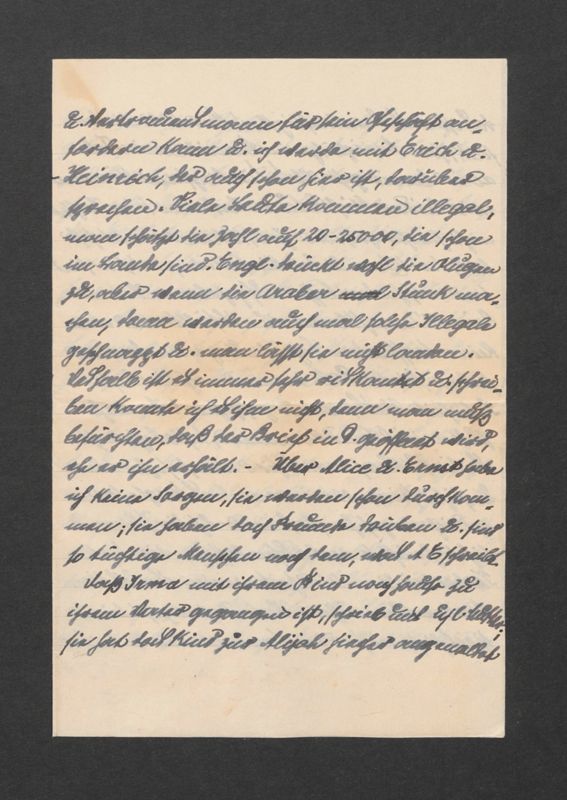 u. Vertrauensmann für sein Geschäft
anfordern kann u. ich werde mit Erich u.
Heinrich, der auch schon hier ist, darüber
sprechen. Viele Leute kommen illegal,
man schätzt die Zahl auf 20-25000, die schon
im Lande sind. Engl. drückt wohl die Augen
zu, aber wenn die Araber
u. Vertrauensmann für sein Geschäft
anfordern kann u. ich werde mit Erich u.
Heinrich, der auch schon hier ist, darüber
sprechen. Viele Leute kommen illegal,
man schätzt die Zahl auf 20-25000, die schon
im Lande sind. Engl. drückt wohl die Augen
zu, aber wenn die Araber mal Stunk
machen, dann werden auch mal solche Illegale
geschnappt u. man lässt sie nicht landen.
Deshalb ist es immer sehr riskant u.
schreiben konnte ich es ihm nicht, denn man muß
befürchten, daß der Brief in D. geöffnet wird,
ehe er ihn erhält.—Über Alice u. Ernst habe
ich keine Sorgen, sie werden schon
durchkommen; sie haben doch Freunde drüben u. sind
so tüchtige Menschen nach dem, was A E schreibt.
Daß Irma mit ihrem Kind nach Hause zu
ihrem Vater gegangen ist, schrieb Euch Eu. l. Mutter;
sie hat das Kind zur Alijah hierher angemeldet
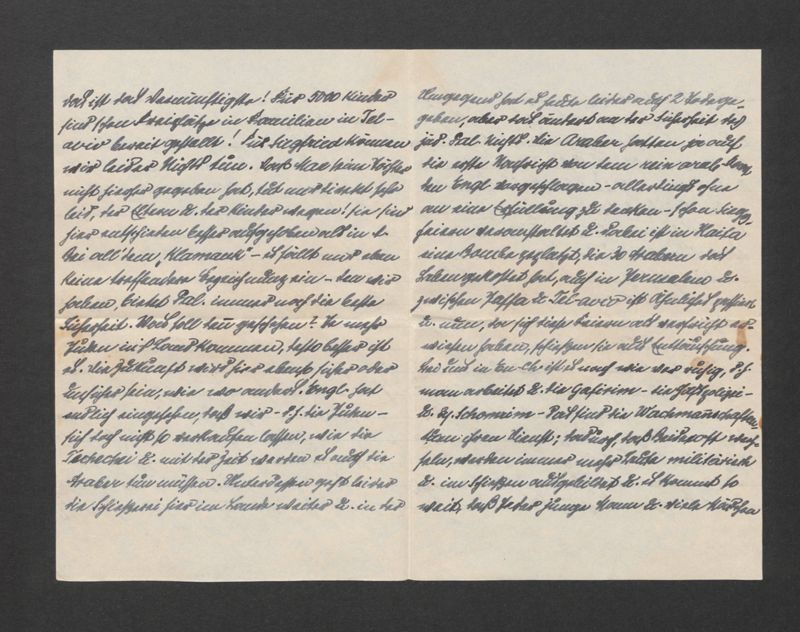 das ist das vernünftigste! Für 5000 Kinder
sind schon Freiplätze in Familien in
Tel-aviv bereit gestellt! Für Siegfried können
wir leider nichts tun. Daß man seine Töchter
nicht hierher gegeben hat, tut mir direkt sehr
leid, der Eltern u. der Kinder wegen! Sie sind
hier entschieden besser aufgehoben als in D.
Bei all' dem "Klamauk"—es fällt mir eben
keine treffendere Bezeichnung ein—den wir
haben, bietet Pal. immer noch die beste
Sicherheit. Was soll nun[?] geschehen? Je mehr
Juden ins Land kommen, desto besser ist
es. Die Zukunft wird hier ebenso sicher oder
unsicher sein, wie wo anders. Engl. hat
endlich eingesehen, daß wir —d. h. die Juden—
sich doch nicht so verkaufen lassen, wie die
Tschechei u. mit der Zeit werden es auch die
Araber tun müssen. Unterdessen geht leider
die Schießerei hier im Lande weiter u. in der
Umgegend hat es heute leider auch 2 Tode
gegeben, aber das ändert an der Sicherheit des
jüd. Pal. nichts. Die Araber hatten ja auf
die erste Nachricht von dem rein arab. Plan[?],
den Engl. vorgeschlagen—allerdings ohne
an eine Erfüllung zu denken—schon
Siegefeiern veranstaltet u. dabei ist in Haifa
eine Bombe geplatzt, die 30 Arabern das
Leben gekostet hat, auch in Jerusalem u.
zwischen Jaffa u. Tel-aviv ist Ähnliches passiert,
u. nun, da sich diese Feiern als verfrüht
erwiesen haben, schießen sie aus Enttäuschung.
Bei uns in En-Ch. ist es nach wie vor ruhig, d. h.
man arbeitet u. die Gafirim—die Haftpolizei—
u. us. Schomrim—das sind die Wachmanschaften—
tun ihren Dienst; dadurch, daß Beide oft
wechseln, werden immer mehr Leute militärisch
u. im Schießen ausgebildet u. es kommt so
weit, daß jeder Junge kann u. viele Mädchen
das ist das vernünftigste! Für 5000 Kinder
sind schon Freiplätze in Familien in
Tel-aviv bereit gestellt! Für Siegfried können
wir leider nichts tun. Daß man seine Töchter
nicht hierher gegeben hat, tut mir direkt sehr
leid, der Eltern u. der Kinder wegen! Sie sind
hier entschieden besser aufgehoben als in D.
Bei all' dem "Klamauk"—es fällt mir eben
keine treffendere Bezeichnung ein—den wir
haben, bietet Pal. immer noch die beste
Sicherheit. Was soll nun[?] geschehen? Je mehr
Juden ins Land kommen, desto besser ist
es. Die Zukunft wird hier ebenso sicher oder
unsicher sein, wie wo anders. Engl. hat
endlich eingesehen, daß wir —d. h. die Juden—
sich doch nicht so verkaufen lassen, wie die
Tschechei u. mit der Zeit werden es auch die
Araber tun müssen. Unterdessen geht leider
die Schießerei hier im Lande weiter u. in der
Umgegend hat es heute leider auch 2 Tode
gegeben, aber das ändert an der Sicherheit des
jüd. Pal. nichts. Die Araber hatten ja auf
die erste Nachricht von dem rein arab. Plan[?],
den Engl. vorgeschlagen—allerdings ohne
an eine Erfüllung zu denken—schon
Siegefeiern veranstaltet u. dabei ist in Haifa
eine Bombe geplatzt, die 30 Arabern das
Leben gekostet hat, auch in Jerusalem u.
zwischen Jaffa u. Tel-aviv ist Ähnliches passiert,
u. nun, da sich diese Feiern als verfrüht
erwiesen haben, schießen sie aus Enttäuschung.
Bei uns in En-Ch. ist es nach wie vor ruhig, d. h.
man arbeitet u. die Gafirim—die Haftpolizei—
u. us. Schomrim—das sind die Wachmanschaften—
tun ihren Dienst; dadurch, daß Beide oft
wechseln, werden immer mehr Leute militärisch
u. im Schießen ausgebildet u. es kommt so
weit, daß jeder Junge kann u. viele Mädchen
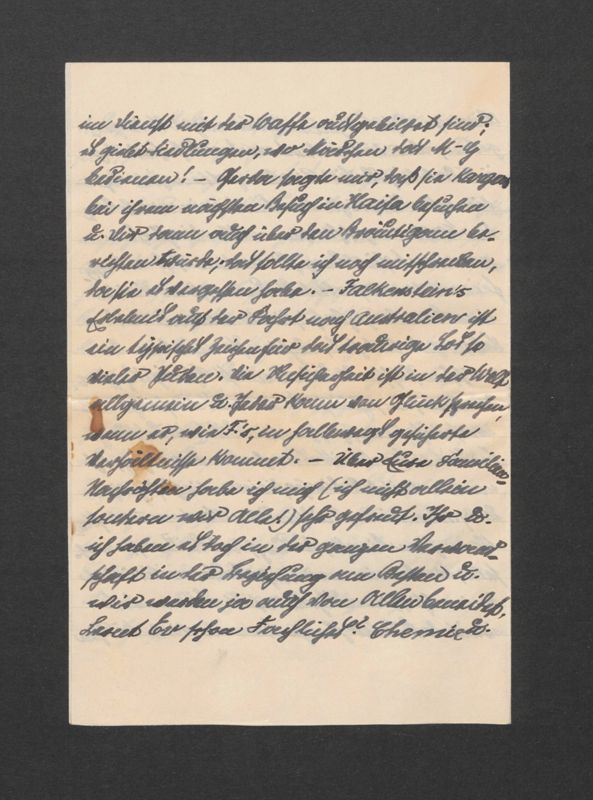 im Dienst mit der Waffe ausgebildet sind;
es giebt Siedlungen, wo Mädchen das M-G
bedienen!—Gerda sagte mir, daß sie Kargers
bei ihrem nächsten Besuch in Haifa besuchen
u. mir dann auch über den Bräutigam
berichten würde, das sollte ich noch mitschreiben,
da sie es vergessen habe.—Falkenstein's
Erlebnis auf der Fahrt nach Australien ist
ein typisches Zeichen für das traurige Los so
vieler Juden. Die Unsicherheit ist in der Welt
allgemein u. jeder kann von Glück sprechen
wenn er, wie F.'s, in halbwegs gesicherte
Verhältnisse kommt.—Über Eure Familien–
Nachrichten habe ich mich (ich nicht allein
sondern wir Alle) sehr gefreut. Ihr u.
ich haben es doch in der ganzen
Verwandschaft in der Beziehung am Besten u.
wir werden ja auch von Allen beneidet.
Lernt Ev schon Fachliches? Chemie u.
im Dienst mit der Waffe ausgebildet sind;
es giebt Siedlungen, wo Mädchen das M-G
bedienen!—Gerda sagte mir, daß sie Kargers
bei ihrem nächsten Besuch in Haifa besuchen
u. mir dann auch über den Bräutigam
berichten würde, das sollte ich noch mitschreiben,
da sie es vergessen habe.—Falkenstein's
Erlebnis auf der Fahrt nach Australien ist
ein typisches Zeichen für das traurige Los so
vieler Juden. Die Unsicherheit ist in der Welt
allgemein u. jeder kann von Glück sprechen
wenn er, wie F.'s, in halbwegs gesicherte
Verhältnisse kommt.—Über Eure Familien–
Nachrichten habe ich mich (ich nicht allein
sondern wir Alle) sehr gefreut. Ihr u.
ich haben es doch in der ganzen
Verwandschaft in der Beziehung am Besten u.
wir werden ja auch von Allen beneidet.
Lernt Ev schon Fachliches? Chemie u.
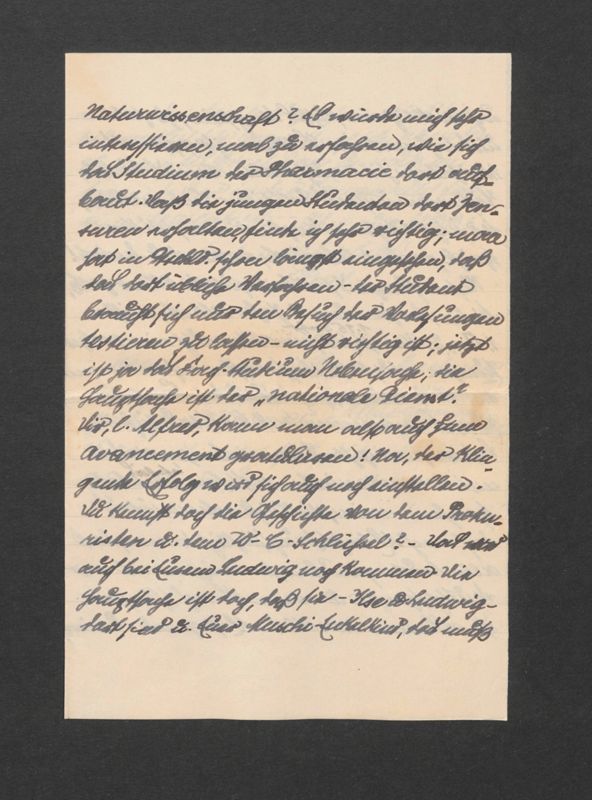 Naterwissenschaft? Ich würde mich sehr
interessieren, mal zu erfahren, wie sich
das Studium der Pharmacie dort
aufbaut: daß die jungen Studenten dort
Zensuren erhalten, finde ich sehr richtig; man
hat in Dtschld. schon längst eingesehen, daß
das dort übliche Verfahren—der Student
braucht sich nur den Besuch der Vorlesungen
testieren zu lassen—nicht richtig ist; jetzt
ist ja das Fach-Studium Nebensache; die
Hauptsache ist der "nationale Dienst".
Dir, l. Alfred, kann man also auch zu
avancement gratulieren! Na, der
klingende Erfolg wird sich auch noch einstellen.
Du kennst doch die Geschichte von dem
Prokuristen u. dem W-C-Schlüssel?—Das wird
auch bei Eurem Ludwig noch kommen. Die
Hauptsache ist doch, daß sie—Ilse u. Ludwig—
dort sind u. Euer Muschi-Enkelkind, das muß
Naterwissenschaft? Ich würde mich sehr
interessieren, mal zu erfahren, wie sich
das Studium der Pharmacie dort
aufbaut: daß die jungen Studenten dort
Zensuren erhalten, finde ich sehr richtig; man
hat in Dtschld. schon längst eingesehen, daß
das dort übliche Verfahren—der Student
braucht sich nur den Besuch der Vorlesungen
testieren zu lassen—nicht richtig ist; jetzt
ist ja das Fach-Studium Nebensache; die
Hauptsache ist der "nationale Dienst".
Dir, l. Alfred, kann man also auch zu
avancement gratulieren! Na, der
klingende Erfolg wird sich auch noch einstellen.
Du kennst doch die Geschichte von dem
Prokuristen u. dem W-C-Schlüssel?—Das wird
auch bei Eurem Ludwig noch kommen. Die
Hauptsache ist doch, daß sie—Ilse u. Ludwig—
dort sind u. Euer Muschi-Enkelkind, das muß
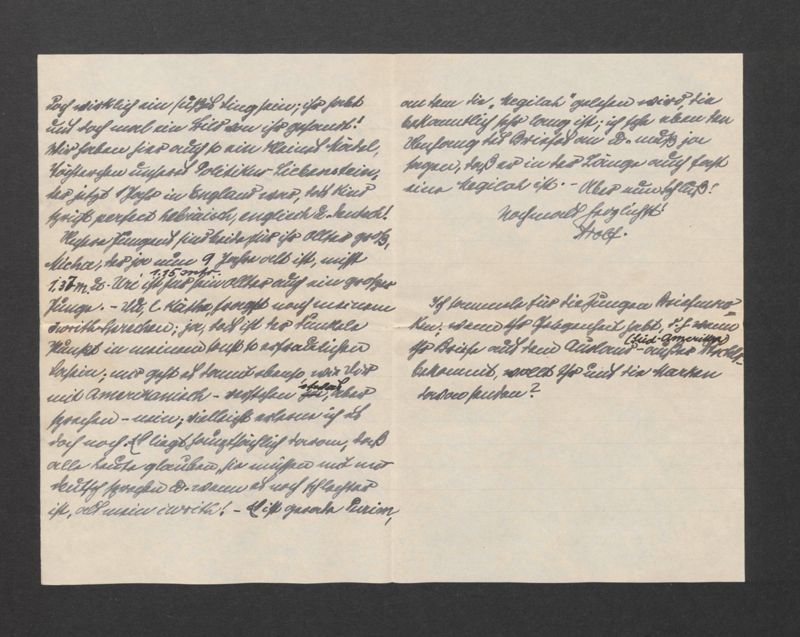 doch wirklich ein süßes Ding sein; ihr habt
uns doch mal ein Bild von ihr gesandt!
Wir haben hier auch so ein kleines Mädel,
Töchterchen unseres Politikus Liebenstein,
der jetzt 1 Jahr in England war, das Kind
spricht perfect hebräisch, englisch u. deutsch!
Unsere Jungens sind beide für ihr Alter groß—
Micha, der ja nun 9 Jahre alt ist, misst
1.37 m. u. Uri ist 1.15 Mtr. für sein Alter auch ein großer
Junge.—Du, l. Käthe, fragst nach meinem
Iwrith-sprechen; ja, das ist der dunkele
Punkt in meinem sonst erfreulichen
Dasein; mir geht es damit ebenso wie Dir
mit Amerikanisch—verstehen
doch wirklich ein süßes Ding sein; ihr habt
uns doch mal ein Bild von ihr gesandt!
Wir haben hier auch so ein kleines Mädel,
Töchterchen unseres Politikus Liebenstein,
der jetzt 1 Jahr in England war, das Kind
spricht perfect hebräisch, englisch u. deutsch!
Unsere Jungens sind beide für ihr Alter groß—
Micha, der ja nun 9 Jahre alt ist, misst
1.37 m. u. Uri ist 1.15 Mtr. für sein Alter auch ein großer
Junge.—Du, l. Käthe, fragst nach meinem
Iwrith-sprechen; ja, das ist der dunkele
Punkt in meinem sonst erfreulichen
Dasein; mir geht es damit ebenso wie Dir
mit Amerikanisch—verstehen jaetwas, aber
sprechen—nein; vielleicht erlerne ich es
doch noch. Es liegt hauptsächlich daran, daß
alle Leute glauben, sie müssen mit mir
Deutsch sprechen u. wenn es noch schlechter
ist, als mein Iwrith!—Es ist gerade Purim,
an dem die "Negilah" gelesen wird, die
bekanntlich sehr lang ist; ich sehe eben den
Umfang des Briefes an u. muß ja
sagen, daß er in der Länge auch fast
eine Negilah ist.—Aber nun Schluß!
Ich sammele für die Jungen Briefmarken, wenn ihr Gelegenheit habt, d. h. wenn Ihr Briefe auf dem Ausland (Süd-Amerika) - außer Dtschld - bekommt, wollt Ihr mir die Marken davon senden?
Your letters of December 15th brought us the first detailed reports about all the horrors that happened to our loved ones during the pogrom in November. Since then, we have received news from Eisenach twice—a letter arrived today. Alwin wrote that the business and house on Johannistrasse were sold very cheaply, and that a "trustee" is handling everything; that is, that the E's will get nothing from it or may even have to pay extra. They will also soon have to sell their house on Luisenstrasse[?], and I fear that they will get nothing from it either, because the sale has to be approved by the SA, which sets the price—that's what I heard from people who have come here since then. Alice will be leaving at the beginning of March, but Egon has no prospects yet; he has gotten engaged and sent us a picture of himself and his bride, who is traveling to the USA at the beginning of March. In my opinion, the AEs should also try to leave as soon as possible. Alwin writes that they don't have any numbers[?] yet, so it will be a very long time before they get out; who knows what else might happen by then. The most terrible thing is that in the midst of all this, we cannot help anyone. Alwin also writes that I should try to find a place for Siegfried here somewhere. I've already spoken with our representative who looks into these matters; there are no options for this. I'm very sorry on behalf of their dear mother, but we really cannot do anything about it. As I already wrote, I can't even do anything for my brothers. Going into the details of the pogrom disgusts me; your Senator Eicker is right when he said that one must protect the Middle Ages from being compared to the current state of affairs. Of my brothers, the youngest—Siegfried in Kassel, who is also already 60 years old—is going first to London, where his two younger daughters (who are both married) have moved, and from there probably to Trude's, the eldest (a gymnastics teacher); [her husband] is a doctor, in Philadelphia, I believe; Annemarie, Julius's daughter, who lived in Munich, has gone to Brazil, and my brother is now alone; Karl (Berlin) has moved to Hamburg to live with my eldest sister Emilie (83 years old), who lives there with her husband and one son. Of my sisters in Mühlhausen, the older one, Ida, died three weeks ago, after 12 years of being bedridden; what Anna will do now, I don't yet know, because she hasn't written yet. A brother of Arthur's will be arriving soon with his family—three children— two brothers are in New York, and he is trying to obtain a certificate for his mother.—One could write endlessly about the topic, but cannot help in any way. While the conference is going on in London, it is even more difficult to obtain a certificate from England. I am, like all of us here in the country and throughout the world, curious about the outcome of the conference. For England, much is at stake, since Palestine is the key location for the shortest route to India, the mouth of the Iraqi oil wells, and control of the Suez Canal. This is all a consequence of the so-called disarmament that England has pursued; I recently read a newspaper from German South Africa, in which this policy was also criticized and described as a "muddle-through," which means something like "sloppy work," I think. — Well, we'll see what comes of it; in any case, we're safe here. — In recent days, I received two peculiar letters, one from Trude Heilbrun from Mühlhausen; she informs me that she sold her business and house on October 1st, that her son Heinz is here in Haifa and has been attending the trade school at the technical college for the past 3 months, that she is now all alone and wants to come here as soon as possible; she writes that her only wish is Palestine: "Couldn't you, dear A., request me as your wife? I'll even join you at the kibbutz and milk cows!" "What are you afraid of? I won't do anything bad to you as your wife!" — And so that I can see if I actually like my future bride, she immediately sends me her latest picture.—What do you think of that? I wrote her that it doesn't work that way, because I cannot request [a permit for] a woman who is not yet my wife. Instead, she should let Heinrich Eckmann take her along as a caregiver for Tilly; for after the operations she has undergone, she is surely in need of assistance. But yesterday I received a letter from the A.E.'s, in which your mother writes that Tilly’s condition is so poor that one must expect her passing at any moment.—In any case, I had a good laugh for once about that letter.—The other letter is from a schoolmate of my brother Julius—a former Protestant pastor named Ruge, who went to America some 45 or 50 years ago and now teaches French in Penney Farms (Florida). I met him once in Mühlhausen before my departure, when he was visiting there for the first time since he emigrated. He would very much like to hear the kind of news from Germany that one can't find in the newspapers, because Julius, with whom he corresponded, always just replied that he was doing splendidly. He doesn't get a clear picture from other letters and newspapers he receives from Germany, either: "Everyone seems to fear censorship, etc.; nobody writes about what they most want to know!"—And he would like to learn about our personal experience here. […] I will answer him in great detail. He shall learn everything I know about Germany, and I will also write him some things about life here that will be new to him.
Writing such letters helps me get through a few evenings and distracts my thoughts from the day-to-day.—I am skimming your letters right now and I noticed your New Year's greetings; we completely forgot about that. People don't usually make much of New Year's Eve here, but the Germans congratulated each other and celebrated in small groups. This year, nothing happened at all. Do people generally celebrate where you are? Similar to Germany?—Here, the children have started preparing for Purim, the carnival around here, and recently we had the first spring festival—even before any true spring—on the 15th of Shevat, "the birthday of the trees," i.e. the day when it's said that the sap rises and the trees start growing again. The celebration consists of a children's parade with music and singing to a chosen spot, where each child plants a small tree. This festival is heavily advertised in the cities because the city festivals derived from Western Europe are really not very Jewish, while the Tree Birthday is a remnant of the Jews' connection to the land and is not celebrated by other peoples.—This evening, a woman who went from here to Germany to organize the Youth Aliyah, i.e., the emigration of boys and girls aged 15–18, will give a presentation about her experience. We already took in 60 such young people six months ago, most of them from Austria, and are now expecting another 60, of whom 9 are already here. It is difficult to arrange the emigration fast enough because most of them lack the money. You can see this especially in the suitcases they carry, which are getting smaller and smaller!—I still want to tell you about a recently introduced new custom here: Every evening, a chapter from the Tanakh is read aloud; currently, we are reading Jeremiah. We eat our evening meal in two shifts; the reading takes place before the second shift. The first shift begins their meal at 6:30, which is too early for me, so I eat with the second shift and have the pleasure of usually attending the reading. As is well known, people here are not religious; on the contrary, they are irreligious. They are ethnic or national Jews, not religious Jews. The reading is therefore not a religious act, but is seen as a history lesson. I don't believe this arrangement will last long; regardless of whether someone is an ethnic or a religious Jew, the place and time are not suitable for it.—And here we are again; I've written down every single thing that came to mind. But Gerda also wants to add something.
We're so glad you're all healthy and doing well—that's more than ever the most important thing. We can say the same about ourselves.
Hopefully we'll hear from you again soon.
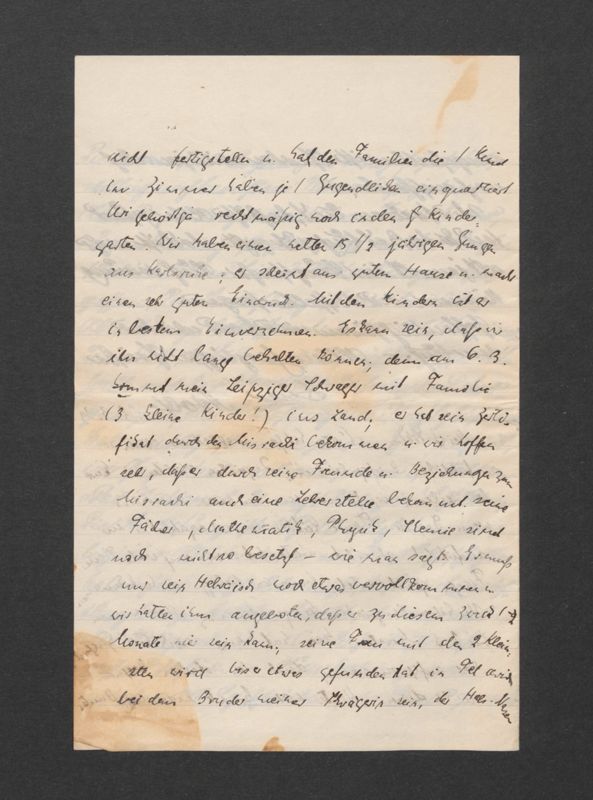
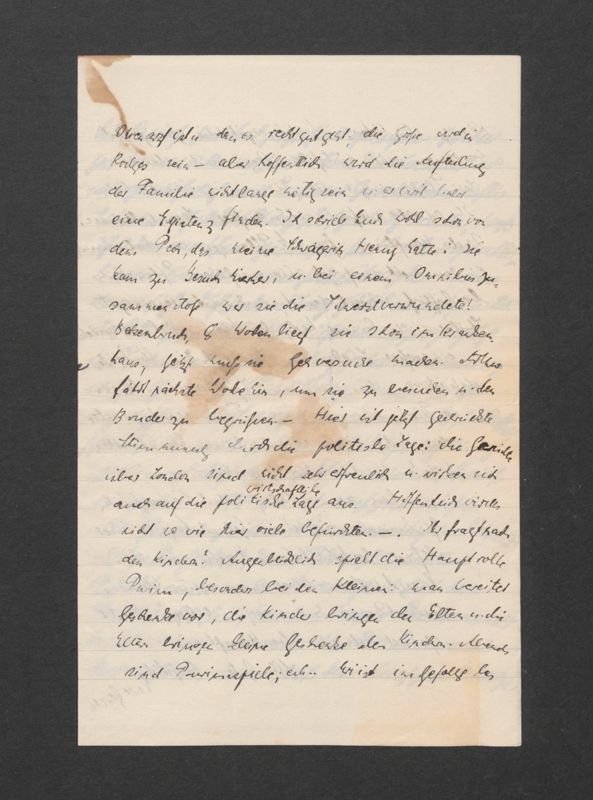
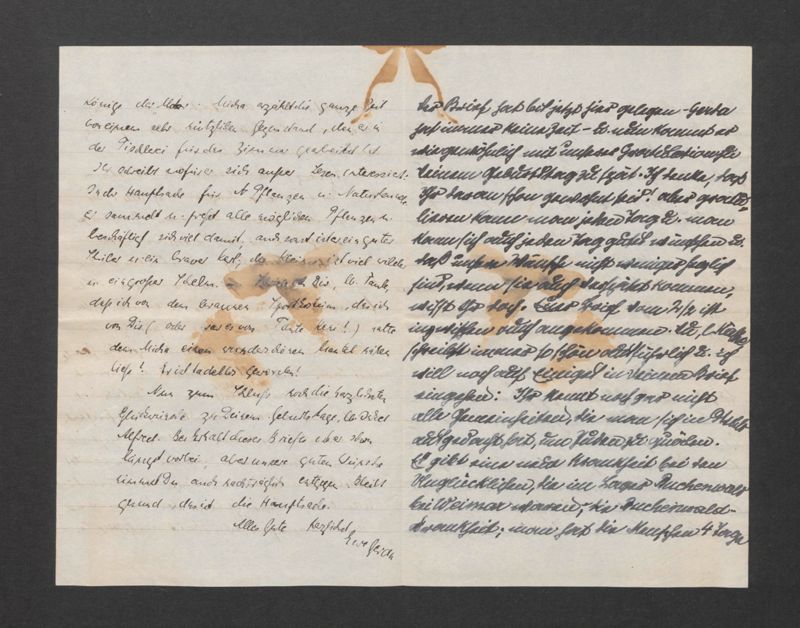
Warmest regards to all fromyour AdolfYet again, Father has written such a detailed letter! By now, we have received your letters as well; we are always so happy when you, dear Aunt Kätchen, tell us so much and write to us in such detail. Father has already answered many of your questions, especially concerning the Eckmanns. We have now been assigned a refugee to live with us for 2–3 months. They have taken in another 60 young people here; due to the heavy rain this winter, the buildings could not be finished, so they assigned one young person to each of the families who have only one child in their room. (Uri should rightfully still be living in preschool housing.) We have a nice 15 1/2-year-old boy from Karlsruhe; he seems to come from a good family and makes a good impression. He gets along very well with the children. It's possible that we won't be able to keep him for long, because on March 6th, my brother-in-law from Leipzig is coming to the country with his family (3 small children!). He received his certificate through the Mizrachi party, and we very much hope that through his friends and connections to the Mizrachi, he will also get a teaching position and that his subjects—mathematics, physics, chemistry—are still in as much demand as is claimed. He just needs to perfect his Hebrew a bit more, and we suggested that he stay here for 1 or 2 months for that purpose. His wife and the two youngest children will be in Tel Aviv until he finds something and stay with my sister-in-law's brother, who is an ear-, nose-, and throat- doctor who is doing quite well; the eldest will be in Rodges—but hopefully the division of the family won't be necessary for very long and he will soon find a livelihood. I think I already wrote to you about the bad luck my sister-in-law Henny had: she came to visit here, and she was the most seriously hurt person in a bus collision! She's been in the hospital with a broken pelvis for 8 weeks already; she is only now allowed to try walking. Arthur is going there next week to visit her and welcome his brother.—The mood is gloomy here right now because of the political situation: the reports from London are not very encouraging and are affecting the political economic situation. Hopefully it won't turn out as many here fear.—You are asking about the children? Currently, Purim takes center stage, especially for the little ones: gifts are prepared, the children give them to their parents and the parents give small gifts to the children. In the evenings, there are Purim games; etc. Uri is part of the retinue of the King of the [?]. Micha talks constantly about a very useful object that he crafted in the carpentry workshop for our room. You ask what interests him besides reading? Primarily plants and natural history. He collects and presses all sorts of plants and devotes a great deal of time to this; he is also a good student in all other respects, and a fine lad; the little one is much wilder and quite a rascal. Did I write to you, dear Aunt, that I took the brown sports outfit I received from you (or was it from Aunt Reni?) and had a beautiful coat made out of it for Micha? It turned out perfectly!
And now, I shall close with my warmest wishes for your birthday, dear Uncle Alfred. By the time you receive this letter, it will surely have long since passed; but I trust you will accept our good wishes even belatedly. Stay healthy; that is the main thing.
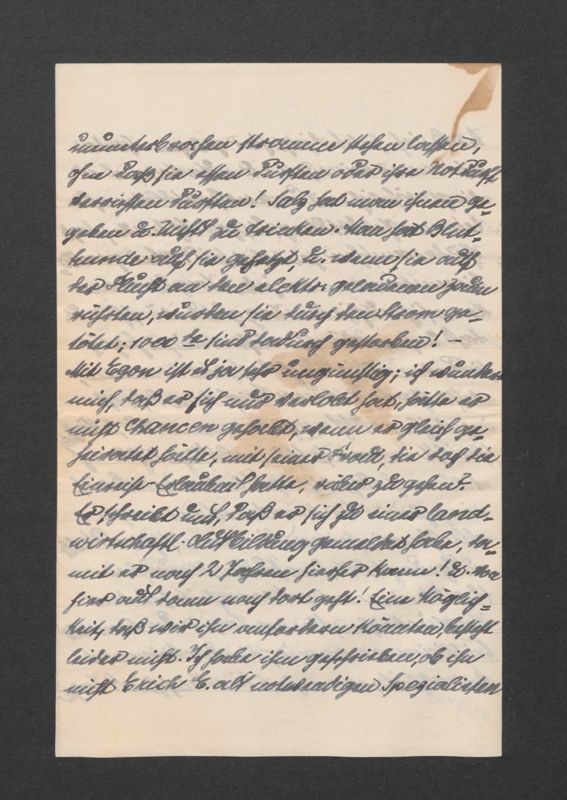
All the best[…] and cordially yours, GerdaThis letter has been sitting here until now.—Gerda never has time, and now it will arrive late, as is usually the case with our birthday wishes. I think you're used to it by now! But we can all congratulate someone any day, and we can also wish each other well any day, and you know that our wishes are no less heartfelt even if they come late. In the meantime, your letter of February 2nd has also arrived. You, dear Käthe, always write so beautifully and in such detail, and I want to address some things you mention in my letter. You don't yet know all the cruelties that have been devised in Germany to torment Jews. There is a new disease among the unfortunate people who were in Buchenwald near Weimar, "Buchenwald disease." People were made to stand at attention for four days without being allowed to eat or relieve themselves! They were fed salt and given nothing to drink. Bloodhounds were set on them, and if they touched the electrified fence while trying to escape, they were killed by the current. Thousands have died as a result!
As far as Egon is concerned, things are certainly very unfavorable; I am surprised that he only got engaged. Wouldn't there have been a chance of emigrating with his bride, who already had the entry permit, if he had simply married her? He only writes that he has registered for an agricultural training program, so that he can come here after two years! and then go there from here. Unfortunately, there is no option for us to request him. I wrote to him asking if Erich E. could request him as a necessary specialist
and trusted representative for his business, and I will discuss this with Erich and Heinrich, who is already here. Many people are coming illegally; the number of those who are already in the country is estimated at 20,000-25,000. England probably turns a blind eye, but whenever the Arabs make a fuss, such illegal immigrants are sometimes caught and not allowed to land. Therefore, it is always very risky and I couldn't write him about that, because one has to fear that the letter will be opened in Germany before he receives it.—I have no worries about Alice and Ernst, they will make it through; they have friends over there and are such capable people according to what A E writes. Your dear mother already informed you that Irma and her child went home to her father. She registered the child for the Aliyah here;
that's the most sensible thing to do! Spots have already been arranged for 5,000 children with families in Tel Aviv! Unfortunately, we can't do anything for Siegfried. I'm very sorry that his daughters weren't sent here, for the sake of the parents and the children! They are definitely better off here than in Germany. With all the "nonsense"—I can't think of a more fitting term—that we have going on, Palestine still offers the safest option. What could happen [?]? The more Jews come into the country, the better. The future here will be just as secure or uncertain as anywhere else. England has finally realized that we—that is, the Jews—cannot be sold out like the Czech Republic, and in time the Arabs will have to see this as well. Meanwhile, unfortunately, gunfire continues throughout the country, and
unfortunately, there were two deaths in this area today, but that doesn't make Jewish Palestine any less safe. The Arabs, upon hearing the first news of the exclusively Arab plan[?] proposed by England—albeit without thinking of making it come true—already organized victory celebrations, and during these celebrations, a bomb exploded in Haifa, killing 30 Arabs. Similar things happened in Jerusalem and between Jaffa and Tel Aviv. And now, since these celebrations have proven premature, they are shooting out of disappointment. Here in En-Ch., things are still quiet, meaning people are working, and the Gafirim—the police—and our Shomrim—the local militia—are doing their duty. Because both have frequent personnel changes, more and more people get trained in military matters and in shooting, and it has gotten to the point that every boy can be and many girls
are in fact trained to handle weapons; there are settlements where girls operate the machine guns!—Gerda told me that she would visit the Kargers on her next trip to Haifa and would then also tell me about the groom; I was supposed to write that, because she had forgotten to.—The Falkenstein's experience on the journey to Australia is so typical for the sad fate of so many Jews. Uncertainty is widespread in the world and everyone can consider themselves lucky if, like the Falkenstein's, they find themselves in relatively safe circumstances. The news from your family made me (not just me, but all of us) very happy. Of the entire family, you and I are certainly the best off in that respect, and we are in fact envied by everyone. Is Ev already learning anything field-specific? Chemistry and
the natural sciences? I would be very interested to learn how the pharmacy degree there is structured: I think it is exactly right that the young students there receive grades; in Germany, it has long been recognized that the usual procedure—the student only needs to have their attendance at lectures certified—is not the right way; now, of course, any specialized course of study is secondary; the main thing is "national service." And to you, dear Alfred, congratulations on your promotion! Well, financial success will sure follow soon enough. You do know the story about the company representative and key to the restrooms?—It will happen for your Ludwig too. The main thing is that they—Ilse and Ludwig—are there, and your Muschi grandchild, who must
must be such a sweet thing; you sent us a picture of her that one time! We also have a little girl like that here, the daughter of our politician, Liebenstein, who just spent a year in England. The child speaks perfect Hebrew, English, and German! Our boys are both tall for their age—Micha, who is now 9 years old, is 1.37 m tall, and Uri is 1.15 m, also a tall boy for his age. You, dear Käthe, ask about my spoken Hebrew; well, that is the dark spot in my otherwise delightful existence; I have the same problem you have with American English—understanding it, yesa little, but speaking it—no. Maybe I'll learn it yet. The issue mainly that everyone thinks they have to speak German with me, even if it's worse than my Hebrew!—It's Purim right now,
when the "Ne'ilah" is recited—which, as you well know, is very long; I am just looking at the bulk of this letter and must say that, in terms of length, it is almost a Ne'ilah of its own!—But enough of that now!
I am collecting postage stamps for the boys; if you have the opportunity—that is, if you receive letters from abroad (South America)—other than from Germany— would you be willing to send me the stamps from them?