Beachhead News Souvenir Edition
- Date
- Format
- newspaper
- Category
- Stories
- Subcategory
- Melvin Thielbar
- Collection
- Melvin Thielbar Collection
- People
- Savacool, Jack
- Tackaberry, William R.
- Gould, Alan E.
- Gilderman, Arthur C.
- Grimes, J. C.
- Weyant, Robert I.
- Miller, Vernie B.
- Holloway, James
- Quinn, Jr., Wm. H.
- Cebula, Rudolph
- Hantz, Russell
- Cross, Ty
- Shear, Dwight P.
- Broide, Macy I.
- Mole, Robert J.
- King, Harvey K.
- Harr, Bill
- Winter, Arthur
- Conditt, Harvey
- Mandrell, Troy F.
- Schmidt
- LeMay, Alfred
- Hitler, Adolf, 1889-1945
- Smyth, Victor
- Truscott, Lucian King, 1895-1965
- Combs, Delma
- Flaherty, R. P.
- Klapper, Gordon
- Whittier, Wallace
- Quinn, Leon D.
- Young, Robert A.
- Richter, Otto
- Porter, Mark
- Polich, George
- Palmer, Joseph
- Claunch, James E.
- Places
- Toulon, France
- Texas
- Morocco
- North Africa
- French Riviera
- Doubs River
- Gela, Italy
- Fréjus, France
- France
- Besançon, France
- Algeria
- Saint-Tropez, France
- Rhône River Valley
- Montélimar, France
- Germany
- Marseilles, France
- Port-Cros,Îles d'Hyères
- Le Muy, France
- Weirton, West Virginia
- Mediterranean
- Licata, Italy
- Moselle River
- Livron, France
- Oran, Algeria
- Île du Levant, Îles d'Hyères
- Normandy, France
- Draguignan, France
- Îles d'Hyères, France
- New York, New York
- Anzio, Italy
- Sicily, Italy
- Fedala, Morocco
- Salerno, Italy
- Durance River Valley, France
- Data URI
- soh.sto013.00022.xml
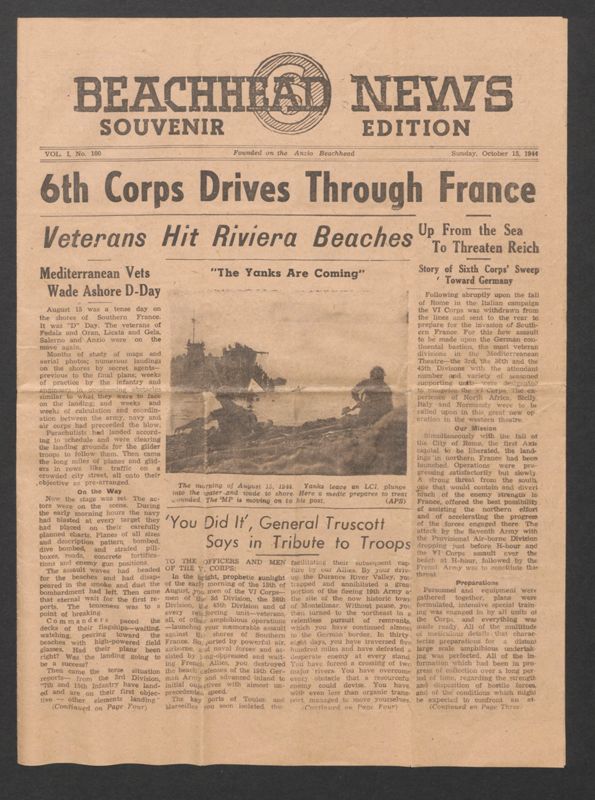 BEACHHEAD NEWS SOUVENIR EDITION
6th Corps Drives Through France
BEACHHEAD NEWS SOUVENIR EDITION
6th Corps Drives Through France
Veterans Hit Riviera Beaches Mediterranean Vets Wade Ashore D-Day
August 15 was a tense day on the shores of Southern France. It was "D" Day. The veterans of Fedala and Oran, Licata and Gela, Salerno and Anzio were on the move again.
Months of study of maps and aerial photos; numerous landings on the shores by secret agents - previous to the final plans; weeks of practice by the infantry and engineers in overcoming obstacles similar to what they were to face on the landing; and weeks and weeks of calculation and coordination between the army, navy and air corps had preceeded the blow.
Parachutists had landed according to schedule and were clearing the landing grounds for the glider troops to follow them. Then came the long miles of planes and gliders in rows like traffic on a crowded city street, all onto their objective as pre-arranged.
On the WayNow the stage was set. The actors were on the scene. During the early morning hours the navy had blasted at every target they had placed on their carefully planned charts. Planes of all sizes and description pattern bombed, dive bombed, and strafed pillboxes, roads, concrete fortifications and enemy gun positions.
The assault waves had headed for the beaches and had disappeared in the smoke and dust the bombardment had left. Then came that eternal wait for the first reports. The tenseness was to a point of breaking.
Commanders paced the decks of their flagships- waiting, watching, peering toward the beaches with high-powered field glasses. Had their plans been right? was the landing going to be a success?
Then came the terse situation reports- from the 3rd Division, "7th and 15th Infantry have landed and are on their first objective - other elements landing."
(Continued on Page Four)
The morning of August 15, 1944. Yanks leave an LCI, plunge into the water and wade to shore. Here a medic prepares to treat wounded. The MP is moving on to his post. (APS)
TO THE OFFICERS AND MEN OF THE VI CORPS:
In the bright, prophetic sunlight of the early morning of the 15th of August, you men of the VI Corps- men of the 3rd Division, the 36th Division, the 45th Division and of every reinforcing unit - veterans, all, of other amphibious operations - launched your memorable assault against the shores of Southern France. Supported by powerful air, airborne, and naval forces and assisted by long-oppressed and waiting French Allies, you destroyed the beach defenses of the 19th German Army and advanced inland to initial objectives with alomst unprecedented speed.
The key ports of Toulon and Marseilles you soon isolated, thus facilitating their subsequent capture by our allies. By your drive up the Durance River Valley, you trapped and annihilated a great portion of the fleeing 19th Army at the site of the now historic town of Montelimar. Without pause, you then turned to the northeast in a relentless pursuit of remnants, which you have continued almost to the German border. In thirty-eight days, you have traversed five hundered miles and have defeated a desperate enemy at every stand. You have forced a crossing of two major rivers. You have overcome every obstacle that a resourceful enemy could devise. You have with even less organic transport, managed to move yourselves.
(Continued on Page Four)
Story of Sixth Corps' Sweep Toward Germany
Following abruptly upon the fall of Rome in the Italian campaign the VI Corps was withdrawn from the lines and sent to the rear to prepare for the invasion of Southern France. For this new assault to be made upon hte German continental bastion, the most veteran divisions in the Mediterreanean Theatre - the 3rd, the 36th and the 45th Divisions with the attendant number and variety of seasoned supporting units - were designated to comprise the VI Corps. The experience of North Africa, Sicily, Italy and Normandy were to be called upon in this great operation in the western theatre.
Our MissionSimultaneously with the fall of the City of Rome, the first Axis capital to be liberated, the landings in northern France had been launched. Operations were pregressing satisfactorily but slowly A strong threat from the south one that would contain the divert much of the enemy strength in France, offered the best possibility of assisting the northern effort and of accelerating the progress of the forces engaged there. The attack by the Seventh Army with the Provisional Air-borne Division dropping just before H-hour and the VI Corps assault over the beach at H-hour, followed by the French Army was to constitute this treat.
PreparationsPersonnel and equipment were gathered together, plans were formulated, intensive special training was engaged in by all units of the Corps, and everything was made ready. All of the multitude of meticulous details that characterize preparations for a distant large scale amphibious undertaking was perfected. All of the information which had been in progress of collection over a long period of time, regarding the strength and disposition of hostile forces, and of the conditions which might be expected to confront an at-
(Continued on Page Three)
 Page Two BEACHHEAD NEWS Sunday, October 15, 1944
BEACHHEAD NEWS
Page Two BEACHHEAD NEWS Sunday, October 15, 1944
BEACHHEAD NEWS
VI CORPS
Founded on the Anzio Beachhead
Capt. J. C. GRIMES..... Officer in Charge
FIRST LIEUT. ALAN E. GOULD..... Executive Officer
SGT. WM. H. QUINN, JR..... Editor
PVT. TY CROSS..... News Editor
CPL. R. P. FLAHERTY..... Feature Editor
Correspondents: Bill Harr, James E. Claunch, Mark Porter, Joseph Palmer, Macy I. Broide, Jack Savacool and Dwight P. Shear.
Published daily for troops of the VI Corps. Acknowledgement is made to the Wire News Service of the Corps Signal Battalion and the G-2 Section of VI Corps for the daily Corps news summary. The Beachhead News receives CNS material. Republication of credited matter prohibited without permission of CNS, War Department, New York, N. Y.
VOL. I, No. 100 Sunday, October 15, 1944 SouvenirThis second Souvenir Edition of the Beachhead News, commemorating the 100th Edition of our publication of news for front line troops and containing a resume of the Southern French campaign, has been published in 80,000 copies and has been ccarefully censored so that subscribers may send their copy home.
We are proud of the unique position we have as a mobile front-line newspaper. Trucks on which we printed our original issues at Anzio are with us no longer but we have other trucks and equipment and intend to continue to publish the daily news for all VI Corps troops.
This is not a typical copy of the Beachead News. All up-to-the-minute news has been cut out and special summaries of our operation have been published instead. We have also tried to select our best features and art of the rapid drive just past.
German GeneralAnd the Private
Yank Infantryman Private Arthur C. Gilderman was returning after a trip to the prisioner's cage when he noticed a heavily-braided German sitting among the bushes just off the trail. The solider fired a shot over the German officer's head. Convinced, the officer put his pistol away and surrendered.
"I asked him for his pistol, but he refused to give it up," the doughboy reported, "so I made him lie flat on his back while I searched him and took the gun. Then I marched him back with his hadns over his head. He didn't like the idea of being ordered around by a private, so I had to help him get started. It sort of upset him, but he came along okay."
The much-braided German who objected to capture at the hands of a private was Major General Otto Richter.
Looking BackOver Our Shoulder
Picked at random from the files of the Beachead News, looking back over the road since invastion day ... somehow, we failed to immortalize a GI as the first ashore ... Pvt. Arthur Winter Goose stepped a column of prisoners through town as liberated civilians cheered ... A captured bakery was quickly put to use by one front line infantry unit and white bread was served in southern France, D-day ... Pfc. Rudolph Cebula, from Weirton, West Virginia, who was supposed to have fired the first shot at Salerno, fired the first round of artillery on the Riveria ... Six hours after the beach was stormed, six GIs were found in a private home jitterbugging with local girls ... Pennies from the people of Draguignan purchased the land for our first American cemetery, their gift to the Untied States ... Five 45th Division infantrymen marched honor-guard for a fallen member of the Maquis ... 130 Germans resting in a rest camp awoke one morning to find that the swiftly advancing American troops had surrounded them ... A Frenchman, guiding the Yanks, had passed his own home but wouldn't stop to visit his wife until the objective had been reached. He hadn't seen her in two years ... 3rd Division troops, once under teh mercy of German Anzio guns on the heights, turned the tables when they climbed a hill here and found a column of German vehicles passing by below them. Somebody yelled, "Remeber Anzio" and they opened fire ... Pfc. Harvey Conditt, jeep driver, found a bomb straddling a bridge, looped a rope around it and draged it off with his jeep ... A 36th Division task force, led by Second Lieutenant James Holloway, slipped past a barracks-full of sleeping Germans one night ... A column of Yanks and a column of Germans met head-on in the main street of a village. Villagers cheered from high windows as they fought it out ... Tech Sergeant Leon D. Quinn, messenger, had a half a haircut before he found out that the village was still in German hands. He left town ... Another rnner, Pfc. Wallace Whitier, escaped death when a bullet, fired from the turret of what he thought was a Yank tank, lodged in a thick notebook in his breast pocket ... Third Division artillery, in a three
The Liberatorhour barrage, wiped out 222 German vehicles when they caught them in a three-mile trap ... The city of Die re-named their main street, "Texas Avenue" after the 36th Division troops that liberated them ... Platoon Sergeant George Polich knocked out his second German "88" in France ... Pvt. Russell Hantz, hidden in bushes, ordered a platoon of Germans to la down their arms and they did, until they found out who gave the order ... The 142nd Infantry captured a German CP and 24 cases of scotch. The 36th Division Recon hi-jacked it ... A French girl walking along before an American patrol waved to hidden German
LIAISONA little French girl presents an Amercian soldier with a gift as the infantry comes into a newly-liberated town (APS)
machine gunners, and when they waved back the Yanks got them ... When five Nazi soldiers used a girl for a shiled, Pfc. Alfred LeMay fanned their hair witha bullet and they surrendered ... A village in the Alps, liberated but not visited by troops, joyously welcomed jeep-driver Cpl. Robert A. Young when he drove in looking for some eggs ... A Berlin-born Yank escorted his own uncle, a German medical officer, to the 3rd Division prison camp. They had met once in Berlin.
Lieutenant Swims RiverTo Get Boat for Patrol
The mission assigned Lieutenant Gordon Klapper was to take an infantry patrol across a large river and reconnoiter the terrain on the other side.
One of his men spotted a row boat on the opposite bank and pointed it out to the officer. The Lieutenant stripped, swam across and returned with the row boat. His patrol crossed without getting wet.
NIGHT PATROLWhen a patrol leaves on a night mission, it might turn up anything behind the German lines. One of the recent patrols ended up in a German motor pool.
The park was jammed with recon car, trucks, a heavily armored car and a tank, as well as many sleeping Germans.
The patrol maneuvered around for a postion to get at teh tank, put a rifle-grenade through it, and took off.
Believe It or NotA First Sergeant, a Sergeant and a Corporal were enjoying a few hours of leisure at a sidewalk cafe in a newly-liberated town, basking in the smiles and handshakes from the citizens. A chicken, belonging to the owner of the cafe, hopped up on hte table and before the starteld eyes of the three non-coms, deposited an egg on the table.
They Fried it.
"Halt," yelled his prionser.
"Cut it," ordered Pvt. Victor Smyth.
"You don't want to go back on this road," the prisoner came back, "it's mined."
 Sunday, October 15, 1944 BEACHHEAD NEWS Page Three
Escape up Rhone Valley Smashed at Montelimar
Task Force Butler Hits Northward to gap
Sunday, October 15, 1944 BEACHHEAD NEWS Page Three
Escape up Rhone Valley Smashed at Montelimar
Task Force Butler Hits Northward to gap
(Continued from Page One)
tacking force was maded available to the VI Corps. This was tehn supplemented and brought up to date through intensified reconnaissance by every available land, sea and air agency. Reports of northern operations were studied carefully.
Plans and operations quickly took shape and before long no detail had been overlooked.
The AttackThen came the order - to move against the enemy.
The huge force was assembled on signal and, under smoothly coordinated arrangements, each element without hitch, assumed its proper place in the overall scheme of things.
The operation was under way - but before arrival at the taget area - every individuals participating had been briefed thoroughly on the plans, the expectations, and the imporant part that he was to play in the vital enterprise.
On the moringin of the 15th of August the great armade, supported by the all out efforts of the airforce over-head, stood off the beaches of the Southern France then defended by the 19tj German Army. Precisely at H hour attack against the hostile shores began.
Moving InThe results of the critical first day's operations are described prosaically in an official report as follows: "Assault of all units of VI Corps in the San Tropez-Frejus sector made according to plan and advance inland toward beachhead line initiated. All initial objective successfully ocupied." The carfully laid plans and guarded preparations had borne fruit; the enemy had been taken by surprise.
Quickly taking advantage of this, the veteran divisions of North Africa, Sicily and Italy broke through the prepared enemy defensive positions and crushed the forces marshalled against them. The First Airborne Task Force landed successfully in the Le Muy area, disrupted enemy communications and blocked the movement of his reinforcements. The attack of the First Special Service Force on Port Cros and the Ile du Levant proceeded satisfactorily. Contact had been made with teh small group of French commandos opeaing on the left flank. At the day's end the Corps was consolidated and established firmly ashor. The campaign in Southern France had begun auspiciously.
PursuitThe impetus of the initial assault was sustained and progress continued to be rapid in all division sectors. Within a week the 3rd Division had fought its way to the west to encircle and isolate the great ports of Toulon and Marseilles and were being passed through by elements of the French units which were to complete their reduction. The 45th Division was nearing Grenoble. The 36th Division had reached the Livron area in the Rhone River Valley and was making dispositions for the great battle of Montelimar which, in fact, had already begun.
Task Force ButlerThe Task Force Butler, a fastmoving hard-hitting composite force conceived during the planing period was with the 36th Division. This force which had been assembled on the 18th of August had streaked to the North as far
On the Road to Berlinas Gap and had caused great disruption and consternation in the German forces on the right flank before it was turned to the west.
The surprised, shaken and disorganized 19th Army, feeling the weight of our advance, harassed from all sides, and recognizing the precariousness of its position tried to break contact and salvage itself by withdrawal up the valley of the Rhone; but at Montelimar it suddenly and unexpectedly found its escape route blocked by the elements of the 36th Division and Task Force Butler that had raced up the valleys of the Durance and the Drome Rivers to intercept it. Under the pressure of the 3rd Division on the south a great portion of the retreating army was forced into the Montelimar pocket between the river and the heights occupied by the 36th Division which dominated it.
Fierce fighting followed as the trapped Germans fought for their very existence. In the bloody battle tht ensued great numbers of the enemy were annihilated, enormous quantities of supplies and equipment were captured or destroyed and thousands of prisoners of war were taken. Those elements of the great German 19th Army that succeededin making their escape continued frantic efforts extricate themselves through flight to the North but the valley of the Rhone was opened to the allies.
Sensing quickly the changing situation and seizing the opportunity offered, the VI Corps regrouped, re-oriented itself towards the Northeast, entered a new phase and tooke up hte pursuit of the fleeing Germans.
By the 15th of September, after just one month of operations, the VI Corps had driven its advance as far north as the Lure-Luxeuil-Darney Line. Forty days after the landings, the advance had progressed more than 400 miles and against resistance which has increased day by day. Every conceivable obstacle to terrain and enemy action have been encountered and overcome enroute. Two major barriers the Doubs and the Moselle Rivers, both with practivally every usable bridge blown, were crossed almost without hesitation. Approximately 40,000 prisoners of war have been taken. Vast quantities of irreplaceable equipment have been lost to the enemy and at this moment the VI Corps, side by side with other Allied units in this theatre in one unbroken line, stands on the threshold of Germany.
Credit must be given here to the gallant members of the French Forces of the Interior for their inestimable ocntribution to these remarkable achievements. At great risk to themselves, their families and their possessions the brave members of that Force have in innumberable instances facilitated the progress of the VI Corps units by harassing action against enemy units and installations and have made possible the attainment of many specific objectives with considerably less losses than might otherwise have been expected.
French Cheer While Yanks Fight in StreetIt started when a column of marching Americans turned a corner into the main street of one of the hundreds of now forgotten villages. Up the street, some 500 yards away, a column of German troops appeared. Until the Germans opened fire, the Americans believed them to be prisoners because they marched in a column of two. When the shooting started the Yanks dispersed to ditches and behind buildings. The sound of heavy machine guns could be heard above the rattle of small arms. Yanks rushed to set up two anti-tank guns and blasted 15 rounds down the main street.
The battle lasted for about fifteen minutes before the Germans fell back. Through it all, civilians kept sticking their heads in and out of upper story windows to give out with lusty cheers.
FAMED SS FAILED TO STOP PADDLEFEETWhen troops of the 45th Division arrived at the Moselle river, one regiment, experienced in the dangerous art of crossing rivers, came up against crack SS Troops defending the other side.
Heavier weapons started to blast the enemy shore the next noon whiel the troops, known as "Paddlefeet" because of their success in such action, waded, swam, and slung ropes across the stream as the Germans poured on a murderous hail of bullets.
Up against concrete walls, once on the other side, the doughboys pyramided each other over while tanks roamed the American side, blasting away at enemy defenses.
Infantry Enjoys Hot Bath As Germans Abandon TownWhen troops of the 36th Division liberated a town in which was to be found a building equipped with every type of bath, including sulphur springs, the Division Special Service officer had an idea.
Generators to power pumps were secured and connected and everything made ready. That night hundreds of tired, infantrymen came in from the woods and fields for their first bath since arrival in France.
 Page Four BEACHHEAD NEWS Sunday, October 15, 1944
'HARD FIGHTING LIES AHEAD,' GEN TRUSCOTT
(Continued from Page One)
Page Four BEACHHEAD NEWS Sunday, October 15, 1944
'HARD FIGHTING LIES AHEAD,' GEN TRUSCOTT
(Continued from Page One)
your weapons and your supplies over distances almost logistically unbelievable. You have, by your successes, not only contributed immeasurably to the advance of the northern Allied Forces by preventing the movement of reserves against them but have eliminated the German 19th Army as an effective fighting force. Your operations have been a most vital factor in clearing the enemy from almost all of France.
Your conduct here and your relationships with the people of France in the areas that you have liberated has been in accord with the highest standards of American military tradition. The fervent and whole hearted welcome which they have extended to you is testimonial of their gratitude and will remain, I am sure, a treasured memory in the minds of every member of this command. Your country has reason to be proud of your accomplishments and grateful for the services that you have rendered.
This campaign will stand as a monument to you Americans of the VI Corps - a tribute to your training, initiative, ingenuity, aggressiveness, boldness, determination, and fighting spirit and to the leadership of the officers and non-commissioned officers of all ranks. To every officer and to every man, I tender my sincere appreciation for your untiring efforts and my deep admiration for your accomplishments.
Our task in not yet done. Hard fighting lies ahead. A fanatical enemy, reorganized and reinforced, is at bay on his own doorstep. Rugged terrain confronts us. Rain, cold, and snow will soon increase the difficulties of operations and add to the hardships that you must sustain. But - surmounting every objective as you press on - you will destroy the enemy before you and, together with all the other forces at the command of the Allied Nations, will bring about his final defeat and unconditional surrender.
Veterans - men of the VI Corps - with respect and pride, your Commander salutes you.
L.K. TRUSCOTT, JR.Lieutenant General, U. S. Army
Commanding SPANNED DOUBS RIVER IN TWENTY-TWO HOURS
Engineers of the 36th Division, when the Allied march reached the Doubs river, worked through the rain and dark night, to throw a bridge, 20 feet high, across the 150 feet of water. The job was done in 22 hours and the American armor moved on across the river.
Onlookers, civilian and military, were amazed at the speed at which the engineers did the job.
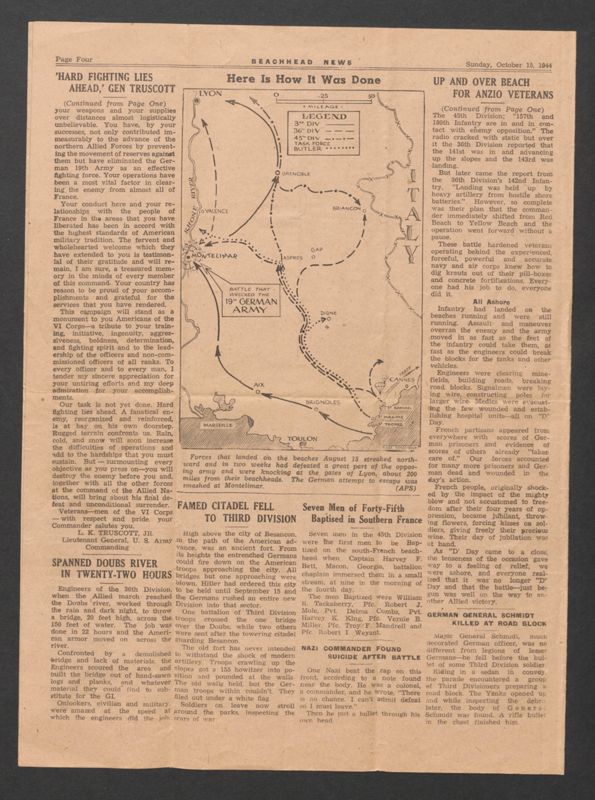
Here Is How It Was Done Forces that landed on the beaches August 15 streaked northward and in two weeks had defeated a greate part of the opposing army and were knocking at the gates of Lyon, about 200 miles from their beachheads. The German attempt to escape was smashed at Montelimar. (APS) FAMED CITADEL FELL TO THIRD DIVISIONHigh above the city of Besancon, in the path of the American advance, was an ancient fort. From its heights the entrenched Germans could fire down on the American troops approaching the city. All bridges but one approaching were blown. Hitler had ordered this city to be held until September 15 and the Germans rushed an entire new Division into that sector.
One battalion of Third Division troops crossed the one bridge over the Doubs, while two others were sent after the towering citadel guarding Besancon.
The old fort has never intended to withstand the shock of modern artillery. Troops crawling up the slopes got a 155 howitzer into position and pounded at the walls. The old walls held, but the German troops within couldn't. They filed out under a white flag.
Soldiers on leave now stroll aroudn the parks, inspecting the scars of war.
Seven Men of Forty-Fifth Baptised in Southern FranceSeven Men in the 45th Division were the first men to be Baptized on the south-French beachhead when Captain Harvey F. Bett, Macon, Georgia, battalion chaplain immersed them in a small stream, at nine in the morning of the fourth day.
The men Baptized were William R. Tackaberry, Pfc. Robert J. Mole, Pvt. Delma Combs, Pvt. Harvey K. King, Pfc. Vernie B. Miller, Pfc. Troy F. Mandrell and Pfc. Robert I. Weyant.
NAZI COMMANDER FOUND SUICIDE AFTER BATTLEOne Nazi beat the rap o this front, according to a note found near the body. He was a colonel, a commander, and he wrote, "There is no chance. I can't admit defeat so I must leave."
Then he put a bullet through his own head.
UP AND OVER BEACH FOR ANZIO VETERANS (Continued from Page One)The 45th Division; "157th and 180th Infantry are in and in contact with enemy opposition." The radio cracked with static but over it the 36th Division reported that the 141st was in and advancing up the slopes and the 143rd was landing.
But later came the report from the 36th Division's 142nd Infantry, "Landing was held up by heavy artillery from hostile shore batteries." However, so complete was their plan that the commander immediately shifted from Red Beach to Yellow Beach and the operation went forward without a pause.
These battle hardened veterans operating behind the experienced, forceful, powerful and accurate navy and air corps knew how to dig krauts out of their pill-boxes and concrete fortifications. Everyone had his hob to do, everyone did it.
All AshoreInfantry had landed on the beaches running and were still running. Assault and maneuver overran the enemy and the army moved in as fast as the feet of the infantry could take them, as fast as the engineers could break the blocks for the tanks and other vehicles.
Engineers were clearing minefields, building roads, breaking road blocks. Signalmen were laying wire. Medicswere evacuating the few wounded and establishing hospital units - all on "D" Day.
French partisans appeared from everywhere with scores of German prisoners and evidence of scores of others already "taken care of." Our forces accounted for many more prisoners and German dead and wounded in the day's action.
French people, originally shocked by the impact of the mighty blow and not accustomed to freedom after their four years of oppression, became jubilant, throwing flowers, forcing kisses on soldiers, giving freely their precious wine. Their day of jubilation was at hand.
As "D" Day came to a close, the tenseness of the occasion gave way to a feeling of relief; we were ashore, and everyone realized that it was no longer "D" Day and that the battle - just begun was well on the way to another Allied victory.
GERMAN GENERAL ACHMIDT KILLED AT ROAD BLOCKMajor General Schmidt, much decorated German officer, was no different from legions of lesser Germans - he fell before the bullet of some Third Division soldier.
Riding in a sedan in convoy, the parade encountered a group of Third Divisioners preparing a road block. The Yanks opened up and while inspecting the debris later, the body of General Schmidt was found. A rifle bullet in the chest finished him.