Norman Smith Boone Central Presentation
- Date
- Format
- testimony
- Category
- Stories
- Subcategory
- Norman Smith
- People
- Olson, Cassandra
- Eisenhower, Dwight D. (Dwight David), 1890-1969
- Wolf, Hannie
- Flisiak, Stefan
- Hitler, Adolf, 1889-1945
- Roosevelt, Franklin D. (Franklin Delano), 1882-1945
- Hager, Frank
- Hernandez
- Places
- Landsberg, Germany
- Dachau concentration camp
- Poland
- St. Edward, Nebraska
- New York, New York
- Obersalzberg, Germany
- Ulm, Germany
- Fullerton, Nebraska
- Krakow, Nebraska
- Silver Creek, Nebraska
- Washington, D. C.
- Fort Benning, Georgia
- Lincoln, Nebraska
- Madison, Nebraska
- Columbus, Nebraska
- Northwestern University, Evanston, Illinois
- Rhine River
- Fort Lewis, Washington
- Data URI
- soh.sto016.00027.xml
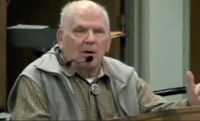
 Norman Smith
I want to show you today, and I'm very conscious of our time. It is a map that you have. Very important that you understand. I'm talking about a concentration camp that was located in the block. I've got a block with an arrow April 28, 1945, and it's pointing to a place called a Landsberg. There's a difference in these camps. Slave labor camps like more or less to the left, right over when you get out into the area of Poland, when you get over in Poland, notice the death heads. Every one of those is a mass extermination camp. You're going to have a power point presentation. That will go ahead and get that started. It's behind you.
I sound more like Kermit the Frog, than anybody else here, but... This is right here, this is actually a sketch that he drew himself. He went up on a hillside, all day long... Minor camp, in Poland But this one, it was actually his sketch, he sketched this. I think what you could do it, in a moment, I want to create... When you read about combat. I want to tell you what combat was in World War II. In this case, let's say that the concentration camp is at St. Edward, but it's way in the distance.
We can't see it. All we know about what's happening is that there are tanks ahead of us, and we don't know how many tanks. We don't know how far they are, but they're American tanks. You can see the smoke, you can hear the explosions, and it's a massive traffic jam, bumper-to-bumper. We are the support troops. We're coming right behind the tanks. Every so often, the whole thing would stop. And we wonder, what's going on? You could still hear the firing. It wasn't until that column moved, and when that column moved then you begin to see the results of what's happening. They are burning vehicles on both sides of the road. There are dead Germans in those- We ran over what I would call a bump in the road. You look down and you'd realize you'd just run over a couple of corpses. That was the way it went. We got through a point on the highway where suddenly the whole highway is covered with smoke. And it's just as if we had run into a brush fire. And any of you have driven in this part of the country, you know, when you have a grass fire. That's the way it is, sometimes you have a good fire, you just can't see. We got into that smoke, and some of them, some of the guys begin to get very sick, begin to vomit, and it's putrid, terrible, pungent. And we all went through it.
You don't know what's going on. When you're this, the man that's in behind, you're just infantry. You only know what you're being told. At one point, finally, we got the word passed down the line, He says, "my god" he said, there's a building up here burning on the left side of the road. It's half submerged into the earth. He said, it's full of people. They got the doors barricaded and they put gasoline and they're burning those people alive. Now, that was my entrance.
That was my first time I was introduced to the concept of the Holocaust.
We kept on moving and eventually toward the end of the day was when the battle was ebbing down and we were near the town of Landsberg. When we got in there, we went past what was the entrance to the concentration camp. We could look over there we could see people massed inside and some people wandering out and around. We were under orders number one you do not fire upon anybody unless you're fired upon, so we took us into town we took over a building and that's where we bedded down for the night. The next morning they brought us back out and my, in particular, company, we were assembled in front of the gates these people were standing there and they're staring at us as - it's like a zoo where you stare at the animals, them looking out at us. These people were emaciated, they're so thin. You can't believe it. They're skin covered, skeletons.
And we were given the order. You got to move through the woods. They called it mopping up, or cleaning up. And so we're going to make a big sweep through the woods. We went out into the woods and body after body, after body. Some of these people had enough strength. left and walk out of that gate and go as far as they could and then find a dignified place to die. And as I came upon a body, I would fix the muzzle of my rifle and I dipped down and lift the garment back all the way make sure that they was indeed dead. And they had enough strength to get that far that was the only freedom that those people knew and we were standing in front of the group there I I watched one individual, his particular, who came through the crowd, and he had a little stick. And at the end of that stick, he had a bottle and he had it over his shoulders. And I thought, where in the dickens does he think he's going? Well, he had definitely, he was leaving, and he was going somewhere. So I watched it to put his way through the crowd, and he went out to the edge of it. And then he started down the road and finally he sat back down to rest, and I didn't think anything more about it. So we made our sweep through the woods. That part of Germany, and there forested. They're fur-trees, coniferous. A bed of needles that were so thick that he could just walk in. It was deadly silence inside of those wood. You had to watch where you walk it because the other people had diarrhea and dysentery so bad, no time for modesty. They just went before you. Or they dropped dead before you. One of the two sort of like coming on to a herd of a very starved animals and they went as they say we went around when we got around the whole camp took us about three hours on that sweep and as we came back to the front of the camp we were talking quietly among ourselves now what we wanted is any of you people speak you know - Sprechen Sie American we were looking for people who could speak English. And several came forward. One in particular told us he was a banker in Austria, and we have been in that eight years.
We think we're going to be compassionate. We tried to feed these people. It was a wrong thing. These people were so dehydrated if they they took one bite of food they immediately began to vomit. Somebody got the idea, well, sugar would be good. Well, that didn't really work well, but it came up, I don't know where they got the sugar cubes, but they came out with them. We were handing out sugar cubes to them. They needed medical attention, and they desperately needed it, and they needed it now. One of the banker demonstrated for us, and he could speak very, very good English. He went up into his crotch with his fingers like this, as clear up as he could, and he could, and he could move him back and forth, his fingers to show you how emaciated that he was. This is something that we're saying what happened. We are in a state of shock. They're in a state of shock because they know they are free but where are they going to go? And this is what I mean by an introduction to the Holocaust.
I got to turn, to see the [?]. Now this is the slide we really should have left until last. But I'll tell you this is the slide in New York City at the end of the war when we came home and we had a big parade there. This is the largest, to my knowledge, this is the largest military parade ever held in the United States. We're marching up 5th Avenue. In New York you see all kinds of confetti of this every type of person in history is honored this way. Admiralty we even came up. Spanish American War for example. So let's go to the next slide. Now you're gonna get an idea. We played the same two pieces, for three hours and 40 minutes. So you mean if you talk to [?] a few people back here, because you can't see my head. We talked, but we played three, the two pieces, three hours and some forty minutes. Trumpet players couldn't speak. And the drummers their hands were blistered from that but out of this is the 82nd Airborne. Later in doing my own research i found out there were only eight original members of the 82nd Airborne that marched in that all the rest of them had been killed in action or they were in veteran's hospitals. Okay, next.
If you had lived in Germany at this time you would have been a member of the Hitler Youth. There is a book that everyone carried they uh had no choice. You either were a good Nazi and you went in to the Hitler Youth. You didn't say, well, I don't like that. And you don't want that. That's fine. Maybe every chance if you want to. But so this is like Boy Scout could, in some recent sentence, inside that page is, or page after page of all the physical requirements that you had to meet. You have to run a distance in such and such a speed. The best thing I can say to you, like the President's physical fitness, test that we have, and I don't know whether we're still running that again or not. This, you see, this young man is from home Ulm. Ulm is where Hannie Wolf was originally from. And it's got an official stamp on like a passport. So this individual born in 1922, well, I was born in 1925, so I'm 84 now. If that man lived through the war, what he did, slightly older than I am right now, may have, I don't know whether he survived or not. Next.
This is known as the Hitler House. It's also located in an area of Germany called Obersalzberg. Beautiful. Those of you that have seen Sound of Music, same area where that was filmed. [?] [laughing] When Hitler was thrown into jail, he tried to overthrow the Weimar Republic for which they put him in jail. He wrote a book called Mein Kampf, which means My Struggle. And then he was popular, when he became Chancellor he was popular all over Germany. Sold millions of copies of that thing. He used the royalties to remodel his house. So 1933, as it was in the beginning, 1939, as they had modified it, and he designed this himself. This is the way I first saw it in 1945, and you could see what the German government finally did with it. It got to be such a tourist attraction. Everybody went up there and wanted to take a brick home. as it was for several years. This was taken over, this entire area was taken over by the American government and they made it to resort for American troops for years. They finally turned the area back to the Germans. Okay next. There's Hitler. The house in the distance. [?] in April of 1945, you can see a fighter plane, this is a British plane, flying over it, and the remains of the Berghoff are right behind the trees. Next.
This is a concentration camp called Dachau, and I was making this presentation Fullerton, and in the audience was the Father Glechik.2 Father Glechik was a Polish priest that had been imprisoned by the Nazis in the early part of the 1933 era. He'd been their eight years he was in the audience because he had a parish here in Nebraska and Krakow, Nebraska, Silver Creek. He came up and he pointed out and he said, I carried cement to build that building. My back is the day after day and the month after month to build that crematorium. And behind that gate is a place where they burn the people are cremated. This is what we found, no matter where we went, as far out of the area of Landsberg. I know where you'd find a pile of bodies. The Germans were desperately trying to cover up what they had done. They machine gunned those that were living, put them in piles that were trying to burn. And this is at Dachau. In Dachau was the first camp, the Germans built. Okay, next. It gives you a close up. You can see these people have... You're there until you worked yourself to death, and that was your choice. You see how emaciated these people are. Now Germans were very, very conservative. They didn't waste anything. So every part of that human body was used. They, Germans didn't do it. They had the prisoners do the work. So in other words, it might be my job in the concentration camp to do nothing but pull teeth. So I'm going to open the mound. Every one of those people. And if they got gold teeth, I'll pull those out. Or silver teeth. Pull all the teeth out. And the bones were later ground up for fertilizer so they went back out on the fields to raise the crops. This is clothing big piles of clothing all of everything was salvaged he bundled and sent back to the factories to make new garments out of. Next.
These pictures they are taken in Dachau but you can not imagine the stench there and you could see these soldiers these are not 101st Airborne. There were many, many, many different divisions that converged upon this area at that time. Next. More of the same. You know that they've got masks or handkerchiefs. Next. [?] That's all we could do with them there. We went into the city of Landsberg and we gathered up the population at rifle point and drove people out. They said they didn't know there was a concentration camp outside of town. Well, they didn't know it then. And they knew it when they got out there. They had to pick up the bodies and throw them into the pits. There's bulldozers in there digging big pits. That's all you could do. So there's no way you could ever say that I know exactly how many people that were killed in the Holocaust. We simply had to get rid of them for sanitation. Okay, next.
Found evidence to some of them tried to escape. And in fact that they were fully clothed and put outside the gates and shot [?] while they were all trying to get away. This is an interesting feature here. A human body will hold a lot of fluid, but some of the bodies, maybe a sort of a heavy guy like me, I don't burn well, so they stack the bodies in here and they had one of the other prisoners go along and jab the bodies so that the body fluid would drain, and these are drains, and the body to put its drain on the ground or into a pit. Next. They had train loads of bodies there waiting to be cremated they couldn't keep up with the demand. Next.
Notice this train here notice the looks like a little observation place that was where of all things they would put a guard on the train and I don't know what in the world they were guarding or why they were worried about guarding it. But he rode that little place the court in there he had the fire out of there right there is. Next.
Here's one of the trains that's completely loaded with body parts. Next.
It's more of the same. [?] I didn't have to do that, but that's the kind of thing you found. Next. [?] In the old days I could move around, I can't move around anymore.
What you're looking at here, this is a crematorium. This is the actual furnace that the bodies were being burned in. And you can see they jammed as many bodies in there as they can. The Germans didn't touch things. Certain people that were selected, and they were told, if you want to live, then you'll follow directions. And this is what you'll do. And all day long, you will take the bodies, shove them in there. And if you look carefully, you can see there are rollers there. And then there's gurney is. You put the body on the gurney, and then they keep this rolling right in there. It's slow business. It's fast to kill somebody, but it's very slow to dispose of the body. Here, for example, was a man, this man once lived in Norfolk, Nebraska. He was a fighter that was shot down by the Germans. He was his job to clean out the furnaces. He had to take all of the ashes out there and take them out by the wheelbarrow and just [dump them on the field]. And this was his basic job. We had, at one time, we had a number of people in this area that had immigrated to, the United States and then we, one by one we very much to identify them, find out what they did. And nice looking fellow. How would you like to have that job? Clean out the ashes. Okay, next.
So many people at the end, the Germans were in a frenzy trying to get the every one of the camps empty and trying to get rid of the evidence. And there's no way they could possibly do that. Okay. If you'll notice on this German soldier's collar, notice it's skull and crossbones. This is a Schutzstaffel they call them, and this is the SS. They were the ones who were put in charge of the concentration camps. And I thought I did never realize that not only did they tattoo the people they put into the concentration camp. And any survivor will tell you, I lost my identity, and I became a number. And there's my number printed on there.1
What do you think about the Holocaust?
Everything I've told you today and shown you in these pictures, this is just a little political grapple. Go to Washington, D.C., go to the Holocaust Museum, it's there, and then you'll really see the different things, and like people who were the undesirable. Undesirables, I'm not an Aryan. I can't be Aryan pure. I'm a pure, Scottish, Irish, English, and Dutch, German, Norwegian, and God knows what else. So I'm a mixture. That's what makes me an America. I got on the train one time, and I'm going back to Fort Benning, Georgia. A very, very drunk lieutenant came along. He looks at me, and he says, Corporal, you are a Yankee or are you a rebel? And I said, I'm neither. Oh, he says, you can't sit down on the fence. He said, you're one of those damn Yankees, or are you a rebel? Where do you live? I says I'm from Washington. I knew it, he said, you're a damn Yankee. I said, I live in the state of Washington, sir. My God, my apologies, sir. You're a Westerner. So anybody can't... That's the way I was classified at that time. You don't know why it takes you in life. I'm often wondering about every one of these people. I didn't know any personally but I know what happened. You need to know that any one of you in here can write to the National Archives and you can actually rent thousands upon thousands upon thousands of feet of film taken into the concentration camps. That's one thing Eisenhower President Eisenhower had done when he was the general. He wanted every man who was over there at that time. He said "bring him over here. I want them to see this." And if you've seen one concentration camp, you've seen them all. Questions?
Cassandra OlsonYou have questions for him, about anything.
Norman SmithI told you I had the connection with Roosevelt. When I was twenty six, I felt like I was coming down with the flu, with the flu, on a Friday night. The next morning, Saturday, I am so miserable. I can't stay still and I'm squirming and moving and whatnot. I had tried to urinate and it stopped in the middle. I couldn't urinate, but I knew I had to go. I went down to the doctor, and then there, and the doctor was busy. One doctor and one nurse. And I started to fidget, wiggling my legs, and going like this. And the nurse came over to me and said, I'm going to give you a shot, and this was relaxation. What I didn't know was she was giving me a shot of morphine in the spine and I laid down and I heard the conversation I could hear the conversation going out there and hear people talking I heard somebody say listen to that guy snore and I listened and then I realized it's me they're talking about I'm really snoring. Pretty soon the doctor came in and you said okay come on [?] I'm going to take a spinal tap so he put a needle in my back and then she gave me a spinal tap and he said you either have spinal meningitis or you have polio. He said, I'll, you go on home, he said, can you drive? Because he had an emergency, and he and the nurse had to leave. Oh, yes. I felt great. Well, he told me that he'd given me morphine. Man, I'm walking and walking, so to speak, about nine. I went outside of that office. I hadn't had anything to eat. It was about one, two o'clock in the afternoon. And there was a bakery there, and I went in, and I bought a big cream puff. Now, I could no more hit my mouth than I could fly. I mean, I had cream all over my face, all over the room. I shouldn't have driven. I drove home and I wait. I remember there was a big football game on it, so I lay there and listened to that. And then I had these shooting pains in my abdomen area. I tried to get up and go to the bathroom, couldn't passing anything, knock on the door, and there's the ambulance driver, and I said, but do you don't mind if I ride up in front with you? And he said, oh, I can't have that. He says, that wouldn't look right. I've got to go back and sit in the back. The ambulance took me to the hospital, walked in, checked in, got to my room, and the last thing the nurse said, now look, if you need to go to the bathroom, you'll be sure you ring your call button. Oh, sure. I've got this terrible alert I've got to go. I got up, and I started and I collapsed halfway to the bathroom. That's the last time I was ever able to walk normally. Happened in a period of less than 24 hours. Then you did the forced marches, such as 25 miles in 8 hours.
What else can I tell you? If you have any questions at all, don't be shy about anything. I want you should know that many people today would tell you that the Holocaust did not happen. Everything I showed you on there screen [was imagination].
Student and Cassandra OlsonWho took the pictures that you had in the slides? Where did the pictures come that you had in the slides? Who took your picture? Who took your pictures?
Norman SmithFrank Hager. Frank Hager. Frank Hager had met at the VFW's conference one year, and I had been invited to speak at the Capitol, in Lincoln. And Hager said, by the way, he said, I was at Berchtesgaden, and he had been to Hitler's House. I was home with him, and he had a massive scrapbook. Which is still in existence, only it's in the museum. But he said you can take anything you want from there, so I made a collection of slides, these are not all the slides that I have. Hager had been the chief of police in Madison. [?] I have a picture that Hager gave me of a Nazi flag flying on the 4th of the July in Madison, Nebraska. [I believe his name was Frisco] he was a convicted felon who worked at the pork plant there. He's was an ex-marine and he had quite a testimony of why he had decided to become a Nazi. All written out. Nice fellow, he chained his wife to the bed when he went to work with the plant. And they finally convicted him of weapon possession [?] and they put him away. So we've had active neo-Nazis, that's what you would call them, in the state here. Another individual was Lincoln, Nebraska, who used to print Nazi literature, and then we sent it all over. We have a very definite problem in the country, the hate groups. That's the map. That's on the complete back, the last page. That's a map. It's from the magazine that [?] actually "Teaching Tolerance". It's a current map of all of the hate groups in the United States at this time. If you notice every single state, all 50, there is at least one hate group in every state. Are you planning to publish a books about your experiences? [?] I've written about my experiences [?]. We had a very prominent neo-Nazi that lived in Columbus, Nebraska. He used to offer $10,000 of anybody who could prove that the Holocaust actually happened. It's amazing. He used to offer a scholarship at Northwestern University in Illinois. We have people, and it's not that the man is not intelligent, he's plenty intelligent. [?] And these people will say, this country's not worth living in, and it would have been better in Nazi Germany, and kind of a piece of [?] I'm being very polite. Any other questions?
Cassandra OlsonMolly
Molly[question is unclear]
Norman SmithI should have a tin. I was quite excited I was quite excited because this is a big new adventure and I'll tell you one thing I found out in a hurry it was sure valuable to have a second language. At that time I was fairly fluent in Spanish. I've taken Spanish for these two years, plus I'd taken additional work. I went down on the train to Fort Lewis and a guy named Hernandez, was sitting next to me, and we became friends. He said, I don't know what I'm going to do. He said, I can't read and I can't write in English. He and I became buddies in basic training. He had to learn the 10 basic guard - Orders of the Guard. I wrote them out in Spanish. The value of it, a better relationship. Because I was much as chubby as I am right now, and he called me Gordita. Hey, Gordita, vaminos. He would always tell me vaminos let's go. And we had a lot of fun. I don't know what ever happened to him, because we were split up [?] is one thing. I didn't like the shots in the army, I'll tell you that.
Cassandra OlsonAmber.
AmberHow many camps did you go out of all of them?
Norman SmithConcentration camps? Only the one. Because one is enough, because everything is scattered. If you go to the Holocaust Museum, you'll find that they have a record done, they're going to 1,000 camps to detain people. Yeah.
Student[?] any of your friends? Did you keep in contact with any of your friends.
Norman SmithYes. The remarkable thing in my day, we were kept together as a company. There were 120 men in the company, and what I say roughly is there's about a dozen of those you know I still keep in contact with it. I was a late replacement. [?] When I got there, we were on the Rhine River. My combat experience as such took place in a foxhole on the Rhine River of watching them bomb [?] Germany.
Cassandra OlsonWell, that's sixth period, so you should be going to your seventh period classes. Thank you guys.