Child of Two Worlds
- Creator
- Wolf, Hannie
- Format
- book
- Category
- Stories
- Subcategory
- Hanne Wolf
- People
- Baer, Simon
- Loeb, Milton
- Laupheimer, Ralph
- Luise
- Baer, Regina
- Roloff, Walter
- Meyner, Lother
- Bill
- Guggenheimer, Ilse
- Berlinger
- Greenbaum, Anna
- Baer, Charlotte
- MccElroy, Louis A.
- Durbin, Deanna
- Cass, Yolan
- Jones, Frank
- Lehar, Franz
- Roloff
- Wolf, Ernst
- Moses
- Irani, Meherwan C.
- Wolf, Bill
- Heine, Heinrich
- Fleischmann, Ruth Baer
- Grynszpan, Hershel
- Baer, Max
- Biggard, Florence
- Schulherr, Martin
- Lowey, Esther
- Dostoyevski
- Lebrecht, Rosa
- Flanagan, Edward Joseph
- Baer, Felix
- Temple, Shirley
- Frankfurter, Felix
- Schiller
- Bissinger, Leopold
- Emmerich, Frederick C.
- Zodick, Siegmund Israel
- Marilyn
- von Karajan, Herbert
- Leiter, Mariane
- Baehr, Guenther
- Shakespeare, William
- Marx
- Lebrecht, William
- Baer, Ben
- Roosevelt, Franklin D.
- Baer, Lisl
- Whittlesey, Edward
- Fleischmann
- Loeb, Carrie Baer
- Schulherr, Mina
- Eckstein, Otto
- Cohn, Julius
- Cicero
- Schloss, Jettchen
- Kennedy, Bessie Ireland
- Willkie, Wendell
- Syrlin, Joerg
- Metzler, Max
- Grimes, Max
- Baer, Ilse
- Nathan VII
- Baer, Siegried
- Gimeno, Irene Arellano
- Loeb, Otto
- Wolf, Hanne Lore
- Loeb, Laura
- Hirsch, Mina (Bobby)
- Baer, Sigbert
- Neumann, Camilla
- Baer, Erwin
- Rothschild
- Berblinger, Albrecht Ludwig
- von Zepplin, Ferdinant
- Baer, Joe
- Baer, Jakob
- Chaplin, Charlie
- Grimes
- Baer, Jack
- Fleischmann, Willie
- Fleischmann, Edith
- Fine, Sarah
- Neuhaus
- Reinhart, Max
- Faustus
- Schloss, Elli
- Kepler, Johannes
- Gay, Peter Jack
- Fenimore Cooper, James
- Baer, Miriam
- Baer, Emmo
- Hirsch, Bobby
- Loeb, Susan
- Bob
- Drucker
- Wolf, Marian
- Lebrecht, Heyner
- Neterwala, Menuh
- Fleischmann, Fred
- Perry, Matthew C.
- Fleischmann, Martl
- Carl, Mirel
- Ulrich, Fanny
- Baer, Marion
- Frankfurter, Emmy Metzler
- Einstein, Albert
- Biggard, Ben
- Baer, Hilde
- Gothe
- Baer, Ed
- von Rath, Ernst
- Kneipp, Sebastian
- Jones, Agnes
- Tolstoy, Leo
- Frankfurter, Eugen
- Baer, Lotte
- Weil, Jack
- Grauer, Gertrud
- Dall' Asta, Giuseppe
- Johnson, Lyndon
- Lowenthal, John
- Schloss, Arthur
- Schulherr, Hattie
- Porter
- Kauvar
- Sousa, John Phillip
- Wolf, Marilyn
- Weil, Edith
- Baer, Lazarus
- Claus, Joseph
- Hitler, Adolf
- Lang, Rosemarie
- Kipling, Rudyard
- Metzler, Johanna
- Places
- Pittsburgh, Pennsylvania
- Argentina
- Israel
- Kuenzelsau, Germany
- Buttenhausen, Germany
- Ulan-Ude, Russia
- Sverdlovsk, Russia
- Kirovograd, Ukraine
- Perm, Russia
- Honduras
- Bad Nauheim, Germany
- Lichtenfels, Germany
- Bitterfeld, Germany
- Denver, Colorado
- Poland
- China
- Potsdam, Germany
- Shimizu Island, Philippines
- Lafayette, Indiana
- New York City, New York
- Moscow, Russia
- Tegel, Germany
- Seattle, Washington
- Bamberg, Germany
- Greece
- India
- Switzerland
- Manchuria, China
- Deroit, Michigan
- Scotland
- Hamburg, Germany
- Mexico
- Hungary
- Berlin, Germany
- Omsk, Russia
- Chita, Russia
- Vienna, Austria
- Omaha, Nebraska
- Dillingen, Germany
- Augsburg, Germany
- Buckow, Germany
- Saalfeld, Germany
- Norway
- Neustadt an der Aisch, Bavaria
- Irkutsk, Russia
- Kobe, Japan
- South Africa
- Vancouver, British Colombia
- Kaliningrad, Russia
- Albion, Nebraska
- Andernach, Germany
- Dettensee, Germany
- Frankfurt, Germany
- Canada
- Wittenberg, Germany
- Harbin, China
- Chile
- Osaka Bay, Japan
- Munich, Germany
- Changchun, China
- Nagoya, Japan
- Key West, Florida
- Sweden
- Portland, Oregan
- Novosibirsk, Russia
- Mittelburg, Austria
- Philippines
- Nizhneyansk, Russia
- Alaska
- London, England
- Korea
- Shanghai, China
- Bingen, Germany
- Hohebach, Germany
- Naumburg, Germany
- Philadelphia, Pennsylvania
- Gdansk, Poland
- Shimonoseki, Japan
- Nuremberg, Germany
- Yokohama, Japan
- Wiesbaden, Germany
- Hirschegg, Austria
- Emmendingen, Germany
- Austria
- Australia
- Friedrichshafen, Germany
- Mongolia
- Xinjiang Uygur Autonomous Region, China
- Golden, Colorado
- Krasnoyarsk, Russia
- Ulm, Germany
- Lisbon, Portugal
- Riga, Poland
- Minsk, Belarus
- New Jersey
- Stromsburg, Nebraska
- Vladivostok, Russia
- Bialystok, Poland
- Antung, China
- Wuerttemberg, Germany
- Japan
- Tokyo, Japan
- Busan, South Korea
- California
- Bavaria
- Mukden, China
- Decorah, Iowa
- Data URI
- soh.sto018.00002.xml

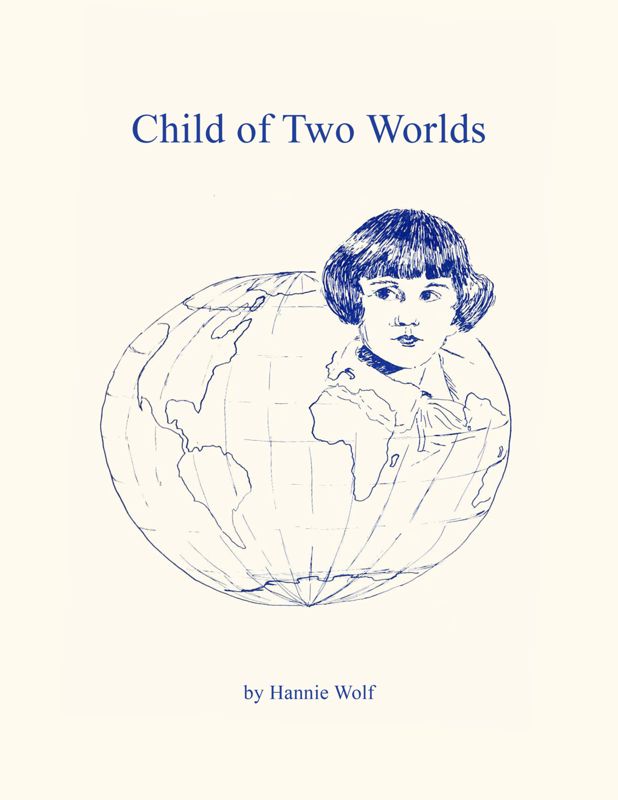
Child of Two Worlds
by Hannie Wolf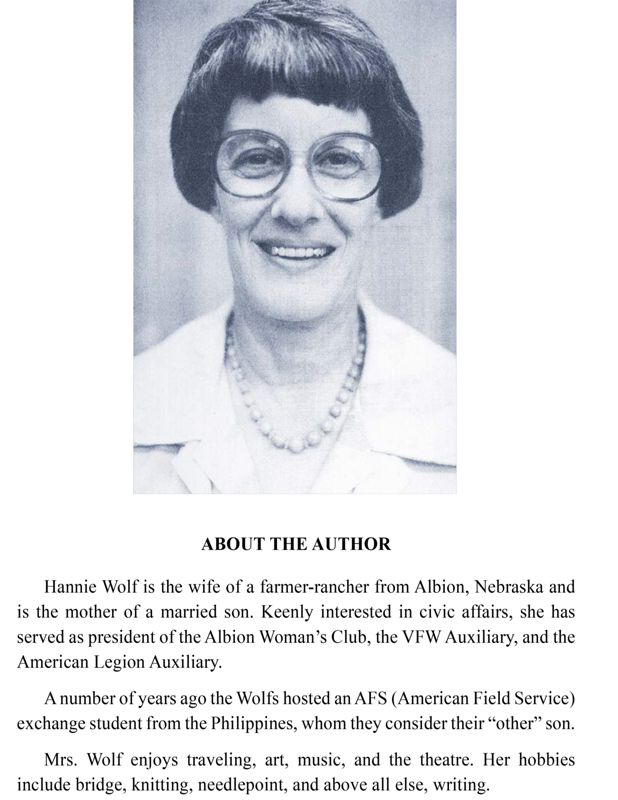
ABOUT THE AUTHOR
Hannie Wolf is the wife of a farmer-rancher from Albion, Nebraska and is the mother of a married son. Keenly interested in civic affairs, she has served as president of the Albion Woman’s Club, the VFW Auxiliary, and the American Legion Auxiliary.
A number of years ago the Wolfs hosted an AFS (American Field Service) exchange student from the Philippines, whom they consider their “other” son.
Mrs. Wolf enjoys traveling, art, music, and the theatre. Her hobbies include bridge, knitting, needlepoint, and above all else, writing.

ISBN No. 0-931068-02-9 Library of Congress Catalog Card Number: 79-91929 Published by Purcells, Inc. 305 South 10th Avenue, Broken Bow, Nebraska 68822 First Edition, December, 1979 Copyright by Hannie Wolf All rights reserved. No part of this book may be reproduced in any form without the written permission from the publisher, except brief passages included in a review appearing in a newspaper or magazine.
REFERENCES:
All pictures are from the many photo albums, scrapbooks and autograph books I collected in my youth. The photographs of Ulm were taken prior to World War II.
Family, friends and teachers signed their autographs along with messages appropriate to the times we lived in. Often the pages were enhanced with personal photographs, silhouettes, cut-outs or drawings by the artistically inclined.
This is a sampling of the prose I discovered while gathering material for the book:
- 1. Memory is a Paradise form which we cannot be driven.
- 2. In sorrow and joy as the days unfold, Always remember your friends of old.
- 3. Put on a happy face in times of stress. In times of joy be serious. Much you will achieve this way. As you learn from day to day.
- 4. Worldly goods can be bought – Friends only and friendship nought.
- 5. To have a friend – first learn how to be one. Perhaps the best one of them all was:
- 6. “YOUTH IS A BUNDLE OF ILLUSIONS.”
FOREWORD
I am a child of two worlds, European by birth, American by choice. My generation is known as “the refugees”. We are the people no one wanted, the wandering Jews, the survivors of the Nazi era. Many of us are still walking on earth looking for a home.
The memory of my childhood is there to haunt me. Often I wonder why I survived when family and friends perished.
This is the story of my life as I lived it many years ago.
I dedicate this book to the memory of my beloved grandmother, Emmy Metzler Frankfurter and to the millions who, like her, perished during the Holocaust.
ACKNOWLEDGEMENTS
My thanks to four very special people: my mother, Hilde Baer, for her help in recalling various incidents; my husband, Bob, and my son, Bill, for their words of encouragement; and last, but by no means least, my daughter- in-law, Marilyn, for her illustrations. Without their support this book could not have been written.
Excerpts from “The Holy Scriptures” are copyrighted by and used through the courtesy of the Jewish Publication Society of America.
PROLOGUE
“Memory is the treasury and guardian of all things.”
Cicero 80 B.C.
TABLE OF CONTENTS
Chapter I The Gathering Storm
Chapter II Journey to Freedom
Chapter III The Snug Harbor
Chapter I
THE GATHERING STORM
“The Lord hath made every thing for his own purpose – yea – even the wicked for the day of evil.”
Proverbs 16:2-4
The 20th Century was still young. The war to end all wars was over. Peace had come at last, or so it appeared.
In our part of the world it was still customary for marriages to be arranged, along with a sizable dowry for the bride. It was not so for Mama and Papa. Mama was the daughter of Eugen and Emmy Frankfurter. Eugen died in 1912 of pneumonia when Mama was only nine-years-old. Emmy was a shopkeeper in the city of Dillingen on the Saar. Since this territory was forever torn between France and Germany, Mama never quite knew whether she was French or German.
Determined that her daughter receive a good education, Emmy dug into her
Child Of Two Worlds 1 by Hannie Wolf
 meager savings and sent Hilde, her only child, to the “Pensionat Rothschild” in Munich. It was a finishing school for young ladies. Mrs. Rothschild, the matron, was both feared and adored by the girls, who flocked to her school from all over Europe. A beautiful and striking girl, Mama had ivory skin, coal black hair and sparkling brown eyes. Her favorite pastime was dancing. At the New Year’s Eve parties there was always a contingent of Americans, and at midnight everyone rose to sing “Auld Lang Syne”. It was not until many years later that Mama discovered this tune was not the American National Anthem!
Her closest friend at school was Carrie Baer, the blonde, blue-eyed daughter of Charlotte and Lazarus Baer, prosperous grain merchants from Kuenzelsau. Mama delighted in Carrie’s large family. There were four brothers, Jack, Sigbert, Felix and Ben, and sister Ruth. Felix adored his baby sister Carrie. He made frequent trips to Munich and showered Carrie and her friends with candies, flowers, gifts, and fell in love with Hilde. He was already well- established in the family grain business founded by his ancestor, Jakob Baer in Hohebach in 1820, when they married in Dillingen on December 26, 1923 after a brief courtship. Felix was 29 and Hilde was 20.
They settled in Ulm, a medieval city on the river Danube in southern Germany. The city’s best known landmark is its Gothic Minster, which has a church spire that soars to a height of 528 feet, the tallest in the world. Originally a Catholic church, it became a Protestant church during the Martin Luther Reformation. It took 513 years to complete the cathedral, from 1377 to 1890. Although most of the city was destroyed during World War II, the cathedral remained standing.
Ulm was a city rich in tradition. Not only did Ulm cherish the past, it lived it as well. Many yearly events dated back to the 15th Century. (Best known was the “Ulmer Fischerstechen” Stabbing with Fishing Spears.) This was a tournament held annually by the descendants of fishermen and sailors. They would climb into small fishing boats and sail along the Danube river,
Child Of Two Worlds 2 by Hannie Wolf
 all the while stabbing at each other with fishing spears to see who could stay afloat the longest in
the rough current of the waters. The prize went to the one who remained in his boat the longest. However, it usually ended with all of the participants, dressed in historical costumes, going for an involuntary swim in the cold river. Preceding the contest, the “Fishermen’s Ballet” was performed. This re-enacted the story told about two fools who tried to seduce a farmer’s wife. Folklore has it that on this day every fool in town could do just as he pleased.
all the while stabbing at each other with fishing spears to see who could stay afloat the longest in
the rough current of the waters. The prize went to the one who remained in his boat the longest. However, it usually ended with all of the participants, dressed in historical costumes, going for an involuntary swim in the cold river. Preceding the contest, the “Fishermen’s Ballet” was performed. This re-enacted the story told about two fools who tried to seduce a farmer’s wife. Folklore has it that on this day every fool in town could do just as he pleased.
Another holiday was the “Schwoermontag” (Monday of the Swearing In), which was celebrated in August. This event dated back to the days when the mayor of the city, who was elected annually, took his solumn oath of office. The entire ceremony was re-created in front of the City Hall. Afterward, a swimming contest, called “Nabada”, was held in the Danube river.
Once a year a delegation from the city of Ulm took off on a good-will cruise to Vienna on a barge, named “Ulmer Schachtel” (The Box of Ulm), to commemorate the days of old when all passengers and freight were transported by barge from Ulm along the Danube river to the Black Sea.
It was in Ulm that man first attempted to fly. A tailor, by the name of Albrecht Ludwig Berblinger, attempted to fly a sailplane closely resembling a hang glider of today on May 30, 1811. He failed, but a historical marker stands to honor his effort. Ulm’s most illustrious citizen, however, is the world-renowned scientist, Professor Albert Einstein, the father of the Atomic Age. He was born there on March 14, 1879.
Amid this tranquil setting, Felix and Hilde Baer established their first home. The future looked promising. Both were good mixers and had many friends. I was born on December 30, 1925. My parents named me Hanne Lore, and I was to be their only child. They had great plans for my future. I was to be sent to the finest schools. Papa was going to work hard so he could retire at an early age and enjoy his family. All this was not to be though. Papa
Child Of Two Worlds 3 by Hannie Wolf
 found neither the time nor the money for retirement, and I completed barely 10 years of schooling.
Our home was an obscure third floor apartment with large and cold rooms. There was an entryway called the “Diehle” or hall, which was furnished with wicker chairs and a sofa on which no one ever sat. In one corner was my play desk. Our living room had a pot belly stove and was used as a “keeping” room. Most of the furniture was made of solid black wood. There was a sofa and easy chairs, a large sideboard and a cupboard with mirrors. A bird cage stood on the cupboard ledge. We always had canaries names “Hansl”, who spent more time outside the cage than inside. Usually “Hansl” sat in front of the mirror admiring his image. When dinner was served “Hansl” flew at top speed to the nearest dining room chair, perched himself on the back of the chair and waited patiently for tidbits Papa would feed him .Before dinner was over, “Hansl” could be found sitting on Papa’s shoulder, eagerly sharing a meal. My games and toys were housed in the black cupboard, but of all my playthings I preferred the large miniature kitchen which Papa had built for me. It was complete with a stove, table, chairs and sink. There were lace curtains at the windows, and miniature copper pots and pans hanging from the walls. I whiled away many a winter day playing the role of the happy homemaker as I served imaginary food from miniature dishes in my little kitchen.
We ate and relaxed in the family room. On winter mornings I would rush from my bedroom to dress in front of the pot bellied stove. To keep the cold out we covered the window wills with blankets. In cold weather Mama would bring a tub of hot water into the living room and bathe me in front of the stove and wrap me in large towels to dry. We slept under down quilts and wore bedsocks. Our beds were warmed with “bed warmers”, oval-shaped copper vessels into which hot water was poured.
My room was small. It contained a white bed and a white wardrobe closet. In damp weather the steam kettle was always going to clear up my chest from
Child Of Two Worlds 4 by Hannie Wolf
 the bronchitis that annually troubled me. There was a lovely view from the window toward the distant
hills.
the bronchitis that annually troubled me. There was a lovely view from the window toward the distant
hills.
My room adjoined Mama and Papa’s bedroom. On Sunday mornings I delighted to crawl into their big bed where I could feel secure in a safe shelter.
My grandmother, Emmy, whom I call “Oma” spent much time with us. She had the guest room, which became a favorite room for me. She and I spent many hours together. I was her only grandchild, and there was a warm bond between us. A precocious child not given to physical prowess, I was a dreamer who enjoyed writing poetry and fiction. Words flowed easily through my pen. I had a fine command of the German language and vowed someday to become a writer. Oma encouraged me in this endeavor. As most women of her generation, she was adept with needle and thread. From her I learned how to knit and embroider.
The dining room in the apartment was off limits to me, except on rare occasions when we entertained guests. The room was not heated and was always cold. There was a buffet, which housed fine china and glassware, a large table and chairs, a glass tea cart with brass legs, and a piano. Mama would sit down and play at times, but she preferred playing the lute, a guitar-like instrument. In the dining room Mama entertained her ladies’ bridge club. On the days Papa was home, they shared after-dinner coffee, which they sipped out of the silver and china mocha cups Papa had given Mama as an engagement present. Afterward they enjoyed a game of “patience”. (Solitaire)
Papa’s den was called the “Herrenzimmer”, a room for men. There was a large walnut desk and chair, leather upholstered furniture and a glass bookcase housing his library. There were the complete works of Schiller and Goethe, Tolstoy and Dostoyevski, plus a German translation of the works of Shakespeare. There was also a well-stocked bar. A near teetotaler, Papa served his excellent brandies and liqueurs to the customers who came to call on him. Much trading was done in this room over a glass of cognac. Papa had
Child Of Two Worlds 5 by Hannie Wolf
 a pleasing personality, a good sense of humor and was admired and respected in the community, both
for his ability and his integrity.
a pleasing personality, a good sense of humor and was admired and respected in the community, both
for his ability and his integrity.
Our kitchen had a gas and wood stove, a table and a stone sink. The floor was also made of stone. It was not customary to have built-in kitchens. They were bought separately along with the rest of the household furniture. Mama had beautiful cupboards, which she sold with a heavy heart prior to leaving for America. She just knew she would never have such a nice kitchen again.
There was a pantry for storing things and a large box, called the “Kockkiste”, the forerunner of today’s slowcookers. Raw eggs were preserved by putting them into large stone crocks and covered with a clear liquid, called “Wasser Glas” (water glass). This solution turned into a clear, slimy jelly which kept eggs fresh for months.
On the veranda we stored cleaning supplies and hung towels to dry.
Down the hall was the water closet. When the plumbing worked, we had an indoor toilet.
Our apartment was spacious and had such high ceilings that a portable swing hung from the entryway into the kitchen. When there was little activity going on, I was permitted to swing to my heart’s content. My friends and I always had a contest as to who could swing the highest without missing the ceiling!
Our building had a basement, under which was a deep cellar. Tenants were given storage space to keep canned goods, fruits, vegetables, wines, coal and wood. There were few conveniences, but we were happy in our surroundings.
In Ulm the fog began rolling in about September and did not leave until Spring. The spire of the Minster was shrouded by a veil of fog - and we rarely saw the sun.
I had my “annual” bouts with bronchitis, sore throats and ear infactions.
Child Of Two Worlds 6 by Hannie Wolf
 The steam kettle was puffing away in my room, and I spent many hours in the office of our pediatrician, Dr. Neuhaus, who had me sitting under an ultraviolet lamp for hours on end. He prescribed vacations in a “Kinderheim” (children’s camp) in the mountains. I have little recollection of those days, except that for some reason we were served blueberries with every meal. They provided a source of energy and grew in profusion in the nearby forests. It seemed my lips, tongue and teeth were stained purple for months after my annual visit.
I was a light eater, but when it came to the specialty of our region, lentils served with spaetzli, I never knew when to stop eating. Once I became so ill, Mama had to call the good Dr. Neuhaus and inform him I was suffering from appendicitis. As it turned out, I had stuffed myself to the extent that my stomach nearly burst, but there was no sign of an infected appendix.
My best girlfriend was Rosemarie Lang. She used to visit her maternal grandparents who lived in the apartment above ours. When her father died in 1930, she and her mother moved in with her grandparents. Rosemarie was then six years and I was five.
Rosemarie and I were inseparable. After spending most of the days together, we discovered a unique system of communicating before retiring at night. The tub in our bathroom, which consisted of a sink, gas hot water heater and tub, was directly below theirs, and we found that the water pipes which connected the two bath tubs could be used as a “telephone”. Not only did we talk incessantly every evening, we also had a contest as to who could gargle the loudest when brushing our teeth. In later years this “telephone” became our secret means of communicating with each other.
Another friend was Fanny Ulrich, who lived nearby. Ten years older than I, she looked after me like a sister.
Our teachers were strict disciplinarians. Miss Gertrud Grauer taught us everything from reading and writing to arithmetic. A tall spinster, she wore
Child Of Two Worlds 7 by Hannie Wolf
 her long hair pulled back severely in a bun. She was genuinely devoted to her profession. The children loved and respected her. When one of our classmates became ill and died of leukemia, she showed great compassion and taught us that dying is part of living.
Easter signaled the beginning of spring, as the first flowers timidly raised their tiny heads out of the moist ground. Tulips followed the crocus, jonquils and daffodils, and the morning dew bathed the delicate new grass. We went to the neighboring gardens to catch and cuddle tiny Easter rabbits and hunt for Easter eggs, which came in all sizes and varieties. There were real eggs, as well as candy and chocolate-covered eggs. Papa often surprised me with a stuffed bunny and the largest chocolate bunny he could find. Some bunnies were made of hard candy on which we sucked for days, but my favorite bunnies were the ones made out of semi-sweet chocolate.
The Passover Holidays became more meaningful each year as we repeated the story of the exodus of the Jews from Egypt and their freedom from slavery. The phrase, “Next year in Jerusalem” turned into the wish that “next year we hoped to be free.”
May was the nicest time of year, which we celebrated by collecting the huge “Maikaefer”, a distant cousin of the June bug. We stuffed cigar boxes with leaves, punched holes in the cover and tried to see who could collect the most bugs.
On weekends there were picnics in the country. We looked for four-leaf clovers, lilies of the valley, pussy willows and wild strawberries. Papa strung out a hammock, and Mama spread food before us on a blanket. Mama entertained us with her lovely soprano voice, accompanied by her lute. Papa joined her with his tenor voice, and I chimed in with the high soprano. We created our own pleasures and were content with our lot.
For excitement there were the fairs which were held twice a year on the Minster Square. The fairs had the usual midway attractions, the merry-
Child Of Two Worlds 8 by Hannie Wolf
 go-round and a ferris wheel. We munched on confections called “Turkish honey”. Inside booths one could see all types of freaks, including a beaded lady, Siamese twins, midgets, giants and sword swallowers. There were slides featuring worldwide catastrophes. I was mainly impressed with scenes of earthquakes, since earthquakes frequently occurred in our area. Now and then we were awakened in the middle the night to find the bed shaking and the furniture moving about.
There were weekly markets where merchants peddled their wares and farmers sold fresh produce and flowers.
Often we climbed the circular stairway leading to the top of the Minster. At a dizzying height one could see the full magnificence of this Cathedral and obtain a bird’s eye view of the city below. In the Cathedral proper there were daily organ recitals. The sound of this powerful organ sent chills down our spines. We felt chilled not only from the cold temperatures inside the huge Sanctuary, but also from the emotion.
In the fall of the year the taste of apple cider wafted the air. It mixed with the odor of cabbage being made into sauerkraut by the local green grocer.
Always during the Holiday Season we children were treated to a performance for young people which consisted of a fairy tale or a ballet. We eagerly looked forward to this once-a-year treat. Ulm was noted for its excellent theatre. The famous director, Max Reinhart, who was a good friend of Papa’s, received his start there. The music conductor, Herbert von Karajan, also made his debut in Ulm.
Santa Claus did not bring presents on Christmas, rather they were delivered by the Christ Child. Santa Claus did pay a visit every year on St. Nicholas Day, December 6, and he was always accompanied by his faithful servant, “Knecht Ruprecht”, who carried a large knapsack on his back, out of which protruded a pair of legs, clothed in white stockings. We were asked if our behavior had been good during the year, because if it hadn’t, we would
Child Of Two Worlds 9 by Hannie Wolf
 meet the same fate the child in the white leggings had met. Since none of us wanted to suffocate in the knapsack, we assured Santa Claus that all of us had been good and had dutifully minded our parents.
We Jews did not have Christmas trees. Not to be denied the Christmas celebration, I spent every Christmas Eve at the home of my best friend, Rosemarie Lang. There was always a huge Christmas tree with lots of presents. We gathered around the piano and sang Christmas carols. In turn Rosemarie shared the Hanukah Festival (Feast of Lights) with us. We lit the candles on the “Menorah” (candelabra) and sang “Rock of Ages”. This was always followed by a gift exchange and the playing of Hanukah games. All the while we munched on nuts, fruits and sweets.
My birthdays were always celebrated with parties. Mama baked my favorite cake, a marble cake made in a bundt pan. Then my friends and I sat spellbound as we watched pictures flash on a screen from a kerosene projector, called “Laterna Magica”. The show was always short-lived, as the projector fumed and smoked and blotted out the view.
The early movies held us spellbound. We stayed in our seats and watched the pictures come toward us. We laughed at Charlie Chaplin and Mickey Mouse. Every child owned a Mickey Mouse watch. It was also the day of fame for Shirley Temple and Deanna Durbin.
My uncle Ben lived in Philadelphia, Pa., and worked for a clothing manufacturing company. It was a red-letter day when his parcels arrived. There were always Deanna Durbin and Shirley Temple dresses for me, and I was the envy of every girl in the town when I wore my “American” dresses. Uncle Ben also supplied us with yard goods.
Ice cream parlors were always owned by Italians. Our ice cream man was “Giuseppe Dall’ Asta”. We would sit in his little shop on wrought-iron chairs around little round tables and munch on delicious ice cream cones or ice cream sandwiches.
Child Of Two Worlds 10 by Hannie Wolf
Coffee houses tempted us with confections. There were hundreds of cakes, tortes, pies and cookies to choose from.
Bread was baked in huge outdoor ovens. We would set the dough at home and then take it to the baker for baking in his large ovens. His shop was always filled with pastried, breads, rolls and pretzels. Other specialty shops tempted us with cheeses and herring, and the butcher shows hung full of delicious sausages.
In my childhood days we counted the prosperity of a city by the size of its railway terminal. Ulm was a large railroad center. We spent many hours at the station, watching fashionable ladies and gentlemen alight from the platforms, the ladies often carrying small dogs. Now and then the famous Orient Express whizzed through town. Anyone riding on that train surely had to be very rich, so we children thought.
Each spring Mama got the urge to do the annual housecleaning. This literally meant emptying the entire apartment. All the furniture was taken out of the rooms, the bedding was aired, and the carpets were taken into the backyard, strung over a steel rod and literally “beaten to death” with a carpet beater.
It was at that time Papa decided to be gone for a few weeks on an annual business trip. His business made it necessary to travel frequently. He had a chauffeur who would usually be found sitting in the backseat of the car sleeping, while Papa took the wheel.
Once he and Mama bought a motorcycle with a back seat and decided to go on an outing. Papa had ridden quite a distance when he turned around to talk to Mama, only to discover she had fallen off the seat several miles back. That was the end of Papa’s motorcycle. Mama did learn to drive a car and was one of the first women in our town to obtain a driver’s license.
Once a month the “washerwomen” arrived at the apartment to help with the laundry. This was a tedious process. The boilers in the basement needed
Child Of Two Worlds 11 by Hannie Wolf
 to be stoked the night before, so there would be plenty of hot water in the washtubs when the linens
had to be boiled the next day. In good weather the laundry had to be carried in wicker baskets to a neighbor’s yard where the laundry had to be strung on the clotheslines. In inclement weather the laundry was hung in the attic for drying.
to be stoked the night before, so there would be plenty of hot water in the washtubs when the linens
had to be boiled the next day. In good weather the laundry had to be carried in wicker baskets to a neighbor’s yard where the laundry had to be strung on the clotheslines. In inclement weather the laundry was hung in the attic for drying.
A few days later it was time for the “ironing lady” to come in and help with the ironing which took another day or two. The irons had to be heated with briquettes and warmed on the stove.
There was little ready-to-wear clothing. Frequent trips to the dressmaker had to be made or the dressmaker would come to your house where she would sew our garments.
Life was simple but good in those days. Mama laughed when she recalled having been told her fortune by a gypsy woman in her youth. The gypsy told her that life would change drastically for her in the future. She would eventually sail across the ocean in search of a new life. The only places Mama had ever been to was Switzerland during her honeymoon and a few brief vacations in Austria.
There was a crisis at our house once. Mama had engaged a pretty young housemaid who was to look after me one Saturday night while she and Papa went to a nightclub. The maid entertained me alright – along with a few of her boyfriends. We had great fun playing a game of “show and tell”, with me showing and telling them where Mama kept her jewelry. When my parents arrived home that evening, the front door was unlocked. The maid and her friends had departed along with all of Mama’s precious belongings.
When my grandmother Emmy was not living with us, she engaged in various enterprises. During the 1930s she purchased a franchise in Munich in a quick pastry shop, named “Blitzback Betrieb”, no doubt the forerunner of today’s “Doughnut Shops”. Sampling the many deep fried goodies became my favorite pastime during our frequent trips to Munich. The bakery was located
Child Of Two Worlds 12 by Hannie Wolf
 near the Town Hall, where I would watch in fascination the animated musical clock on the tower. I enjoyed feeding the pigeons on Odeons Square. We always stayed in the suburb of Schwabing and enjoyed the parks, museums, castles and churches in Munich and the surrounding area. Occasionally we went to the “Oktober Fest”, and sometimes we ate a meal in the famous “Hofbraeu Haus”. Of all the cities in Germany, Munich was the prettiest.
Summertime often meant a trip to the mountains of Austria or an excursion to visit castles in Bavaria. To this day I like to recall the grandiose splendor of an era long past. In winter we went sledding or skiing in the nearby Swabian Alps.
There are many spas in Germany, and we did our goodly share of visiting a number of them. I traveled to Baden-Baden once with my parents to visit my grandparents who were “taking the baths”. It was known as the most fashionable spa in Germany, where one could enjoy the mineral springs, gamble in the casino or listen to a concert in the Kurpark, but I recall only groups of elderly people and the taste of the bitter waters in my mouth.
However, I enjoyed our jaunts to “Bad Woerishofen”. It was here that the German priest, Sebastian Kneipp, founded a system of hydro-therapy and wrote a book entitled “My Water Cure”. He also invented a sandal known as the “Kneipp Sandalen”. These sandals were supposed to cure all foot ills. We bought our share of these shoes, and to this day I can feel the soft touch of the meadows under my sandal-clad feet.
This was also the age of airships. On our numerous trips to nearby picturesque Lake Constance, which borders on Austria and Switzerland, we never failed to stop in Friedrichshafen to visit the huge hangers at the Zeppelin Airship Building Company. It was here that Count Ferdinand von Zeppelin built the first airships, known as the “Zeppelins”. I can still see these immense airships floating gracefully over our city. They cruised at an amazingly low altitude, very quietly, right above our windows. Many a day and night we
Child Of Two Worlds 13 by Hannie Wolf
 watched the “Gaf Zeppelin” and later on the ill-fated “Hindenburd” begin their flights to overseas destinations.
Often we visited Papa’s parents in Kuenzelsau. They lived in a large house in the upstairs apartment, and Grandfather’s widowed sister-in-law, Aunt Regina Baer lived downstairs. She had raised a large family of 14, and now raised flowers, plants and cacti by the dozen. Sometimes we got to stay up at night to watch her prize flower, “Queen of the Night’ bloom. This rare plant bloomed only at night and on very rare occasions.
Grandmother Charlotte’s sister, Mina Schulherr from Neustadt on the Eich was a frequent visitor to Kuenzelsau. I always hoped she would be there when we visited, because she brought along her own waffle iron on which she baked the tastiest waffles imaginable.
Papa’s brother Sigbert Baer and his wife, Lisl, lived in a villa in Kuenzelsau. Having no children of their own, they doted on all their nephews and nieces. Papa’s cousin Siegfried Baer and his wide Lotte lived on the same street as my grandparents in Kuenzelsau. Siegfried was a partner in the family business, while his wife was a non-practicing physician. Lotte and her children, Miriam and Emmo, taught us how to pick wild edible mushrooms in the nearby forests.
Grandmother Charlotte had been a pretty girl, but the years of child-bearing and hard work had taken its toll. She, like many people living in that ares, suffered from a goiter. To his her swollen neck, she wore dark dresses with high collars. She always wore a huge apron.
Grandfather Lazarus was an imposing figure. As a child he fell off a wagon and fractured his leg. It was not properly set. He walked with a bad limp and had to wear an elevated boot for the rest of his life. It was the rule of his house that all food placed on your plate had to be eaten and children should be seen and not heard.
Grandmother’s dining room table was always crowded. There was Aunt
Child Of Two Worlds 14 by Hannie Wolf
 Carrie with her husband Otto Loeb and their two children, Susan and Laura. Uncle Otto was a wine merchant from Andernach, on the Rhine. Aunt Ruth, her husband, Willie Fleischmann, and their two children, Edith and Fred, from Augsburg were frequent visitors. Then there was Uncle Jack, his wife Ilse, and their two children, Marion and Ed. They lived in Emmendingen in the Black Forest. I have many fond memories of visiting Aunt Ilse’s mother, Camilla Neumann, who lived in a large and beautiful home, surrounded by a garden at the foot of the Black Forest. I dreamed of someday living in just such a home.
It was fun to snuggle under Grandmother’s feather beds. I always slept in the bedroom next to my grandparents’ living room and kept my ears glued to the door, eavesdropping on the grown-ups’ conversations.
My grandparents had a large sun porch filled with books. I would while away the hours reading James Fenimore Cooper’s “The Leather Stocking Tales” and “The Last of the Mohicans”. This was my first introduction to the American Wild West.
Among Mama’s relatives we visited were Uncle Max Metzler and his beautiful wife, Johanna. After Uncle Max became a widower, he was a frequent visitor to our home. He was the patriarch of Mama’s family. It seemed his favorite food was soft boiled eggs, which he downed with gusto every morning. Around his neck he would wear a white napkin fashioned like a bib, and I would sit and watch in fascination as the egg yolks dribbled down his white beard and festooned themselves in it. Uncle Max’s beard was always spotted with yellow flecks.
Then there was Papa’s old maid aunt, Luise, from Dettensee, who always arrived at our house dressed in her Sunday finery, and wearing a black hat. She usually slung a wicker basket over her arm, containing her pet chicken which was her perennial companion.
In no other country were the Jews assimilated as in Germany. In every
Child Of Two Worlds 15 by Hannie Wolf
 aspect of life we were Germans. We practiced Judaism as a religion, the same as our neighbors practiced their Christian religion. Our social life did not evolve around the Church or the Synagogue. Houses of Worship were used only for praying. Our friends came from all walks of life and numbered Jews, Catholics, and Protestants. Germany was the land of poets, musicians and artists and was one of the most highly civilized nations in the world. Culture oozed from its very veins.
We were vacationing in Bavaria in January, of 1933 when Adolf Hitler was appointed Chancellor of Germany. He was full of promises for his people. In his loud staccato voice and foreign accent, he led everyone to believe that from now on they would be living in Utopia. On every wall slogans were posted, reading “Kraft Durch Freude” (Strength Through Pleasure). Like Dr. Faustus who promised eternal youth, Hitler mania was sweeping the country with a euphoria never seen before. Adolf Hitler built the “Autobahn”, the forerunner of today’s freeways. He built huge ships to take workers on holiday cruises. No one realized that the superhighways were built to provide military transportation, and that the pleasure ships were in effect naval vessels.
Germany’s past misfortunes were blamed on the hapless Jews. We became the scapegoats and victims of unbelievable cruelties. Our circle of friends grew smaller. Christians were forbidden to associate with Jews and the stores and restaurants posted signs forbidding Jews to enter. Members of the Hitler youth were taught to spy on their parents’ activities.
However, my friendship with Rosemarie, a Catholic, remained undaunted. We had our secret meeting places and swore that no one was ever going to destroy our friendship.
It became increasingly difficult for Papa to conduct business with his customers, since most of them were afraid to talk with Jews for fear or reprisal. We children learned to walk in groups because it was safer that way. It was not uncommon to be called “Dirty Jews” and to have youths spit in our
Child Of Two Worlds 16 by Hannie Wolf
 faces, throw rocks at us or use obscene language.
Somehow we endured such goings on with great patience and held our heads up high. In time we formed our own sports organizations and music clubs where we played the latest American jazz. And there was the theatre where our fantasies came to life. All of us learned to act. Life became a stage.
Papa, always outspoken, was arrested when one of his so-called friends turned him into the police. He was in a local cafe with others when Hitler’s voice boomed over the radio. Papa asked for the radio to be turned off because he could not stand to listen to that fool. Papa’s picture then appeared in the Nazi newspaper, “Der Stuermer” under the heading, “Der Juden Haeuptling” (The Chief of the Jews).
Our Jewish friends of Polish descent were sent to Poland for so-called resettlement. We never learned what happened to them.
The Gestapo came to our apartment frequently, always at night, always unannounced. They would ring the doorbell, click their heels and search our home. Once they tore a grandfather clock apart searching for weapons. If they found something to their liking they would confiscate it with the pretext of “putting it into safekeeping” for us. Of course none of the items were ever returned. For many years the sound of a doorbell sent shivers down my spine, and I trembled at the sight of a policeman.
We did not venture out often since most places were off limits to Jews. Our little canary provided us with many happy hours. His singing and comic antics brought a bit of cheer into our drab lives.
By then Grandmother Charlotte had been widowed and it was decided that she and Grandmother Emmy should live closer to us. (My grandfather died in 1936.) The two of them found an apartment nearby where we could keep an eye on them.
Eventually we Jewish children were no longer allowed to attend public
Child Of Two Worlds 17 by Hannie Wolf
 schools or associate in any way with the youth of the country. Not to be denied an education, we
Jews started our own schools. Our school was housed next to the Synagogue, which became the hub of all our activities. The faculty consisted of our religious leaders. We began living a ghetto-like existence, yet we children never felt deprived.
schools or associate in any way with the youth of the country. Not to be denied an education, we
Jews started our own schools. Our school was housed next to the Synagogue, which became the hub of all our activities. The faculty consisted of our religious leaders. We began living a ghetto-like existence, yet we children never felt deprived.
In the past our friends were both Christians and Jews. Now we became solely dependent upon one another. My best girlfriends were Edith Weil, Bobby Hirsch, Marianne Leiter and Ilse Guggenheimer. Both Edith and Bobby died during the Holocaust. Marianne and Ilse found new homes in the United States.
Always a religious person, I entered into the Jewish studies with a great deal of zest. I envisioned myself as a Rabbi or Cantor, but since there was no place for women in such professions, I practiced my skills in the sanctity of our home.
Above the Synagogue’s entrance it said, “MY HOUSE SHALL BE A HOUSE OF PRAYER FOR ALL PEOPLES.”
The Synagogue became our refuge. We looked to our Rabbi, Dr. Julius Cohn, to guide us through trying years. Under intense Nazis pressure he fled to England in April, 1939. He died in London in March, 1940.
Our Synagogue had a main floor. The men sat in the middle, the children on the sides and the women in the balcony. Since Mama and I sang in the choir, we had the privilege of sitting in the choir loft. We were not permitted to enter the sanctuary without covering our heads. One day when our absentminded organist showed up wearing one hat on top of another, we thought he was carrying things a bit far.
Every so often an elderly scribe, “Lehrer Berlinger” (teacher Berlinger) from Buttenhausen, which had a good sized Jewish congregation, came to our school to give us examinations. During his visits to Ulm he always stayed at our house. Keeping strict dietary laws, he ate only eggs and dairy products.
Child Of Two Worlds 18 by Hannie Wolf
 To me he looked like Moses, and Mama said she felt awed by this holy man’s presence.
One of the best pupils in our school was young Otto Eckstein, who in later years was to become one of President Lyndon Johnson’s economic advisers, and today is one of this country’s leading economists. Otto’s problem was that his handwriting was difficult to decipher. My problem was the opposite.
I was meticulously neat with my penmanship, but the simplest arithmetic eluded me. The old scribe walked over to Otto’s desk with the words, “When you grow up, young man, buy yourself a typewriter.” Then he proceeded to my desk, gently patted me on the shoulder and whispered, “Young lady, someday you will have to buy yourself an adding machine.”
Disaster struck on November 7, 1938. Hershel Grynszpan, whose parents were among the Jews deported from Germany to Poland, assassinated Ernst von Rath, the Third Secretary of the German Embassy in Paris. As a reprisal the Nazis set off a night of plunder and burning. November 9, 1938 became known as the “Kristallnacht” (night of broken crystal and glass). There were anti-semitic riots all over Germany and Austria. Jewish businesses were looted and burned. Windows were broken and nearly all synagogues were burned to the ground.
The Synagogue in Ulm fell victim to the Nazis. As flames engulfed the building, the walls of the foundation were so strong they refused to topple. All that remains of this tragic event is a beautiful plaque engraved in the old walls. This plaque is the property of the Ulm City Archives and serves as a constant reminder to the citizens of Ulm and all those who pass by. Translated into English, it reads, “On this site stood the Synagogue. It was built in 1873 and during the persecution of our Jewish fellow citizens destroyed on November 9, 1938.” Today a savings and loan association is housed there.
Papa carried with him to America a small fragment of the synagogue in Ulm. A member of the congregation saved a few pieces of the stones out of
Child Of Two Worlds 19 by Hannie Wolf
 which the synagogue was built. He wrote in ink on the stone, which reads, translated to English,
“This stone tells of suffering and pain. November 9, 1939.” The stone is now on permanent display at Temple Israel in Omaha, Nebraska.
which the synagogue was built. He wrote in ink on the stone, which reads, translated to English,
“This stone tells of suffering and pain. November 9, 1939.” The stone is now on permanent display at Temple Israel in Omaha, Nebraska.
During the riots, male Jews were arrested and sent to concentration camps. Papa, while wearing only his night clothes, was taken from his bed to be interrogated at the police station. His only crime was being a Jew. Mama ran to the police station carrying some warm clothing. Her pleas for his release went unheeded. He was sent, along with others, to the concentration camp in Dachau where he remained for many weeks. While at the concentration camp he had a sad reunion with his brother Sigbert, who was arrested that same night in his hometown of Kuenzelsau. After Papa was jailed on November 9th, the family living in the apartment below offered us shelter and food at their own risk. Mama refused their kind offer because she wanted no harm to come to them.
To obtain Papa’s release from Dachau, proof had to be furnished that he served in the military during World War I. Mama frantically searched our apartment for his military papers. By accident she found them in our bookcase stuffed between the pages of a Dostoyevski novel. Papa was reunited with us in December 1938 on the first night of the Festival of Hanukah. Ironically this festival celebrates the victory of the Jews in their fight for religious freedom from their Greek overlords.
Papa was thin and gaunt when he returned from Dachau. He suffered from boils, his body was ailing and his spirit broken. From that time on he lived alone with his thoughts. Perhaps wanting to spare us the horror, he never divulged any of his experiences in the concentration camp. He took those secrets with him to his grave.
Before Papa’s sister Ruth, her busband Willie and children Edith and Fred emigrated to America, I had been allowed many times to travel by myseld on
Child Of Two Worlds 20 by Hannie Wolf
 the train from Ulm to Augsburg to visit them. Those were my best vacations. Aunt Ruth and family showed me such a wonderful time that I never wanted to return home. I missed them a great deal when they went to America.
One of Mama’s relatives, Ernst Wolf, lived in Bingen. My parents consented, and in August of 1939 I traveled by train to the Rhineland. Ernst was a widower and was raising his daughter Marian by himself. Like every tourist I cruised along the Rhine in a boat to view the many vineyards, the ruins of once populated castles and to catch a glimpse of the rock “Lorelei”, made famous by the German poet, Heinrich Heine.
I arrived home shortly before the outbreak of World War II. It was to be my final holiday in Germany. I would never see Ernst Wolf and Marian again. They perished during the Holocaust.
It soon became apparent that our days in Germany were numbered. The situation for the Jews deteriorated rapidly. We pleaded for help, but the world turned a deaf ear on our plight. Only those fortunate enough to have relatives living abroad would have a chance to escape.
The Nazis confiscated our family grain business, along with most of our possessions. Papa had to give up the car. Nearly destitute, he found a job in a nearby greenhouse, and each morning would pedal off to work on his bicycle.
Many people in Germany do not have middle names. However, the Nazis saw to it that every adult Jew was given a middle name. All males were named “Israel”, the females “Sarah”. This was to distinguish the Jews from the Christians.
Some Jews emigrated to Englad, Australia, Canada, South America, Mexico, South Africa and other African countries. Some of Mama’s family moved to Argentina and some of Papa’s cousins went to Israel.
But to come to the United States, one had to have a sponsor who would be responsible for you. The
sponsor had to sign a paper stating that you would
Child Of Two Worlds 21 by Hannie Wolf
 under no circumstances become a ward of the Government. There was a strict immigration quota and no assistance from the United States Government. The help given to refugees came solely from charitable organizations.
Actually the roots of Papa’s family were well established in America. His brother Ben and Jack, sisters Ruth and Carrie and Grandmother Charlotte had preceded him. Papa’s brother and wife Lisl chose to remain in Germany. Fortunately they survived the war years. Sigbert was forced to do hard labor in a stone quarry during those years, but after the fall of the Third Reich the family grain business returned to him.
By coincidence, my grandparents gave their children names that were the same in English and German. Grandmother Charlotte was born on October 12, Columbus Day. My father was born on July 4, 1894. When Papa came to the United States years later he always joked about how pleased he was that the whole country celebrated his birthday! July 4th became our favorite holiday. Papa loved seeing the flags on display and never missed a parade or a fireworks display.
Years earlier Papa’s Aunt Carrie (his sister also was named Carrie) moved to Lafayette, Indiana. She married a Mr. Loeb and they established the Loeb Department Store there. And Papa’s Uncle Ed was a pioneer settler in the town of Decorah, Iowa. He changed the spelling of the name to “Baer” to “Bear” and opened a dry goods store there. Papa’s cousin Milton Loeb invented Brillo soap pads, and another cousin, Joe Baer became a stockbroker on Wall Street. Papa’s Aunt Florence and Uncle Ben Biggard lived in Pittsburgh, Pennsylvania, where they owned a jewelry business. Some of Papa’s family moved to Key West, Florida, where they lost all of their properties in a hurricane.
A distant relative, whose acquaintance we never made, was the boxer Max Baer. Whether Papa was influenced by him or not, Papa loved the fights and never missed seeing one when given the chance. He was always a great
Child Of Two Worlds 22 by Hannie Wolf
 boxing enthusiast.
Papa’s cousin, Erwin Baer became a stockbroker in New York, another cousin, Simon Baer, became a successful engineer in Detroit. Some cousins became prosperous chicken farmers in Tom’s River, New Jersey.
Mama was less fortunate. She had no known relatives in the United States. Her uncle, Felix Frankfurter, went to America as a young man. Once he left Germany all traces of him vanished, and he was never heard from again. (Years later we contacted the then-Supreme Court Justice, Felix Frankfurter to see if he might be the “missing uncle”, but discovered he was born in Vienna, Austria). Most of Mama’s family perished during the Holocaust. Some managed to escape. Among them were her cousins, Elli and Arthur Schloss, who came to the United States by way of Lisbon, Portugal in 1941 and settled in southern California.
The one family member who came to our aid and saved our lives, was Papa’s cousin, Matin Schulherr and his wife, Hattie, from Pittsburg, Pa. In earlier years my grandparents helped Martin, and he did not forget their kindness. By sending an affidavit that gained us entrance into the United States, he paid back a moral debt.
Papa hired his good friend, Leopold Bissinger, to tutor me in English. Leopold and his brothers had lived for a time in England and America. He mainly taught me the art of conversation. To make it interesting, he chose to take me on long hikes, with the understanding that I was not to utter a word of German. As it turned out, Leopold did all the “conversing” while I remained silent. He tried his best to teach me, but gave up in frustration.
As a parting gift he gave me a red, white and blue necklace which I have to this day. His final words to me were that in all probability I would never master the English language.
World War II erupted on September 1, 1939. Our hopes for an escape from Germany grew dimmer by the day. There were shortages of food and
Child Of Two Worlds 23 by Hannie Wolf
 clothing. I was grateful for the many hand-knit sweaters my Grandmother Emmy had knitted for me and
the parcels of yard goods Uncle Ben kept sending from Philadelphia.
clothing. I was grateful for the many hand-knit sweaters my Grandmother Emmy had knitted for me and
the parcels of yard goods Uncle Ben kept sending from Philadelphia.
Our only chance for escape would be to take the long way and arrive in the United States by the back door, so to speak. As yet, Russia was not involved in the war. If we could get to Russia, we might go to Japan and then take a ship bound for the United States West Coast.
I received a final report card from the Jewish Parochial School in Ulm, dated Fabruary 29, 1940, a leap year. The principal, Siegmund Israel Zodick made the following comment, “Because of immigration this pupil is leaving the local school. May the future for her be a happy and blessed one.” Thus ended my formal schooling in Germany. It lasted barely seven years.
Ulm was a major railroad center and had several military bases. The city almost immediately fell prey to air raid attacks. Our landlord, being sympathetic to Jews, allowed us to share the basement air raid shelter along with the other tenants. Other Jews were denied such privileges. We became accustomed to spending night after night in the air raid shelter. When France surrendered in May 1940, one of the tenants announced that “now that the war is over” there would be no more cause for alarm, and there would no longer be a need for air raid shelters.
History proved otherwise. The war had just begun. Its effects would be felt worldwide, and nothing would ever be the same.
Papa literally had to buy our way out of Germany. Grandmother Emmy sewed a few of our precious possessions inside the stuffing of pillows and packed along a few items in our steamer trunks. All other belongings were packed and stored in Germany with a promise they would be returned to us after the war, a promise which was not kept.
By the time we reached America, most items had been stolen from our steamer trunks, with the exception of Mama’s silver and china tea service
Child Of Two Worlds 24 by Hannie Wolf
 and the mocha cups. The thieves probably thought the service was worthless because it was so badly
tarnished.
and the mocha cups. The thieves probably thought the service was worthless because it was so badly
tarnished.
On the evening of September 14, 1940, Rosemarie Land and I bade each other a tearful farewell. We promised to keep in touch, and did. My two Catholic friends, Fanny Ulrich and Rosemarie Lang survived the war years. Our friendship was renewed and has remained steadfast to this day.
Our affidavit for the United States was sufficient only for three people. Grandmother Emmy insisted that since we were young, Mama, Papa and I should leave first. She would follow us later. But that was not to be.
One the gray, dismal morning of September 15, 1940, we bade a tearful farewell to Ulm, our beloved family and friends. The hardest part was to leave Emmy behind. Before we left, Emmy handed me a tan leather book filled with blank spaces. She suggested that I keep a diary of my experiences. Both of us had a premonition that we would not meet again on this earth.
This diary is the basis of my book. Emmy inscribed the diary with these words,
“For my only granddaughter as a remembrance. God bless you, my dearest child. May He let you write only happy adventures into this book. May your new home bring you the happiness I desire for you with all my heart.
Ulm, the day of your departure,
September 15, 1940
Your faithful Grandmother,
Emmy Frankfurter.”
The diary was not completed until Thanksgiving, November 23, 1944. At the time we were living in Denver, Colorado. The first page in the diary is
Child Of Two Worlds 25 by Hannie Wolf
 dedicated to my grandmother. The diary was written in German, translated to English, in the form of
letters to my grandmother, who is referred to as “Oma”. My mother is referred to as “Mutti”. The impressions are seen through the eyes of a youngster.
dedicated to my grandmother. The diary was written in German, translated to English, in the form of
letters to my grandmother, who is referred to as “Oma”. My mother is referred to as “Mutti”. The impressions are seen through the eyes of a youngster.
At the time I was unaware of what lengths my parents went to in order to obtain our freedom. Our visas were obtained mostly through bribery. Berlin abounded with spies and double agents who would do anything for money. Papa had no choice but to meet their demands. As far as I was concerned it was all a big adventure which must be savored to the fullest.
Our journey from Ulm to Seattle took 46 days. We traveled by train to Berlin. From Berlin we flew to Moscow, where we traveled on the Trans-Siberian Railroad to the Russian border into Manchuria. From there we went on the Chinese Eastern Railroad to Harbin, where many of our fellow passengers left for their trip to Valdivostok and their eventual destination of Shanghai, China. We traveled on to Korea where we boarded a ferry for Japan. From Japan our voyage by sea took us to the coast of Alaska, into Canada and finally to Seattle, Washington. During the long jouney to America, I carried a small notebook in which I recorded my experiences. Fearful that the Russian police would discover it on the train, I always kept it hidden. They might not suspect a 14-year-old youngster of being a spy, but I saw them arrest passengers for just such reasons, and I had no desire to land in a Russian prison. I recorded my notes very carefully and took great caution not to offend anyone, or make any comments that might be cause for suspicion. Cameras were not permitted on the railroad ride.
Among the few possessions I brought with me to America was a small, wood-carved jewelry box given to me by my girlfriend, Edith Weil. Inside the lid she inscribed this message, “As a remembrance of your 14th birthday from your friend, Edith.”
In many of my letters I refer to the “committee”. There were many Jewish
Child Of Two Worlds 26 by Hannie Wolf
 charitable organizations helping the refugees, including one called HIAS (Hebrew Immigrant Aid
Society). The kindness of these volunteers will never be forgotten. Often at personal risk, they offered us food and shelter. Destitute themselves, they willingly shared their meager food supplies with us and gave us moral support when needed.
charitable organizations helping the refugees, including one called HIAS (Hebrew Immigrant Aid
Society). The kindness of these volunteers will never be forgotten. Often at personal risk, they offered us food and shelter. Destitute themselves, they willingly shared their meager food supplies with us and gave us moral support when needed.
Surprisingly we found the Russian people friendly and kind, though the language barrier made it difficult to communicate.
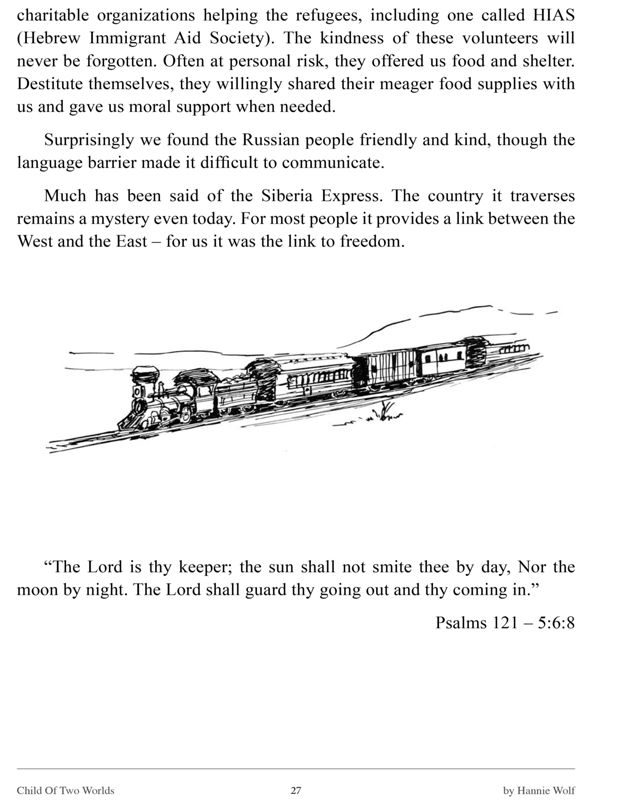
Much has been said of the Siberia Express. The country it traverses remains a mystery even today. For most people it provides a link between the West and the East – for us it was the link to freedom.
Child Of Two Worlds 27 by Hannie Wolf“The Lord is thy keeper; the sun shall not smite thee by day, Nor the moon by night. The Lord shall guard thy going out and thy coming in.”
Psalms 121 – 5:6:8
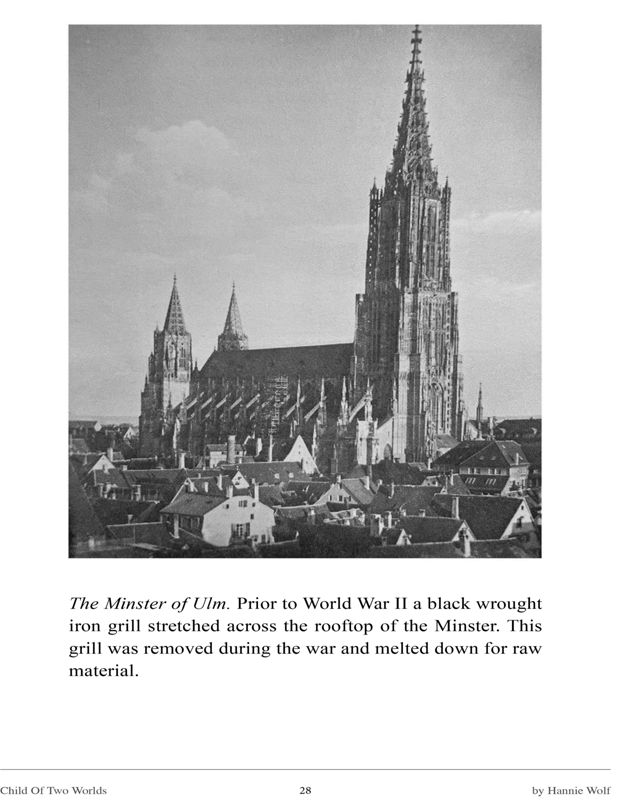
The Minster of Ulm. Prior to World War II a black wrought iron grill stretched across the rooftop of the Minster. This grill was removed during the war and melted down for raw material.
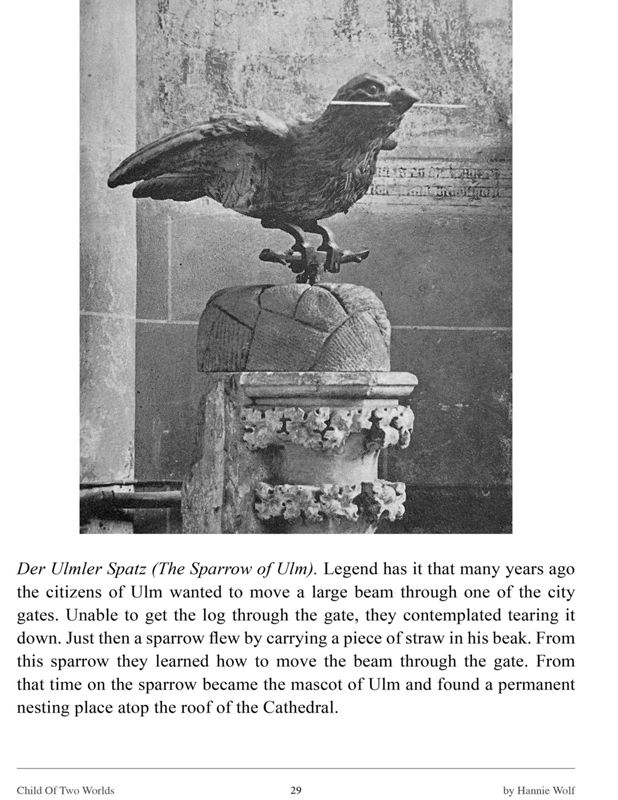
Der Ulmler Spatz (The Sparrow of Ulm). Legend has it that many years ago the citizens of Ulm wanted to move a large beam through one of the city gates. Unable to get the log through the gate, they contemplated tearing it down. Just then a sparrow flew by carrying a piece of straw in his beak. From this sparrow they learned how to move the beam through the gate. From that time on the sparrow became the mascot of Ulm and found a permanent nesting place atop the roof of the Cathedral.
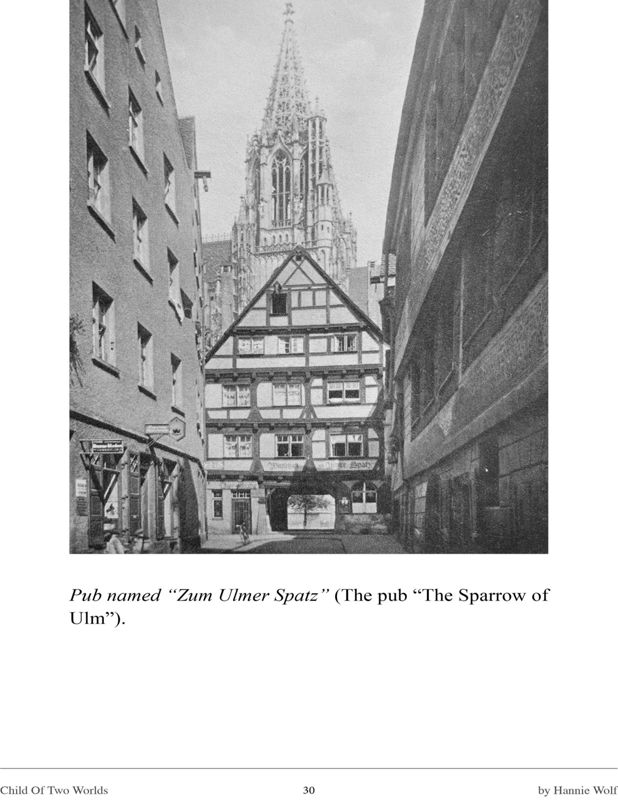
Pub named “Zum Ulmer Spatz” (The pub “The Sparrow of Ulm”).
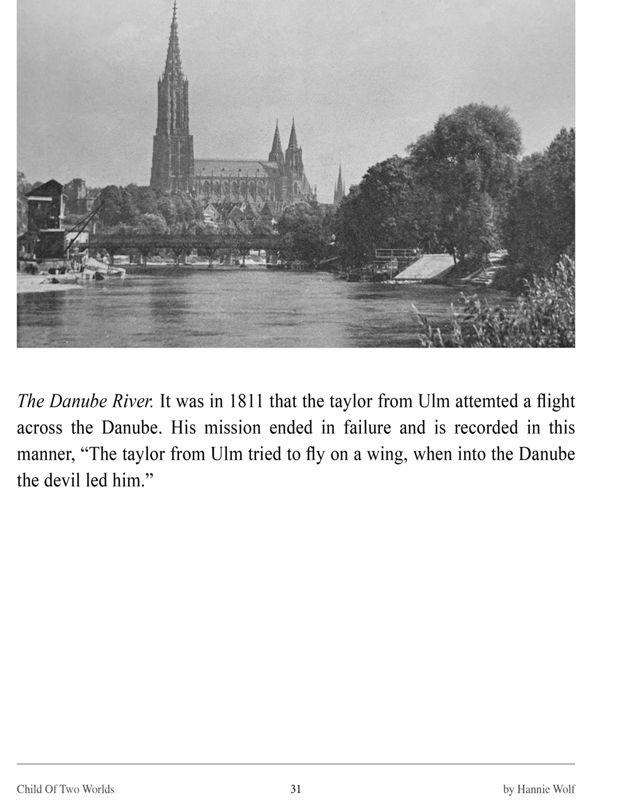
The Danube River. It was in 1811 that the taylor from Ulm attemted a flight across the Danube. His mission ended in failure and is recorded in this manner, “The taylor from Ulm tried to fly on a wing, when into the Danube the devil led him.”
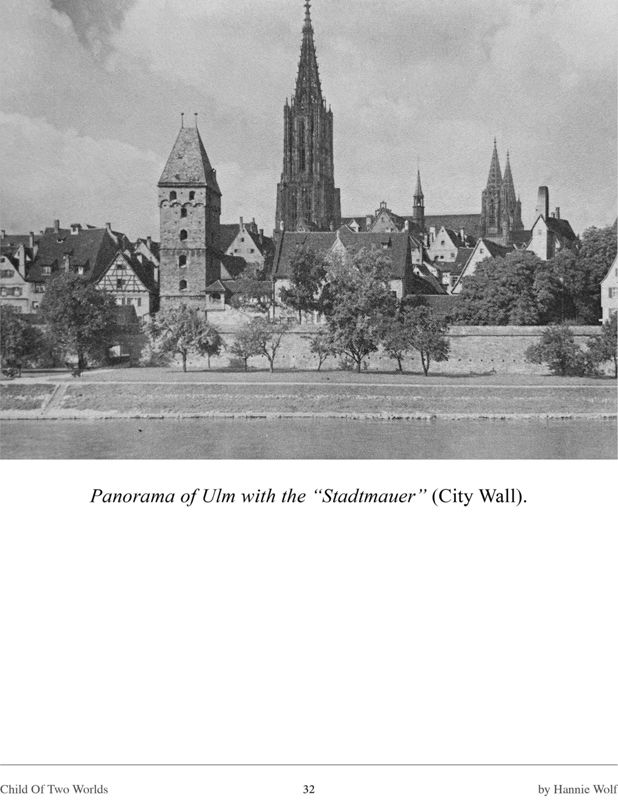
Panorama of Ulm with the “Stadtmauer” (City Wall).
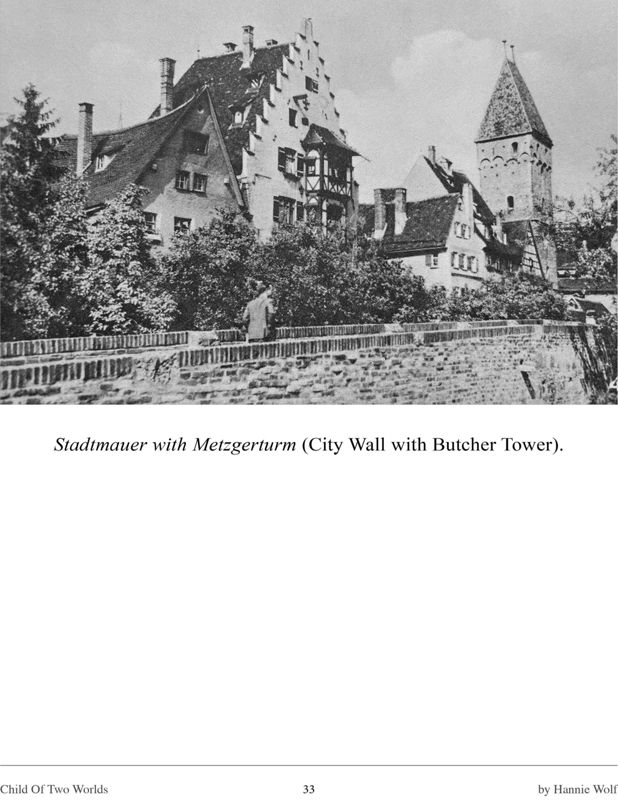
Stadtmauer with Metzgerturm (City Wall with Butcher Tower).
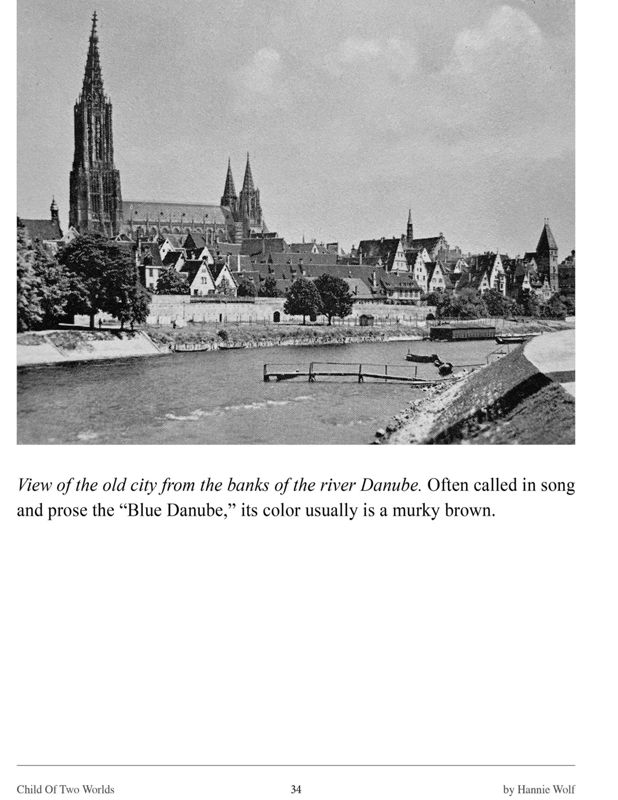
View of the old city from the banks of the river Danube. Often called in song and prose the “Blue Danube,” its color usually is a murky brown.
Chapter II
JOURNEY TO FREEDOM
“And Moses called unto Joshua – and said unto him in the sight of all Israel – “Be strong and of good courage.”
“Deuteronomy” 31:20:7
Berlin, September 15, 1940
Dearest Oma,
Tonight we arrived in good shape in Berlin. My head is still spinning, but then people tell me I have always been a scatterbrain. I refuse to believe I’ll never come home to you again.
Let me tell you how everything is going up to now.
Child Of Two Worlds 35 by Hannie Wolf
What a strange feeling it was as our train pulled away from the station. You, dear Oma, Uncle Sigbert and Aunt Lisl, grew smaller and smaller. A steady drizzle fell from the sky. The train gathered speed, finally the spire of the Minster disappeared from sight. A veil of tears clouded my eyes. How many happy and sad hours I spent in Ulm! What will the future hold? Then I remembered an old saying, “Look to the future – never the past.”
By the time we arrived in Augsburg I had calmed down. The familiar faces of Mrs. Fleischmann and her daughter, Martl, greeted us at the station. (Mrs. Fleischmann was the mother of my Uncle Willy. She and her daughter perished during the Holocaust.) As always, Martl was late and greeted us with, “Did you have to arrive so early in the morning? And on a Sunday as well? I didn’t want to leave my nice cozy, warm bed.” The train stopped in Augsburg for 1 ½ hours. A cold rain fell steadily all the while.
From Augsburg the train took us through Nurenberg, Bamberg, Saalfeld, Lichtenfels, Naumburg, Jena-Halle, Bitterfeld, Wittenberg and finally to Berlin, where night had fallen.
I was disappointed, expecting the train terminal to be much larger. Berlin is the capital and such a small railway station? We crossed a street, went down a flight of stairs and saw the sign, “S”. This was the subway station. Subways were new to me. I stood amazed watching this mode of transportation. We jumped on the train, departed at the Friedrichstrasse exit and found only escalators. Never having seen escalators before, we didn’t want to get on, but soon we mastered this art. It’s so much fun riding the escalators that I want to go up and down all day!
Our headquarters is the Hotel Atlas. This is a beautiful hotel. We even have a tiny balcony off our room, overlooking the river Spree. It’s just big enough for two fat or four thin people. In the evening there are concerts in the hotel. (The Hotel Atlas was destroyed during World War II.)
I am so tired. Farewell, dear Oma, have a good sleep.
Child Of Two Worlds 36 by Hannie Wolf
“Your loving granddaughter.”
Berlin, September 27, 1940 Dearest Oma,
Guess what? Tomorrow we fly from Tempelhof Airfield to Moscow! Can it really be true? We’ll phone you later on tonight. Up to now we thought it just can’t happen that we will really leave Germany. I thought all the while we’d come back to you in Ulm, but sooner or later we must leave. I enjoyed our stay in Berlin and will tell you all about it.
The food here is very bad. There is rationing and mostly we eat bread and gravy, a sort of white pasty gravy is put on top of everything that is served to us.
Our first night was interrupted twice with an air raid. We had just crawled into bed when the siren sounded. We made a dash for the basement air raid shelter, but no fighter planes arrived.
On Monday the Hirsch’s came to visit. We went for a walk with them “Unter Den Linden”, then we saw the “Brandenburg Gate, the Victory Elipse and the Tomb of the Unknown Soldier.
In the afternoon we visited Germany’s largest department store, Adolf Wertheim, A.F. Oma, you should see all the things they have there! We almost got lost and exhausted ourselves just walking about. Afterward we saw the castle, the Dom and all the Government Buildings.
The following day we went to the “Kurfuerstendam” then to the suburb of Tegel, such a pretty hamlet located on one of the Havel lakes. We saw
Child Of Two Worlds 37 by Hannie Wolf
 another suburb, Buckow. My head was spinning from seeing too much. Such a big city!
Guenther Baehr, a friend of Esther’s phoned, and we had a nice little visit (Esther Loewy was one of my girlfriends from Ulm. She was living near Berlin in preparation for her trip to Israel, where she still lives.)
On Friday Mom and I took Heyner to the train. We will probably not see him again. (Heyner Lebrecht was a friend from Ulm, who accompanied us on the journey to Berlin, after which he returned to Ulm.)
On Saturday Dr. Marx, his wife and daughter “Klaerle” came to see us. Klaele is an acrobatic dancer. She is 16 years old, so beautiful and slender. I look like a tub of lard next to her.
My friend Esther Loewy phoned. I was so happy to hear her voice. On Sunday Klaerle and I took the train to Trebbin and visited Esther. We were happy to meet again after being separated a year. Yet somehow we drifted apart during that time. There was an awkward gap, but soon we became reaquainted and spent a wonderful Sunday together. Klaerle danced for us. Is she ever good!
We spent 1 ½ hours in the air raid shelter again during the night.
On Monday Papa obtained the visa for Manchuris, and again we spent part of the night in an air raid shelter. Every night the hours we spend in the shelter get longer. It sure is gruesome. First there is an eerie silence - then you hear the crackling of the bombs, again silence and soon wave after wave of bombs falling. It sounds like a thunderstorm.
The people in Berlin speak German very differently from ours. We have a difficult time understanding one another.
On Wednesday, Mutti, Mrs. Marx and I visited the castle of Sanssouci (Castle without Sorrow) in Potsdam. What a gorgeous castle! It reminded me of some of the castles we used to visit in Bavaria.
Child Of Two Worlds 38 by Hannie Wolf
On our way back we stopped at Wannsee.
That night we again spent five hours in the air raid shelter. Papa remarked wryly that it was too bad we were charged for our room when we hardly ever got to sleep in it!
Every morning we feed the sea gulls off our balcony. They are so tame and nearly fly into our room.
Today we went to a beauty shop. After all, we must look presentable for our long journey.
Oma, this will be the last time I write to you from Germany.
Ten thousand farewell kisses for you.
“Your loving granddaughter.”
On the Trans-Siberian Railroad
September 29, 1940 My dearest Oma,
We have been on the Siberia Express for a few hours and are pleasantly surprised how comfortable and clean it is. Let me tell you how we arrived here.
We left Berlin Saturday morning in a driving rainstorm through the darkened streets for Tempelhof Airfield, from where we flew to Moscow. We flew to Danzig (Gdansk), Koenigsberg (Kaliningrad), where we changed to a Russian plane and Russian crew. From there we flew to Bialystok, Minsk and finally Moscow.
Child Of Two Worlds 39 by Hannie Wolf
There was strict inspection at the border. The guards went through all our luggage. The men and women were taken to separate rooms and had to undress. The border guards must have been looking for secret weapons and money. The women guards who examined us even looked inside the girdles and examined the girdle stays to see if we had anything to hide.
How strange it felt to be on a Russian plane. I don’t think their crews are as experienced. We said our final goodbye to Germany.
Oma, will I ever see you again?
Can you visualize how it feels to fly 7,000 and 10,000 feet high in the air? Not always so nice. The plane bounced up and down. I sat in my seat holding the little brown paper bag, reading “After use, please close and put on the floor” on my lap. Several times I had to take medicine, but you should have seen the view! Mostly we flew above clouds which looked like snow-covered mountain peaks. The prettiest sight was our flight over the Baltic Sea - above the clouds, below us the ocean. The ships looked like toys.
It was strange to see the city lights as we arrived in Moscow, after being so used to having everything blacked-out in Germany. I almost forgot to tell you that we stopped in Minsk. There was only one small dirt runway. We were greeted by members of the Jewish Committee with steaming hot cups of tea and cookies. Oh, how they envied us going to America!
In Moscow we were met by a gentleman from the Intourist Bureau and taken to the Hotel Metropole, one of Moscow’s finest hotels. You never saw such traffic! Car after car, streetcar after streetcar, bus on bus, and everywhere people and more people. Motorists honk their horns so loud that your eardrums nearly split. The people are dressed like peasants. Clothes seem unimportant here. We have a suite in the hotel, complete with a grand piano.
On our arrival a pretty young chambermaid played the piano for us. We were so hungry!
Child Of Two Worlds 40 by Hannie Wolf
The food is beautifully served in the elegant, palmlined dining room. It is always served piping hot from round silver vessels. Most of all we like the Russian caviar. No one dresses up for dinner. The men wear their work clothes and no ties. The women wear drab dresses. Everything is owned by the Government. No one is poor, and no one is rich. There is little incentive to work, and not many ways to spend money, so the people use what little money they have for dining out.
There was a concert after dinner in the huge dining room, both vocal and instrumental music was played and broadcast over the local radio station. For the first time we saw a genuine Balalaika orchestra performing in another part of the hotel.
Oma, I still refuse to believe we’ll never return to you! The people here are so different from us. Other countries-other customs. You really know you are in a foreign country when you cannot speak the language and have a difficult time making yourself understood. Most of the women in Russia have blond hair. They wear lots of lipstick and fingernail polish.
This morning we took a city round trip. There are no newspapers in Russia for sale. They are given out free and hundreds of people line up at the newspaper stand waiting for the papers to arrive.
First we visited the Red Square and the Lenin Mausoleum. In Russia red means “beautiful”. Many people queued up to view the embalmed body of Lenin, but being with a tourist group we got our turn quickly. This is a Holy Shrine for most people. Not a sound is heard from all the people waiting their turn. We saw the Kremlin from a distance. Red Square is huge and quite impressive. We saw St. Basil’s Cathedral, which is now a museum; however, we were not allowed inside. Most churches in Russia are now museums.
Our girl tourist guide told us that Mockba, the Russian name for Moscow, has 83 high schools, 47 theatres, including puppet and children’s theatres. It also has Europe’s most beautiful subways, running 230 feet underground.
Child Of Two Worlds 41 by Hannie Wolf
 We saw one “Metpo” (subway) station. It was all done in marble. There are no stairs, only escalators. There are 49 subway stations, each one built in a different style.
Moscow has a movie studio and also a huge amusement park, similar to the Prater in Vienna. The world’s largest building is just being erected, but I forgot its name. We were told that the Lenin Library has space for 20 million books.
All buildings in Moscow look alike, and seem to crumble before they are barely finished.
There is no room for individuality, only for the masses. No one smiles in Russia.
The city of Moscow lies on the Moscow river and has 57 bridges. It is a modern city, but next to a skyscraper you will see an old frame structure. The streets are wider than Berlin. The squares are huge, and the city is spread out over a wide area. Still the streets are being widened everywhere.
Houses, if still in good shape, are moved to new locations. Our interpreter told us the story of a woman who supposedly was talking to a friend over the telephone while her house was being moved. She informed her friend that she was “sitting at home and driving off.” This probably was exaggerated. I doubt there are meny telephones in Moscow!
There was no time to visit the Bolshoi Theatre, which we deeply regretted
We did get to visit a department store which displayed a variety of goods, mostly for show. Little is available to the customers. One must stand in line for everything, but no one dares to complain.
After our evening meal we were taken by bus to the railway station. We had to go through a barricade before boarding the Siberia Express. It is a primitive looking train and runs on a single track, making weekly round trips.
Child Of Two Worlds 42 by Hannie Wolf
We are fortunate in having first-class tickets throughout our trip. Mutti and I share a compartment. Papa has a Japanese roommate. When he saw Papa he looked at him and said, “I was the one who issued your visa for Japan.” It turned out he is the Japanese General Consul from Hamburg on his way home to Tokyo.
We left Moscow a few hours ago. The landscape is very monotonous. Everything is flat marshland and forest. Here and there you can see a rundown adobe or frame house with a thatched roof. I have to say goodbye for now. We are going to the dining room for our evening meal. I am curious to see how I will like the food. Goodnight, dear Oma, fondest kisses,
“Your granddaughter.”
Manchouli, October 6, 1940 Dearest Oma,
The second phase of our trip is behind us. We arrived here safely this morning and are rather tired. Our trip was quite uneventful. Let me tell you about it.
We travaled from Moscow to Kirov, Perm, Sverdlovsk, Omsk, Novosibirsk, Krasnoyarsk, Nizhnendinsk, Irkutsk, Ulan-Ude, Chita, Karinskaya, Otpor to Manchouli.
For a few days the scenery varied little. There was nothing but prairie, marshland, small lakes and forests. There are lots of birch trees.
The country is sparsely populated, unlike Germany where you find one town after another. Once in a while we saw a log cabin. They tell us in winter
Child Of Two Worlds 43 by Hannie Wolf
 the roofs are covered with straw to keep out the cold. We wondered how people could live without neighbors in sight.
One day the train stopped in the middle of a marshland. The engineer departed, headed for the nearby forest, chopped down a few small, crippled birch trees and re-entered the train, carrying the branches over his arms.
On the Siberia Express there is no set schedule. Trains arrive and depart without a timetable. We never dare leave the platform for fear of being left behind.
When we reached our next stop, we discovered the reason for our previous unscheduled stop. Again the engineer departed from the train with two cut-off tree branches. He wrapped a large rag around the branches, proceeded to spit on the rag and nonchalantly began washing the windows on the train.
It seemed off that we always stopped at all large cities at night and had no chance to see anything. The Russians, always a suspicious people, do not want others to see how they live. We were told that often rather than repair a house, one tears down the old one clear to the foundation and builds a new one over it.
Most of Russia is flat. As far as the horizon not a sign of life could be seen for miles, with the exception of strange looking white birds. Often from the train we could see forest fires.
We arrived in Novosibirsk on October 2 during the daytime hours. This city, originally founded in 1893 grew rapidly and is now the largest city in Asiatic Russia.
This city seems to be built without any zoning laws. The streets run in every direction, old and new buildings sit side-by-side.
The weather is still mild. To catch a breath of fresh air, we try to get off the train for a few minutes at every stop. All of us suffer from colds. Often the weather changes drastically.
Child Of Two Worlds 44 by Hannie Wolf
No signal is given before the train departs. One must watch carefully, because if you are left behind there is no train for another week.
Since leaving Moscow, the clock has been set ahead one hour every evening. The food is not bad but very greasy. Some of us suffer from diarrhea. I have a persistent cough. On the train hot tea is served out of large silver samovars, poured into tall glasses held in a silver container with a handle.
Most Russians travel third class, where all seats are made out of wood. There are no sleeping compartments, and travelers must share quarters with their assorted animals.
We never get bored and have nice company on the train. Many of us are headed for America, some will go to Shanghai. I’ll never forget spending Rosh Hashanah (Jewish New Year) on the Siberia Express. Among the passengers was a Cantor, who conducted Worship Services. It was mostly for men, since the compartments were too small to hold the women and children also.
The scenery changed abruptly the next day. We saw beautiful forests and mountains. The city of Krasnoyarsk is located in these mountains. It is an important transportation center in south central Siberia.
We had been told that the Siberia Express on occasion gets covered with dust. Up to now we had not seen much of that. As we entered the dining car, where the tables had just been covered with badly needed freshly laundered white linen table cloths, a swirl of dust obliterated our view. Within seconds everything had turned coal black. Inspite of double-paned windows the black sand had seeped through. The dust storm left as quickly as it had come, but it enveloped the entire city of Krasnoyarsk. We were told duststorms are a common occurrence in this area, Since the soil is mostly sand. This certainly is not where I want to live!
There are wild horses and cattle everywhere. One sees more forests and houses in this area.
Child Of Two Worlds 45 by Hannie Wolf
Our next stop was Irkutsk, located on the Angara river, which flows into Lake Baikal, the largest fresh water lake in Asia and the deepest lake in the world, 5,710 feet deep. It is up to 50 miles wide and stretches for 387 miles between mountains rich with mineral resources. The Siberia Express skirts only the southern shore. None of us left the windows for fear of missing a view of the lake, which appeared at first as a few small lakes and inlets.
Next to me by the window stood a tall Russian man in a military uniform. I pointed my finger toward the landscape and he proudly said, “Baikal”. Expecting to see a large lake I was disappointed to see only a small body of water. I did not realize we had not yet arrived at the lake.
The Russian officer was funny. We could not converse, but pointing to his uniform, he made war-like noises and said “boom-boom”. When he spotted my friend, Lother Meyer, who with his parents is also going to America, then Mutti and Papa, he could not figure out how we belonged together. He pointed a finger at Lothar, then at me and said, “moosh”. He probably assumed we were brother and sister. I said, “no”. He then pointed toward Mutti and said, “Mama?” I answered him yes. He laughed and said, “no, no”, pointing at my red sweater he puffed up his cheeks and pointed toward Mutti, laughing all the while saying, “no, no”. He probably thought Mutti was too young to be my mother. We all had a good laugh. Motioning that we were going to America, he beamed and said, “America? Good.”
I have learned to speak “dining room” Russian. “Dada” means yes, “nyet” means no, “chai” means tea, “cleper” means bread, “neeponomaya” means “I don’t understand, which is a word I use frequently.
We were still perched at the window when an immense body of water appeared. There was water as far as the eye could see. Snow-covered mountains rose in the distance. For nine hours the train skirted the lake. We were told Lake Baikal freezes over completely in the winter. There was not a single craft to be seen and only about four or five villages.
Child Of Two Worlds 46 by Hannie Wolf
We got off the train at one small village. Women were carrying water buckets. A few peasants sold fruit and eggs. A farm woman tried to sell us eggs, but we never figured out whether she asked one rubel for two eggs or two rubles for one egg. The water came out steaming hot from a nearby well. There must be hot springs in the entire area. We went through 51 tunnels, and over many bridges, yet we touched only a small rim of the lake.
On October 5 we arrived at a spa, located in the hills covered by large forests. We arrived in Chita, high in the mountains. There are nearby woods and many rivers. Goats and sheep are seen wandering all over the railroad tracks and at the railroad stations. They mingle with the citizens of this area, most of whom are Mongolians.
Up to now the landscape looked like parts of Europe, but the scenery changed abruptly. The hills are barren, the sky is a deep blue. There is no twilight, night follows day. There is little vegetation. We saw many frame building and herds of buffalo.
This morning at 3 a.m. we were awakened. At 4 a.m. we were to arrive in Otpor, the Russian border. Oma, I have never seen such a star-studded sky! The stars seemed close enough for us to touch. For hours we sat in the bitter cold weather waiting for the customs house to open. After passport and luggage controls we went into the small coffee shop and drank hot tea. The waitresses everywhere smoke cigarettes while waiting tables and wear the brightest red fingernail polish I have ever seen.
Our stop was to be 2 ½ hours but was extended to eight hours. The Russians searched every one of us, and I saw them taking a few people away. I was so afraid they’d find my notebook, but they didn’t. I hid it in a safe place.
Farewell to Russia! This will no doubt be my first and last visit to that country. Never in my wildest dreams did I believe that someday I would travel through Russia. It is a large and immensely wealthy country, but it is not very clean! Russia has tremendous resources, timber, grain, copper, iron,
Child Of Two Worlds 47 by Hannie Wolf
 etc. Everyone is equal. There is no wealth and no poverty. All races are alike, everyone earns what he need, but the State owns everything. In Russia a man has the right to a decent life, but not a FREE life.
Twenty minutes out of Russia we arrived in Manchouli, just in time to see our train for Harbin pull out of the station. What were we to do now! It was aggravating. Since we must wait for another train we had time to take in the sights. We bade farewell to the Siberia Express which had been home to us for eight days.
The Manchurians are a mixed race. There are Russians, Europeans, Chinese, Japanese and Mongols. All the people stared at us. We stared right back at them. Chinese coolies brought our luggage over to the customs building. I am so tired of traveling and the perennial passport inspection.
We were met at the station by a Jewish representative from the local committee who took us to the Hotel Tamaya, if you want to call it a hotel! It is a small building with a few rooms. We have to sleep six to a room. Upon entering the room you are required to remove your shoes, then you walk up one step to the floor on which are spread several straw mattresses. There is also a small, low table. We are getting used to eating our meals sitting on the floor. Soon we won’t be able to sit on a chair any more.
Since we were forced to spend a night in Manchouli, we made the most of our stay. Mutti, Mrs. Brock, a traveling companion, and I went for a walk through the town of Manchouli, which is a rather picturesque little town. I assumed it to be a larger city. Three Jewish familes live here. The “committee” consists of one man, who does all he can to help those in need. They even have a Synagogue.
Sheep, pigs, goats, horses and cattle take their leisurely time walking in the streets. One sees all races and nationalities. There are beautiful geisha girls. The elderly women still have their feet bound and can barely walk. The houses are very tiny. Men and women wear wooden sandals and white
Child Of Two Worlds 48 by Hannie Wolf
 anklets. The anklets have a space between the first two toes to hold the strap of the sandal. That must be the way shoes are worn. In Japan. The women can be seen sitting on benches in front of their houses, gossiping.
Manchouli is a clean town surrounded by sandhills. The desert wind brings duststorms, which is the reason many people are seen wearing masks over their mouths and noses. There is very little water in the country. People have to buy expensive water and must carry it to their homes. The water carriers sing a chant which sounds like “hodoolah” to me. Until 1925 Manchouli belonged to Russia, now it is under Japanese rule. Manchuria was part of China till 1933 and is now ruled by Japan. (The year was 1940).
A little while ago we saw a priest walk into the hotel. He offered prayer and was carrying a rosary. A geisha girl arrived and put a yen on the tiny pillow the priest carried in his hand. I understand the priest comes to the hotel once a month to offer prayers. There are also Christians living in Manchuria.
Our dinner was very good, especially the coffee, which was pure coffee and not mixed with grain. The waitresses wear so much makeup they look grotesque. They also smoke while waiting tables. The dining room is very cozy.
The bell captain in the hotel is from Riga, Poland and speaks German. He showed us the “bathroom” which consists of two tubs or large buckets where one can wash up. There are two wash basins in the hall also. How can one take a bath or washup in a public place where we can’t undress? However, Mrs. Meyer, Lothar’s mother, proceeded to strip and give herself a sponge bath in one of the tubs. Just then the bell captain appeared. Furious when he saw all that water in the tub, he blurted out, “Nix Berlin, this is Manchouli”! Water here must be too costly to be wasted on such luxuries as a bath.
The toilets are nothing but holes in the ground. One must learn to “take aim.” The Japanese, who always sit on the ground have no problems with the local toilets. In our hotel we are blessed with a European type water closet.
Child Of Two Worlds 49 by Hannie Wolf
Mutti, Papa and I, Mr. and Mrs. Brock and Mr. Drucker all have to share one mattress tonight for sleeping. Two people have to share a blanket, and pillow shams act as bed pillows. Papa and Mr. Drucker share a blanket, while I sleep with Mutti.
I am so tired and will fall asleep right away. I miss you very much.
“Your granddaughter.”
Mukden
October 9, 1940 Dearest Oma,
If you were to see me at this moment, standing in a corner of a filthy Mukden railway station, surrounded by Japanese and Chinese people, you’d raise your arms and say, “How you have changed!” We never get to wash, but I guess dirt never hurt anybody! I am just glad you can’t see me now.
Let me tell you how we arrived here.
Do you remember I told you how six of us had to sleep together? Mr. Brock snored all night, but his wife insisted it was Papa and Mr. Drucker who snored. I talked in my sleep and screamed, “I’m thirsty”, but survived without getting a drink of water. I guess we beggars can’t be choosers. We remember that night as “Rembrandt’s Nightwatch.”
We rose early to secure our railroad tickets and have our passports checked. Everyone stared at us, so we stared back at them. I am a stranger in a strange land. A wave of homesickness came over me. How I miss my dear old home!
Child Of Two Worlds 50 by Hannie Wolf
At the railway station we saw a man who looked like some sort of royalty. On his filthy head he wore a large gold crown. He might have been a king, but I doubt he sees a bathtub more than once a year! If you couldn’t see him, trailed by his large entourage, you could probably smell him a mile away. Porters were playing checkers with bits of broken glass. The people are very childlike and admire everything. You should have seen the face of the custom’s agent when he saw Mutti’s fountain pen case. He twisled the box in his hands, turning it over and over, as if it contained some sort of magic. My little brooch that glows in the dark was much admired.
As we were about to enter the train, we saw what looked like a medical team line up all the passengers and inoculate them with one big needle. They went from one person to another, using this same unsterilized syringe. Not wanting to risk an infection, we fled to the other side of the train, thus avoiding a possible catastrophe.
We found an entrance to the train, just as we entered, Mutti slipped and fell on her knees but was unhurt. We all stood there and laughed. She looked as if she were kneeling in grateful prayer, and well she might have.
At long last we were happily seated in a beautiful train headed for Harbin. A few militia men came aboard. At times the shades were pulled down to obliterate the view. I assumed we were not to see all the military installations. We were foreigners and obeyed, while the native peeked through the shades to see what was going on.
We were served steaming hot cups of tea frequently, and the train was sprayed with a disinfectant at intervals. In this part of the world malaria, smallpox, plague, cholera and typhoid fever occur frequently.
At all trail stops policemen with guns stand guard. A man who looked like a Buddhist monk got on the train. He was dressed in white. The men and women standing on the platform sang farewell to him.
The train is very clean. I share a compartment with a young lady. There
Child Of Two Worlds 51 by Hannie Wolf
 was a kimono on each bed that may be used for a pajama at night. Of course I put on my kimono
immediately. Mama was angry with me when I walked to the other coaches and looked over the rest of the passengers. The train was moving at such a fast pace she worried that I’d fall off a platform, or slip in between two railroad cars.
was a kimono on each bed that may be used for a pajama at night. Of course I put on my kimono
immediately. Mama was angry with me when I walked to the other coaches and looked over the rest of the passengers. The train was moving at such a fast pace she worried that I’d fall off a platform, or slip in between two railroad cars.
The scenery is so monotonous. We saw some lakes and swamps, but no trees, only sandhills on which buffalo and black sheep grazed. Apparently the prairie grasses are the only nourishments these animals receive. We saw Chinese men with pigtails walking along the country roads. Much of Manchuria is uninhabitable. The cities consist mostly of low mudhouses. The air is very dry, and the climate unhealthy. We are always thirsty.
People here do not shake hands. They bow to each other. The people in the Far East are very polite. No wonder the composer Franz Lehar called Japan and the orient, “Land of Smiles.” The people always smile and never show their true emotions.
Yesterday morning we arrived in Harbin. A few people from the committee met us. Papa first had to go to the bank to get the money he had deposited for our Manchurian visas.
As we left the railroad station, we saw a strange sight. Hundreds of rikshas were driving on the street or standing on the side. Cars and streetcars seemed to be driving in all directions. In this part of the world, Harbin is considered a beautiful city. It is located in Sunkiang province on the Sungari river. It was not an important city until Russia was granted a concession and built a modern part alongside the old Chinese town. It is a major trade center in central Manchuria and very Russian in character.
You can’t imagine how fast the men pull the rikshas. Up and down hill they go, just like a horse. Riksha means “wagon of the strong man”. They tell us that all riksha drivers die very young. Most of them drop dead of heart attacks.
Child Of Two Worlds 52 by Hannie Wolf
We were taken out to lunch by members of the committee. The food was very good. We were warned not to eat any raw fruits or drink cold beverages until we reach Shimonoseki, Japan. This will prevent contracting cholera, typhoid fever or dysentery. We were glad to be able to purchase canned fruits. The committee even had a physician present to give us all physical examinations.
The Jewish refugees living in Harbin envied us for going to America. I can’t blame them. I would not care to live here either. The summers are very hot and the winters bitter cold with temperatures of -50 degrees. Every day the weather is different. One day will be hot and the next day cold.
We were served dinner and afterward taken to the railway station. Before leaving we bade a sad farewell to those traveling companions who are headed for Shanghai. Many of our group are going there, and I feel sorry for them. They tell us that Harbin is paradise compared to Shanghai. I only hope all those people will soon have an opportunity to come to America also. I wish them everything good and the best of luck. They are all such lovely people.
Since we have first class tickets from Harbin to (Pusan) Fusan it is very lonely for us. Only one other family is traveling first class. All others have seats in second class. After bidding farewell to our friends, we were informed that we were on the wrong train. We were to go with the other passengers after all. Was I happy! But then the plans were changed again. We had to rush to get back on. It pulled out of the station just as we stepped inside.
Was I glad to leave the dirty Harbin railroad station. You could hardly breathe the stale air. The people looked at us as if they were going to eat us alive, especially when they saw money. I hung on to my pocketbook for dear life, and kept my mouth shut for fear of swallowing germs. Mothers are nursing their babies all over the terminal. No one pays any attention to them.
I spent a restless night. The train was so crowded. Since leaving Harbin we have no sleeping compartments. The train stopped at some of the larger
Child Of Two Worlds 53 by Hannie Wolf
 cities like Hsinking. Before reaching Mukden, we saw a glorious sunrise.
Mukden, a very pretty metropolis, also called “Shenyang”, is located in Liaoning province. It is the provincial capital and was the capital of the Manchu emperors from 1625 to 1644. The city was largely developed by Russia in the late 19th and early 20th Century. The rikshas here have bicycles. Oh, how I’d love to ride on one, but they are just too dirty.
We are sitting at the train depot with another lady and other family waiting for the next train. Everyone here eats with chopsticks. It would be fun to go to another restaurant besides the coffee shops at the train stations, but it is only 8 a.m., and we see no other restaurant close by. Our stay is always too short, and we don’t want to miss our train. And handful of kisses to you.
“Your filthy granddaughter.”
Kobe
October 16, 1940 Dearest Oma,
It is just two days before we start our trip across the “Big Sea”, I want to send you at least one letter from the Land of the Rising Sun, the most beautiful country I have ever seen.
We were happy to leave Mukden for Fusan. As we were leaving, a Japanese girl got on the train wearing the same suit as mine. Isn’t that a coincidence? The train trip was just beautiful. Korea is so picturesque, and we didn’t know which side of the train to look out on. The landscape looked like a fairyland. We passed villages consisting of mud huts. Each village seems to be inhabited by a different tribe. Some are Chinese, others mulatto.
Child Of Two Worlds 54 by Hannie Wolf
There are mountains with deep gorges, lakes and verdant valleys. We saw many buffalo and donkeys. Korea is rich in silver, copper and iron. One can see the mines and factories that dot the countryside. We passed quite a few large cities. The sky is a dep blue, and the sun beats down on the cloudless sky. The heat was unbearable. We were served bitter tasting cups of green tea, which quenched our constant thirst, along with damp hot towels to wipe off the perspiration. Some people wrapped the towels about their necks to keep cool. It seems strange to use hot instead of cold towels for that purpose, but it sure did the trick. The train was kept spotlessly clean. It meandered through many tunnels. This is a very tropical country.
By afternoon we reached Antung, a city located at the mouth of the Yalu river. I guess you could say Korea begins here. Again there was the passport control. Korea is a part of Japan. Here no one speaks English or German. We met a gentleman riding the train on his way to Tokyo. I don’t know how we made ourselves understood, but he was just like a parrot. When Papa pulled out his cigarette lighter, he did likewise. He copied all our motions and everything we did. Do you remember Mutti’s pretty lapel watch? There was a man on the train who admired it so much that Mutti sold him the watch for five American dollars. She hated to part with it, but five dollars is a lot of money.
We passed by huts built out of straw. There is lots of bamboo, silk, rice and tea in Korea. Lush tropical fruits are grown there. We felt a bit like Eve in Paradise, but for health reasons we did not dare touch the forbidden fruits. Everyone in Korea seems to dress in white, and the country looks quite clean. In the late afternoon, we witnessed a most spectacular sunset.
We had to spend another night without sleeping in a bed. By now we have learned how to cope with such minor discomforts. The next morning we arrived in Fusan, where our train trip was interrupted.
Japan is an island. In order to reach it we had to take a ferryboat. Fusan
Child Of Two Worlds 55 by Hannie Wolf
 is the largest port of Korea and was opened to foreign trade in 1883. The harbor lies adjacent to
the train terminal, so we had no chance to see the city itself, which is located in the foothills. We had to stand in line for the ferry. Hundreds of people were waiting to get on board. Such traffic! These are the most patient people we have ever seen. No one minded to wait their turn. All families are large and well disciplined. Never have I seen so many children! Farewell to Korea!
is the largest port of Korea and was opened to foreign trade in 1883. The harbor lies adjacent to
the train terminal, so we had no chance to see the city itself, which is located in the foothills. We had to stand in line for the ferry. Hundreds of people were waiting to get on board. Such traffic! These are the most patient people we have ever seen. No one minded to wait their turn. All families are large and well disciplined. Never have I seen so many children! Farewell to Korea!
The ferryboat is very large. We were most fortunate in having first class accommodations. It was a strange feeling to leave land and catch our fitst glimps of the ocean in this manner. The only other ocean we had seen was the Baltic Sea, and that was from the air only.
First we wanted to clean up. We eagerly looked forward to the luxury of taking a nice warm bath, something we had not been able to do since leaving Moscow. Suddenly the boat lurched. The inland sea became so rough we could barely walk. Instead of bathing, we took to our beds in a hurry. We swallowed some seasick pills and by afternoon were able to get on deck, where we met some of our old train companions headed for Japan. What a happy reunion we had. It was good to see a few familiar faces.
There was a Japanese artist on board who wanted to sketch our pictures. In return for his favor all he wanted was our autographs. I sure hope that I am not as ugly as he painted me.
One of the ferryboat employees asked me to teach him the German alphabet.
There was a Japanese family on board with a precious little boy. We gave him some of our candy. The Japanese children are so pretty, like little dolls and se well mannered.
There was a beautiful sunset over the ocean. Then came our first view of Shimonoseki, which appeared like a fairyland before our eyes. The lights from the city looked like bright stars shining in the night. They tell us the city has
Child Of Two Worlds 56 by Hannie Wolf
 over 196,000 inhabitants. It is a well-known fishing port on the Shimonoseki Strait. The city it
located in the mountains and has many Shrines. As we left the ferryboat a porter asked Papa for 5 yen for unloading our baggage. At first Papa refused to give in, but when the porter refused to unload our bags, he relented.
over 196,000 inhabitants. It is a well-known fishing port on the Shimonoseki Strait. The city it
located in the mountains and has many Shrines. As we left the ferryboat a porter asked Papa for 5 yen for unloading our baggage. At first Papa refused to give in, but when the porter refused to unload our bags, he relented.
Were we ever hungry! We left the harbor and headed for a beautiful hotel names San-Yo. This was our first encounter with the real Japan, and the reality made a fine impression on us. The beautiful waitresses in the hotel were wearing Japanese costumes. The red tile floor was sparling clean. Everything is just swell here, but they serve all meals cold, which was strange to us.
After our evening meal we went to the railroad station to catch the train for Kobe. The trains leave every half hour. We had to pay an additional fare for taking the express train. No one knew which was the express train, and we could not make ourselves understood. There were forty of us trying to catch the same train. When we finally got on the train, our luggage was missing. All we had left was our hand luggage. Someone motioned that we were on the wrong train. This one did not go to Kobe. Pandemonium broke out. Papa got off the train and began searching for our bags. Mutti became panic-stricken. Here she was in a totally strange country. She began to weep and cried out, “not only have I lost all our belonging, now I’ve even lost my husband, and we’ll miss our train.” Fate intervened. Both Papa and the luggage returned safely and we ended up on the right train. There were no sleeping compartments, and we were exhausted. Since leaving Ulm, our lives have evolved only around trains. All we have done is hurry and hurry, and we’ve begun feeling like Nomads being pushed from country to country, from continent to continent.
We happily greeted the dawn the next morning. As always, there was a deep blue sky. We had not seen rain for weeks and wondered what rain looked like. Such lovely scenery everywhere. There are rice paddies, tea fields, grapevines and many orchards, all surrounded by wooded hillside.
Child Of Two Worlds 57 by Hannie Wolf
 Japan is so heavily populated that you can’t tell where one community ends and another one begins.
Suddenly there loomed an awesome sight! The big blue Pacific in all its might lay before our eyes, with large ships and boats all over. The train went up a steep incline. Below us was the ocean, above us the lovely city of Kobe, which seemed to be built solely out of frame. From the distance it looked as if the entire city was built in one large piece. The homes are built close together. This is a large city, very spread out. When walking up and down the many hills you really get out of breath. The hills are solid with beautiful villas. We searched for a hotel within our price range. We found a pretty little one, though rather shabby, called the Chino Hotel, from where I am writing you this letter. Did you ever think that some day your granddaughter would write you from Japan? That’s life. Man thinks, but God leads.
About 970,000 people live in this city, located on Osaka Bay at the base of Mt. Rokko. There are two universities, a nautical college and several ancient Buddhist temples and shrines. The port was opened to foreign trade in 1868. There are many ship building yards, sugar refineries, chemical and rubber plants.
We cannot make ourselves understood here. Our rooms consist of a suite which has a living room, bedroom and toilet which we have not learned to use. It is built into the ground. The bed linens have not been changed since the last guest left. The chambermaid does not seem to understand that we want clean sheets. I think she understand but pretends she doesn’t. All she does is yell at us. What I wouldn’t give now to be able to speak Japanese! We understand the owner of the hotel is a Chilean.
We arrived in Kobe on Yom Kippur Eve (Day of Atonement). By the time we had our baggage brought to the rooms all stores were closed. We planned to fast the next day, but wondered how we could do that without eating anything the night before. We found some fruit stands open and purchased
Child Of Two Worlds 58 by Hannie Wolf
 some fruit. One fruit in particular is just delicious. It must be a cross between an apple and a
pear.
some fruit. One fruit in particular is just delicious. It must be a cross between an apple and a
pear.
In the evening we went to a community hall for prayer Services. We immigrants held our own Services upstairs in the Synagogue. It is all so different from home. That night we felt homesick, but we must think ahead to the future. Yom Kippur was on October 12th. We fasted very well on just having had fruit the night before. We didn’t even get thirsty.
That evening we went out on the town with the Wolfs, Myers’ and Mr. Drucker. All companions on our long journey. We ate various kinds of foods. Near our hotel we found a large market where everything from soup to nuts was being sold.
You sure see everything here. We saw an elderly man wearing nothing but an undershirt. No one paid any attention to him.
From one of the chambermaids in the hotel I learned a few Japanese words, “Ohio” –good morning. “Hai” –yes, “Keeno” –yesterday, “Sara” – plate, “Mess” –knife, and “Oyasomee” –good night. I wonder if this is correct.
There are taxis all over the place. You have to walk in the street since there are no sidewalks. If you raise your finger slightly, the taxi stops and thinks you are hailing him.
We know of 45 immigrants who are stranded in Kobe, awaiting the renewal of their American visas.
Twice we went to a seven-story high department store. It had a beautiful roof garden and a restaurant. We bought a few silk handkerchiefs and some chopsticks. I wanted a pair of Japanese sandals, but Mutti sand Papa refused to buy them for me. They think they are bad for my feet.
The Wolfs and Meyers live in a home built by the Jewish congregation. We visited them one evening. There I met a girl about my age. Her name is Lotte Spier. We decided one evening to go for a long walk with others.
Child Of Two Worlds 59 by Hannie Wolf
 The streets are full of chuckholes here. There are deep ditches everywhere, I suppose to hold the run-off water. Traffic is not regulated. People walk in every direction, and motorists drive where they please. You sure take your life into your own hands here. We saw a beautiful villa. Curious to see who lived there, and wanting to catch a glimpse of the house, I tripped and fell into a deep drainage ditch and sprained my ankle. Fortunately there was not water in the ditch. It was so deep that my companions could not find me and thought I had fallen into a manhole. I learned that a family by the name of Cantor lived in the villa. After that I hobbles around with two badly bruised knees and a bad ankle. Served me right for being overly curious.
The ice cream here is very tasty. But why is some of it served only on Sunday? My English is not very good, but here they spell it “sundae”. Isn’t that funny?
October 14th dawned amid beautiful sunshine. We had just gone downtown when the sky seemed to open up, and rain began to pour from an almost cloudless sky. We had never seen such a cloudburst. A Japanese man noticed us walking in the rain without umbrellas. He hurried over to us, held an umbrella over our heads and insisted on walking us back to our hotel.
Later on Mutti and I decided to visit a beauty shop. Can you imagine our hair had not been washed since leaving Berlin? The beauty operator was a pretty girl and so polite. While she could not understand what we were saying, she went ahead and shampooed our hair, all the while feeding us slices of mandarin oranges.
By now the soles on our shoes had worn out. We left them with a shoemaker to be resoled. When we returned the next day a different man was in the shop. He did not understand what we wanted. He insisted on selling us new shoes. We used our hands and the bottom of our feet to demonstrate what we had come for. He finally realized we wanted our shoes and retrieved them. Oh, how difficult it is when you can’t make yourself understood. At the laundry
Child Of Two Worlds 60 by Hannie Wolf
 where we had taken our clothes to be washed we fared better, although no one there understood what we were saying either.
You see all types of people here, besides Japanese. There are Indians with their turbans and many gypsies. Everything is sold right out on the street. Some of the old men sit on the streets all day playing chess. The people here live, eat and sleep on strawmats in back of their stores. They sweep the floors all the time and are very clean.
Yesterday was October 15th. Just a month ago we left Ulm. What has happened in those weeks?
I decided it was such a beautiful day and went for a walk up the hill where I saw a gorgeous hotel names Sah Tor. I suppose only the very rich people can afford to stay here. I walked clear to the top of the hill. Not a living soul was in sight. I drank in the beauty of the landscape. Deep in my thoughts I did not notice the young white male who had apparently followed me. He gave me a “funny” look, his eyes had a strange stare. Was he about to attack or kidnap me? My heart pounded into my head. I took off and ran down the hill like a marathon runner. I didn’t know I could run that fast. I made it safely back to the hotel, completely exhausted. My peace and tranquility badly shattered, I resolved never to venture out on my own again in a strange land.
Dear Oma, I will be so happy to get on the ship at last! I am so travel-weary and so eager to get to America. I do hope and pray that we can stay there and never have to flee again. I am so tired of wandering.
My mood changed quickly when Mama and Papa decided we would eat at the Kobe Kitchen instead of the Hinode where we had eaten previously. The food, though, tastes the same everywhere. Most of it is eaten raw and cold. We stopped for ice cream at the Sanomiya Railway Station. Then Mutti and I went for a long walk to the district where the wealthy foreigners live, mostly Germans, Americans and British.
That evening we went downtown. Everything is very modern. If it were
Child Of Two Worlds 61 by Hannie Wolf
 not for the geisha girls in their colorful kimonos and fancy hairdos, you could almost forget this
is Japan. We saw the subway. The subway stations even have escalators, a barbershop and many other stores underground. We saw one street that is supposed to be 2 ½ miles long. On that street you see store after store and bar after bar. Everything is out in the open. The people sure must be honest. Here and there you see a large modern house, but most of the sights along this street are very Japanese and seem hundreds of years removed from our world. Japan will always be a strange land for us. In the evening we had our usual treat of ice cream at the Kiosho. They served so many varieties there.
not for the geisha girls in their colorful kimonos and fancy hairdos, you could almost forget this
is Japan. We saw the subway. The subway stations even have escalators, a barbershop and many other stores underground. We saw one street that is supposed to be 2 ½ miles long. On that street you see store after store and bar after bar. Everything is out in the open. The people sure must be honest. Here and there you see a large modern house, but most of the sights along this street are very Japanese and seem hundreds of years removed from our world. Japan will always be a strange land for us. In the evening we had our usual treat of ice cream at the Kiosho. They served so many varieties there.
I forgot to tell you that in Kobe all of us were immunized against tropical diseases which are prevalent here. I could talk to you for hours, but have no time. Soon the car that takes us to our ship will arrive. I am so far from you now, but my thoughts are always with you.
AuRevoir, dear Oma,
“Your granddaughter”
On Board the Heian Maru
October 20, 1940 Dear Oma,
The last phase of our journey has begun. At long last we are on our way to America. Behind us lie the Japanese islands with Mt. Fushiyama sleeping peacefully in the background. We glance a final time at this holy mountain, surely the loveliest one in all the world. Before us is nothing but sky and water, as we bid our final farewell to Japan, the strange land of Puccini’s
Child Of Two Worlds 62 by Hannie Wolf
 “Madame Butterfly”. We will never learn to understand the people or realize what thoughts go through
their minds. Rudyard Kipling surely was right when he wrote, “East is East and West is West, and never the t’wain shall meet.” The East will always remain a puzzle for us Westerners.
“Madame Butterfly”. We will never learn to understand the people or realize what thoughts go through
their minds. Rudyard Kipling surely was right when he wrote, “East is East and West is West, and never the t’wain shall meet.” The East will always remain a puzzle for us Westerners.
On October 16th a taxi took us to the ship, called Heian Maru. It is the largest ship I have ever seen, 11,614 tons and holds up to 500 passengers. We will travel in first class. I get to sleep in the upper bunk and have to climb up on a ladder to reach it. It’ll be such fun. From my bunk I can look out a porthole to the ocean, that is, only when the sea is calm, otherwise I see only the sky when the ship is rolling.
As the ship was departing we went out on deck. The sight below was colorful. All the Japanese in their bright garb bade farewell to family and friends. No one came to see us off, and no one cared about us. Yet we did not leave with a heavy heart, rather we are eagerly looking forward to this last phase of our journey.
A Japanese band played Johann Strauss’ Emperor Waltz. Then, of all things, finished with John Phillip Sousa’s march “The Stars and Stripes Forever”.
The sight of land was getting smaller as the ship pulled away from shore. The mountains grew so tiny they looked like small clouds.
We have comfort here on this ship like you wouldn’t believe. There is a big “smoking salon”, a huge dining room, a bar, a barbershop, a ship’s doctor and other conveniences. The nights are beautiful with the moon peeking through layers of clouds. The first night we slept very well.
The next morning, October 17, we arrived in Nagoya, but could see the city only from the distance. The sea here is too shallow for a ship to dock, so anyone wishing to embark in Nagoya had to wait for the ferryboat to arrive for the trip into town. We lounged about in our deck chairs and enjoyed our vacation. At 5 o’clock in the afternoon we departed from Nagoya and arrived
Child Of Two Worlds 63 by Hannie Wolf
 at 3:30 a.m. the following morning in Simizu where we stayed till 10:00 a.m., October 18. We could not leave the ship to visit the city, which is surrounded by high mountains.
Just as I entered our cabin I heard someone yell excitedly, “There it is!” I rushed back on deck in time to see a magnificent sight. In front of our eyes, surrounded by the ever-present halo of clouds, stood the loveliest of all mountains, Fushiyama. Words cannot describe its beauty. I am enclosing a few pictures, so you can get some idea. For the Japanese people this is a holy mountain. Many make pilgrimages to the summit. It is a 12,388 foot high volcano and is covered with snow the year round.
We arrived in Yokohama on October 18 at 5 p.m. Yokohama is a port on the west short of Tokya Bay and lies in the plains. When it was discovered by Commodore Matthew C. Perry in 1854, it was a fishing village. As a result of his visit, Yokohama was opened to foreign trade. Nearly 970,000 people live in Yokohama.
We had dinner aboard ship and then went for a walk into town. We went by the famous “New Grand Hotel”. Surely no hotel in Europe is more elegant. You almost forget you are in Japan. I pleaded with Papa to buy me a Geisha doll, and he gave in. As we left the shop where we had purchased the doll, the store owner and all of his employees came out and bowed at least 10 times. The people are so polite. We didn’t know if it had been in order for us to return the bows.
The Japanese people are immaculate and enjoy taking a bath at least once a day. There are bathhouses all over. It would have been fun to visit a Japanese bathhouse.
In Yokohama everyone walks along the streets until 10 p.m., when the streets become deserted. We are wondering if there is a curfew. We retreated to the ship where we had to show our passports and all items we had purchased. The guard gave me a strange look when I showed him my doll. You know
Child Of Two Worlds 64 by Hannie Wolf
 how I have always loved dolls. They are like a security blanket for me.
October 19 we made a trip to town and to the bank. We also visited the headquarters of the refugee committee, which consisted of one small room. When more than three people are in this room you can hardly breathe.
Suddenly Papa spotted our old friend Heyner Lebrecht, who had followed us from Ulm to Berlin, where he left us. We asked him how he got to Japan. Heyner told us that after we left Germany he did not want to stay there any more either. He was able to get a visa for Honduras for which destination he was now headed. He walked with us to the ship and bade us a tearful farewell.
Another episode has ended. We are getting closer and closer to the West. We leave behind a mysterious and romantic part of the world we will never forget.
With love,
“your granddaughter.”
Vancouver, British Colombia, Canada
October 30, 1940 Dearest Oma,
I am so excited I can hardly write. For the first time in 10 days we see land. I can’t believe that we are almost in the United States! We are now in Vancouver, where we are considered “friendly enemies” by the Government. We are not allowed to leave the ship, if we do we will be interned on the spot. Who wants to end a journey in this manner? I have plenty of time to chat with you about our experiences up to now.
Child Of Two Worlds 43 by Hannie Wolf
We had a good night the first night out of Japan. Can you imagine what it feels like to be out in space and see nothing but clouds and ocean? Man is so small in comparison to nature. In due course nature unleashed her fury. The following day the sea was a bit rough. By October 22 we hit such a bad storm that we were unable to sit or stand. This then was the “quiet” Pacific? We had hit a typhoon. Mutti became very ill and stayed in bed the whole day. Pretty soon we could hear her scream. The ship turned clear over on her side, and in so doing a wall of water poured all over Mutti’s bed, drenching her. She was sure she was drowning. As it turned out the porthole had not been closed tight, and the waves poured in as the ship rolled from side to side. Inspite of being violently ill we could not help but laugh at this sight.
We tried to reach the dining room from our cabin, but it proved to be a near impossible task, even with the help of one of the officers. We literally bounced from side to side. After what seemed like hours we reached the dining room. One lady broke her arm in a fall.
You should have seen the dining room! Thick curtains covered the windows. The tablecloths were held down with clothes pins, and chairs were strapped with ropes to the tables. Use of china was limited. The dishes just slid off the tables. We could hear dishes in the galley come crashing to the floor. The poor stewerds really had a bad time. I was surprised none of them got hurt. They tried their best to wait tables. As soon as our chairs came close to the table, a huge wave pushed them away. The ship reeled from side to side, taking the waiters with it. They were thrown about in all directions. When we finally got served we were too sick to eat anyway. At night we had to hang on to our bunks for fear of falling out. The ship creaked and groaned as if it would split apart at any moment.
We were happy to see daylight approach. The next day the storm abated. By afternoon we were able to make it to the deck. The ship’s doctor gave us cholera shots. Without these inoculations, we were not permitted to enter the United States. I think we have been immunized for the rest of our lives!
Child Of Two Worlds 66 by Hannie Wolf
October 24 was a calm day, which we spent on deck. In the evening we went to the music room where we played the piano and did some singing.
This is probably the only time in my life that I have one day to live over again. On Thursday, October 24, we crossed the International dateline. I wish my friend Edith Weil was along. It is her birthday, and she could have celebrated it twice. This second Thursday we had movies at night.
The clock was set ahead ½ hour each evening. Half of our sea voyage is over.
We made the acquaintance of many nice people and spent a great deal of our time playing ping-pong and other deck games. Many of the passengers are German Jews, some are Polish. There is a contingent of Japanese, Americans, Swedes, Norwegians, Indians, Canadians, one man from Switzerland, a girl from Russia, and some other countries aboard.
October 25 dawned bright and clear. We could see far off in the distance. There was a fire drill. We had to put on our life jackets and were shown how to find the lifeboats in case of a real disaster at sea.
In the morning we were asked if we would like to participate in a typical Japanese meal. Enthusiastically we said yes. It would be a welcome change from the American cuisine which had been served at every meal, although the food was excellent and plentiful. It is usually too much to eat, but we have tasted some of the best food of our lives here on this ship.
That evening the dining room was decorated with Japanese lanterns and garlands. The floor was covered with straw mats and pillows. Everywhere there were small tables with built-in stoves. We had to remove out shoes and sit cross-legged on the pillows. It was not the most comfortable position, but it was lots of fun. While we sipped saki, one of the officers cooked the meal for us which consisted of roast beef, onions, sugar, mushrooms, raw eggs, rice and a variety of side dishes. We ate with chopsticks. After dinner we danced to Japanese music, that is, if you can call it dancing. One person
Child Of Two Worlds 67 by Hannie Wolf
 would lead, and we followed like a bunch of sheep. The delightful evening gave us a quick inside
glance into the Japanese lifestyle.
would lead, and we followed like a bunch of sheep. The delightful evening gave us a quick inside
glance into the Japanese lifestyle.
October 26 the sea grew restless. We spotted many seagulls, a sure sign that we were approaching land. The Americans held church services on Sunday, October 27. October 28 the sea grew calm once more. We spent the day playing deck-billiards, ping-pong and horseshoe. At night there were movies. On October 29 we received more injections. That evening the captain held a farewell dinner for the passengers. We celebrated with fire crackers. New Year’s Eve hats, balloons and lanterns. It was like a Mardi Gras celebration. We put on a good front, hiding out fears of what lay ahead under a veil of false humor. The ship had become a safe haven, and we hated to leave our shelter.
This morning we sighted land—our new home, the North American continent! One side of the shore belongs to Canada, the other to the United States. The scenery is something to behold; spectacular snowcapped mountain peaks, tall forests and lots of water. We skirted the Alaskan coast. The first city to greet us on the continent was Victoria, the capitol of British Columbia. We are told it is one of the prettiest cities in Canada, but we were not allowed off the ship.
At 6 p.m. we arrived in Vancouver, British Columbia. This is the largest city in Western Canada and serves as its chief Pacific port. Its location on hills with views of the harbor and the mountains of the Coast Range, coupled with its mild climate, make it an all-year tourist mecca. Almost 300,000 people live here. There are a few sky-scrapers, mostly small individual homes, all with red tile roofs and small gardens. They look like doll houses. The entry into the harbor was spectacular. We sailed under a huge bridge, built on two girders which serve as radio transmitters. Bright lights and neon advertising signs greeted us. In the far off distance, we could see the northern lights in the sky.
Child Of Two Worlds 68 by Hannie Wolf
Since coming to Victoria we have had to undergo rigid passport controls, but have encountered no difficulties. The customs officers are very polite and chat with us. I can’t understand much English, but when one of them patted me on the head and greeted me with “Hi, kid!” I burst into tears. Do I look like a young goat?
About half an hour ago all the lights went out, and there was a knock on our cabin door. Our hearts pounding, we feared someone had come to arrest us. A few men stood outside the door. They assured us they meant no harm and were merely reporters from the Vancouver News Herald looking to interview a typical refugee family.
On the ship we made the acquaintance of Mr. Meherwan C. Irani. He is on his way to study at the School of Mines in Golden, Colorado. It seems Mr. Irani and a friend, Mr. Menuh Neterwala are looking for someone to keep house for them while they study in America.
While we were not allowed to leave the ship, Mr. Irani went to town and brought us some delicious chocolate bars and the biggest apples we have ever seen. They are the size of a small child’s head and are aptly names red “delicious” apples. That’s all the news I have for now. My next letter will arrive from Seattle. Until then,
With love,
“Your granddaughter.”
Seattle, Washington
November 1, 1940 Dearest Oma, Child Of Two Worlds 69 by Hannie Wolf
We made it at least! Our long journey is behind us. We left Vancouver yesterday morning, October 31 and arrived in Seattle, Washington at 6 o’clock that evening. Before leaving Vancouver, Mr. Irani purchased a copy of the News Herald, and guess what? Our interview was published. This is probably the first and last time our names will ever be printed in a Canadian newspaper. Here is what the reporters had to say about us, “War-time visitor Felix Baer, former corn merchant in Southern Germany, reached Vancouver on Wednesday aboard the Heian Maru from Kobe, Japan, with his wife, one daughter 15, and $11.00 in his pocket. He was forced to sell his business in Germany and was not allowed to take the proceeds with him when he left the country. He is going to Seattle, but beyond that doesn’t know what the future holds. Baer was typical of 50 German-Jewish refugees among the 214 passengers who arrived in Vancouver in the N.Y.K. liner.”
Before leaving the ship one of the stewards who had befriended me presented me with his picture and a poem written in Japanese along with some beautiful postcards of Japan. He said we should keep in touch. Mr. Irani also gave Mutti his address in Golden, Colorado, just in case we needed his help. People surely have been kind to us.
It was very late when we were finally allowed to disembark. A physician came on board to give us a checkup to make sure no illnesses were brought into the country. There was passport control and luggage inspection. We were served sandwiches and milk. At 11 p.m. a lady from the refugee committee came to pick us up and take us to the Hotel Morrison on 509 Third Avenue. We have two rooms, each with a double bed. We went to a coffee shop for a bite to eat. Everything would be great if we could just speak the language! As you see from the enclosed pictures, Seattle is a beautiful city. But for some reason here in America they still have all their electrical wiring above ground. The sight of the poles makes the streets look untidy, but I’ll get used to that. Ahead lies our future. We are happy to be in America at last and to have an opportunity to live as free people.
Child Of Two Worlds 70 by Hannie Wolf
My dearest wish is that you will be able to join us shortly in our new home. I hope my adventures will give you some pleasant hours of reading. From afar I embrace and kiss you,
“Your ever loving granddaughter.”
EPILOGUE
We never saw Emmy again. Through the International Red Cross we received this final message from Emmy on November 3, 1942:
“My Dears, These are my last lines to you. I am going to the unknown. I am well and hope you are the same. God bless you. A hug and kiss. Mother.”
Emmy was sent to Theresienstadt. She perished along with six million other Jews during the Holocaust. The site and date of her death are unknown.
Until the Japanese attack on Pearl Harbor, the Japanese steward from the Heian Maru corresponded with me. The Japanese ship, Heian Maru, was converted into a Japanese Submarine tender. She was sunk by the American Navy during WWII on February 17, 1944.
The last entry in my diary, written in English, reads:
Child Of Two Worlds 72 by Hannie Wolf“My journey has ended. I have come home at last. I have seen many beautiful countries, yet none that I could ever call ‘home’.
“To me home is a place where I can live my life as I please, where no one stands behind me and tells me what to do. Where people settle their problems Child Of Two Worlds 71 by Hannie Wolfpeacefully at the conference table. Where everyone has an equal right to take part in the Government. Where one man respects the other. Where there is no prejudice against anyone. Where all races and creeds live together as a united nation.
This is why I have chosen America to be my new home and permanent home. May it always remain the country of high ideals, Freedom from Want, Freedom from Fear, Freedom of Religion and Freedom of Speech.”

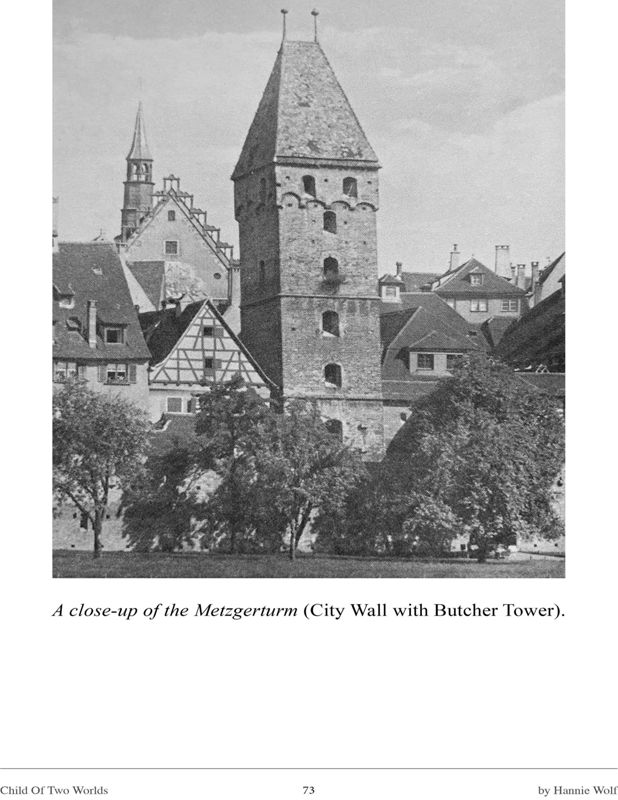
A close-up of the Metzgerturm (City Wall with Butcher Tower).
Child Of Two Worlds 73 by Hannie Wolf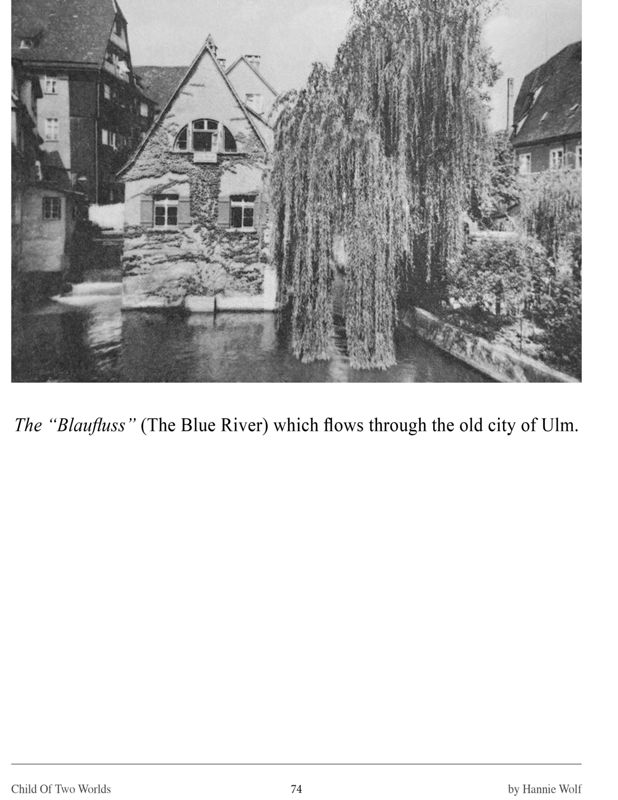
The “Blaufluss” (The Blue River) which flows through the old city of Ulm.
Child Of Two Worlds 74 by Hannie Wolf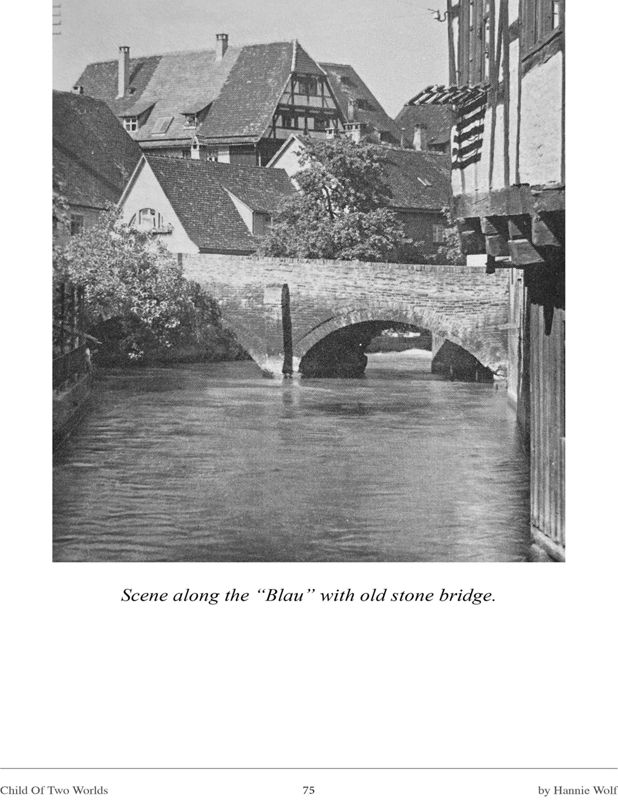
Scene along the “Blau” with old stone bridge.
Child Of Two Worlds 75 by Hannie Wolf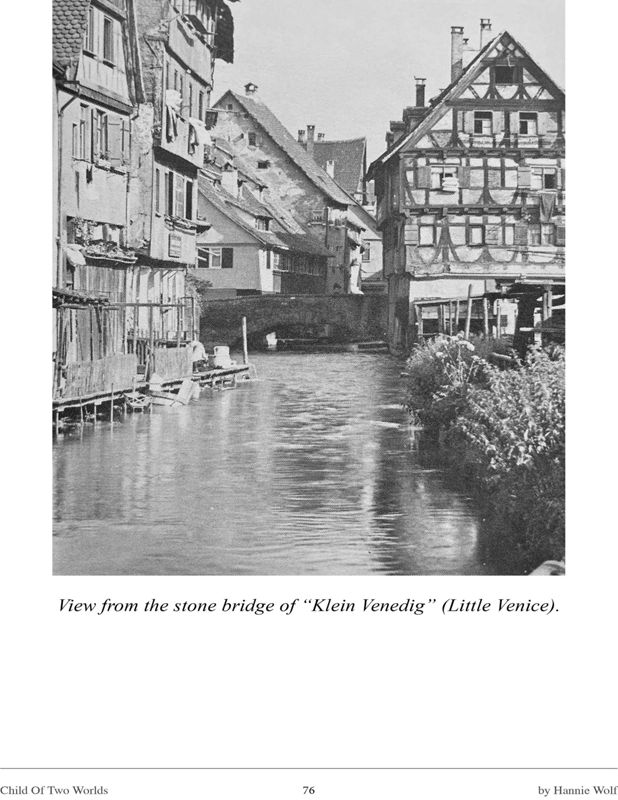
View from the stone bridge of “Klein Venedig” (Little Venice).
Child Of Two Worlds 76 by Hannie Wolf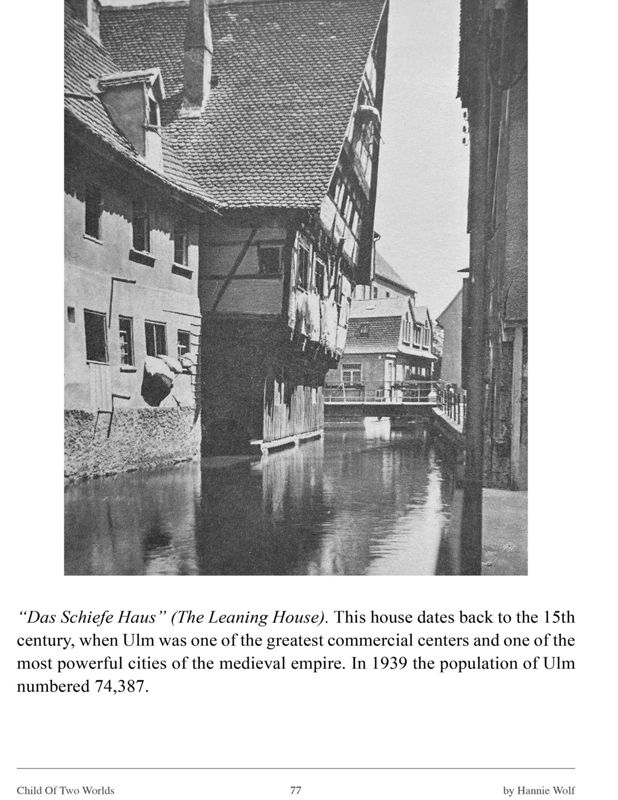
“Das Schiefe Haus” (The Leaning House). This house dates back to the 15th century, when Ulm was one of the greatest commercial centers and one of the most powerful cities of the medieval empire. In 1939 the population of Ulm numbered 74,387.
Child Of Two Worlds 77 by Hannie Wolf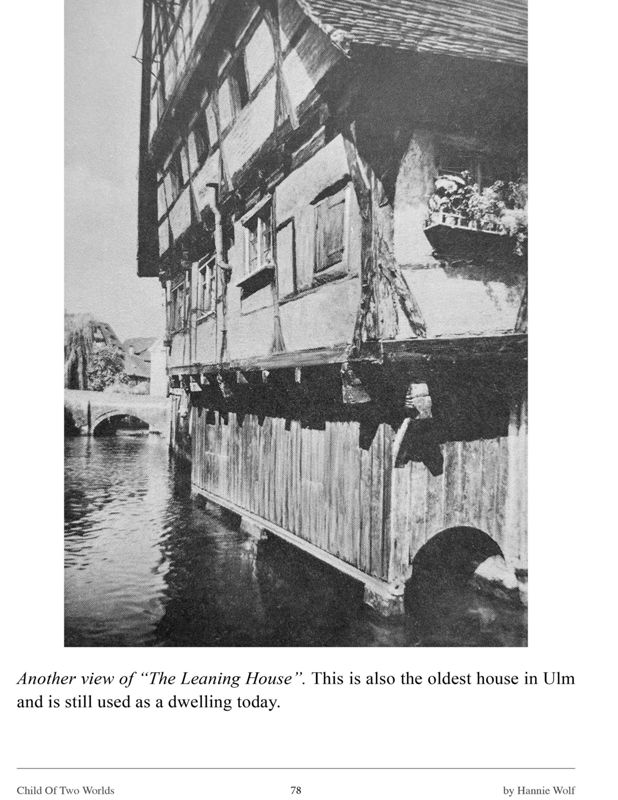
Another view of “The Leaning House”. This is also the oldest house in Ulm and is still used as a dwelling today.
Child Of Two Worlds 78 by Hannie Wolf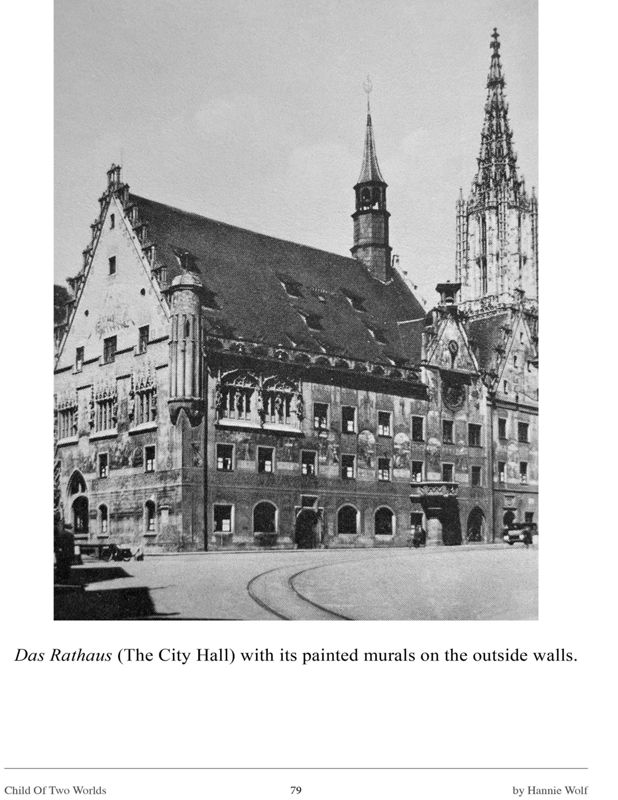
Das Rathaus (The City Hall) with its painted murals on the outside walls.
Child Of Two Worlds 79 by Hannie Wolf
CHAPTER III
The Snug Harbor
“A man’s house should be open to the north – to the south – to the east – to the west – so that the poor should not be put to trouble to finding entrance.”
Ethics of the Father of Rabbi Nathan VII
We had no idea what to expect of the United States, though the country was no stranger to us. By this time all of Papa’s family was living in this country, with the exception of his brother Sigbert and wife Lisl, who chose to remain in Germany.
We had read much about America, but had no conception of its vastness. All of our family had no money to help us. It was 1940, and the country was in the waning years of the depression.
We left the ship with mixed emotions, as we headed for the unknown.
Child Of Two Worlds 80 by Hannie Wolf
 Our first surprise came when we entered the streets of Seattle. If this was a country known for high
fashion, why were the people wearing such strange garb? Horrified we retreated into the hallway of an empty building. It was October 31, and no one had bothered to tell us that on Halloween young people dressed as goblins and ghosts.
Our first surprise came when we entered the streets of Seattle. If this was a country known for high
fashion, why were the people wearing such strange garb? Horrified we retreated into the hallway of an empty building. It was October 31, and no one had bothered to tell us that on Halloween young people dressed as goblins and ghosts.
One of our first meals in America consisted of scrambled eggs, toast and hash brown potatoes. On the ship we had learned to eat cornflakes, which had become a favorite breakfast food for Papa. Now that he got his first taste of a genuine American breakfast, he looked forward to eating eggs and potatoes many a morning.
It was a treat to see such brightly lit streets and so many automobiles. Where was everyone going? Europeans delight in honking their horns at every opportunity. In America the traffic moved smoothly and silently. Did they manufacture automobiles without horns in America?
It was late when we arrived at our hotel. The rooms were all right, but where were the wardrobe closets? We had never seen built-in closets and did not see them at first. When we found them we were amazed to see them stocked with wire hangers. There was a private bathroom. Towels, wash cloths and soap were furnished for the guests.
Exhausted we fell into our beds, only to be awakened a short time later by the wail of a siren. Papa rushed into my room, wearing only his nightclothes. He herded Mama and myself, wearing our pajamas, into the hallway and headed for the nearest elevator. It was in the days before self-service elevators. To the startled look of the operator and the passengers, Papa demanded, in broken English, that he take us to the basement immediately. We failed to understand how the people could remain so calm when Seattle had just been attacked by enemy aircraft. After considerable confusion and many explanations, we learned that we had been awakened by the siren of an ambulance. In time we became accustomed to the street noises of America.
Child Of Two Worlds 81 by Hannie Wolf
It was difficult for us to buy postage stamps then. Once we had accomplished that, it was even more difficult to find the mail boxes.
Signal lights also caused problems. There are few of them in Europe. Usually traffic is regulated by a policeman to whom no one pays any attention. In America traffic moved orderly. Not wanting to show our ignorance, we waited on street corners and followed the footsteps of other pedestrians.
On the ship we had made the acquaintance of a few Japanese businessmen. (It was a year before Pearl Harbor. In later years we often wondered just what “business” they had in America.) In those days we gladly accepted a hand of friendship from anyone. Many of the Japanese were well acquainted with Seattle. One evening they invited us to dinner at a lovely oriental restaurant. Later they took us to the movies where we saw Jeannette McDonald and Nelson Eddy in “New Moon”. It mattered little that we could not understand a word. The music was beautiful, and we were in good company.
In those days one could go to the movies all day long for twenty-five cents, sometimes it was just a dime. It was a cheap form of entertainment and a good way to learn English. I recall having seen “The Philadelphia Story” and “Gone with the Wind” at least three times, without understanding a single word of the dialogue.
Everyone in Seattle sported crazy lapel buttons, reading either “Roosevelt” or “Wilkie”. We did not know of the upcoming election. When so informed, we were amazed to see no rioting in the streets and no gunfire. The Roosevelt and Wilkie fans all seemed to be good buddies.
This was a strange land indeed. There were the drug stores that sold everything but drugs. How we loved the soda fountains! Ice cream was plentiful and cheap in those days. We gorged our war-starved stomachs on such concoctions as banana splits, milk shakes, malted milks, sodas and what have you. And we learned what an ice cream “sundae” was. It became our
Child Of Two Worlds 82 by Hannie Wolf
 favorite dessert. Once we were disappointed though. We went to an ice cream parlor and ordered “ice
coffee” and got just that. Coffee with plenty of ice cubes. In Europe ice coffee consisted of very
strong black coffee, vanilla ice cream and a glob of whipped cream on top.
favorite dessert. Once we were disappointed though. We went to an ice cream parlor and ordered “ice
coffee” and got just that. Coffee with plenty of ice cubes. In Europe ice coffee consisted of very
strong black coffee, vanilla ice cream and a glob of whipped cream on top.
Then there were those strange patties called “hamburgers” that no one in Hamburg ever heard of. And the “Frankfurters”? In Frankfurt they called them “wieners”.
There was no work to be found in Seattle. For the first time in his life, Papa had to accept charity from the Jewish Family Service. For him, who was so used to giving, this was a bitter pill to swallow. His pride was crushed. Within a short period of time Papa was able to pay back every cent. He was never able to accept charity from anyone again.
We were sent to Portland, Oregon where it was hoped we could find work, but again we were disappointed. There were not enough jobs for native Americans, let alone an impoverished refugee family who was unable to speak English.
Our home in Portland for the next six weeks was a furnished, dismal apartment in a small frame building. We had never seen frame houses. In Germany houses were built of brick. Our companions were the ever-present cockroaches. Entertainment was provided by the neighbor’s radio penetrating the thin walls of our apartment. A radio of our own was not yet within our reach.
We were unable to read the newspaper in any language. American newspapers were so large we wondered how much news could happen in a day. The headlines were always in bold print. News traveled slower then. There was no television, and radio provided mainly entertainment. The newsboy standing at the street corner provided the latest news. We watched in fascination as he cried out the latest bulletins, none of which made any sense to us, though we assumed the worst-like the outbreak of war.
Child Of Two Worlds 83 by Hannie Wolf
And always there was the rain. Not once did we see the sun shine during our brief stay in Portland.
Not everything was bleak. We spent much time at the supermarkets. This type of grocery store was new to us, and we never ceased to marvel at the wonders of modern merchandising. Indeed this was the land where milk and honey flows. Unable to read the labels we never knew just what we had purchased until we arrived home. We had difficulties finding eggs. Once we learned where to find the egg cartons, we ate our share. Dairy products and meats were very cheap in those days. We enjoyed the varieties of fruit. Our first cantaloupe, though, ended up in the garbage can. Never having eaten cantaloupe before, we did not know that you eat only the inside. Mama and I loved sweet corn, but Papa would never eat it. He maintained corn was strictly for feeding pigs!
Desperate for work and a place to live, we decided to accept the kind invitation of our Indian friend, Mr. Mehehwan Irani and move to Denver, Colorado, where Mama was to keep house for Mr. Irani and his friend, Mr. Menuh Naterwala, who was also a student at the School of Mines in Golden, Colorado. Papa might be able to find work, and we would have a home at last.
We arrived in Denver, Colorado on the beautiful Union Pacific streamliner, Portland Rose, on Christmas Eve 1940. Colorado greeted us with a cold, deep blue, sunny sky and a vast snow cover. Our friends had not yet arrived in Golden, so we settled into a small hotel, the Rainier Hotel, on Stout Street. Hungry from our long journey, we found the restaurants closed. To keep our spirits up we went to a movie and munched on candy bars. This was the season of joy, for us it was a time of misgivings and apprehension.
With the arrival of the new year our spirits soared. Our friends had located a beautiful, fully furnished brick bungalow with a large front porch on 766 Marion Street. We settled in, and our new lives in America began to
Child Of Two Worlds 84 by Hannie Wolf
 take shape.
I was enrolled in school, first as a pupil at Morey Junior High School, where I was tutored in English. This was a difficult time for me. I had to translate mentally each English sentence into German. By the time I had done so, the teacher was way ahead of me. There were a few refugee children in my class who had come to Denver before us. They helped me overcome my difficulties.
Most of the students being tutored in English at the Denver school were from European backgrounds, a change from the Portland school (which I attended briefly), where most of the children being tutored were Japanese.
In time I entered East High School. My clothes distinguished me from other pupils, and I felt self-conscience in my European garments, but there was no money for new clothes. This was the age of skirts and sweaters, bobby sox and saddle shoes. I was still wearing ugly cotton stockings. My heart ached for a pair of saddle shoes. When I was finally able to purchase my first pair, I was so proud I wanted to wear them to bed.
Not only did we encounter a language barrier, mathematics proved an equal stumbling block. Having been raised on the metric system, the linear measures caused a great deal of confusion. When at long last we could afford to buy some American clothes, we had difficulties making our sizes known. Mama, a rather petite woman, shocked the sales lady in the dress shop when she asked to try on a dress, size 42. The clerk in the shoe store was equally dumbfounded when Mama demanded to see a size 37 shoe.
I remember most vividly my 15th birthday, which I celebrated shortly after our arrival in the United States. Papa could ill afford a gift, but he came up with a tiny sterling silver pin in the shape of an American flag with 48 stars. When handing me the present he said that from now on I had a new country to love. I was to make this country proud of me, since it had literally given me back my life, and I must always show my gratitude to America for
Child Of Two Worlds 85 by Hannie Wolf
 having taken me under her wings. His dearest wish was that I would find happiness in America.
That night we celebrated by going to a cafeteria, only we had never been to a cafeteria and did not know what to expect. Waiting patiently at our table to be served, an elderly gentleman approached us and said, “This is a cafeteria. Here no one will come to wait on you. You must help yourself.” I have always felt this sums up the philosophy of America. It will always be a land of opportunity for those willing to help themselves.
In Germany we could go to a little restaurant, take along our own sandwiches and order a cup of coffee. We tried doing this in America just once, but the proprietor did not take kindly to us. He ordered us in no uncertain terms to leave his establishment.
As we refugees became more affluent, we discovered two restaurants in Denver that were suited to our tastes. The atmosphere was elegant and very European, as were the names of the “Café Edelweiss” and the two “Baur’s Restaurants.” Baur’s specialized in the best ice cream and pastries, whereas the “Café Edelweiss” served excellent meals at a price we could afford.
My given name caused considerable confusion. Had Mama known we would someday be living in America, she would never have named me Hanne Lore. When people called me “honey”, I assumed it was a pronunciation of “Hanne”. For many years I was “honey” until the nickname became “Hannie”.
As newcomers in Denver many people treated us with profound kindness. Mr. Friedman from the Jewish Family Service eased the transition for us. Mrs. Tillie Levy gave generously of her time to minister to the needs of the newly arrived refugees. One of her first acts was to pack me off to school and catapult me into the mainstream American life. Mr. and Mrs. Max Grimes often entertained newcomers on the grounds of their spacious home. Members of the National Council of Jewish Women offered their help. Mrs. Jack Weil saw to our social needs. Mrs. Anna Greenbaum volunteered teaching
Child Of Two Worlds 86 by Hannie Wolf
 English to the newly arrived immigrants, and Mrs. Sarah Fine tutored us in American Citizenship
classes. Because of their efforts, we were able to pass the tests required prior to becoming American citizens.
English to the newly arrived immigrants, and Mrs. Sarah Fine tutored us in American Citizenship
classes. Because of their efforts, we were able to pass the tests required prior to becoming American citizens.
Professor Walter Roloff and his wife invited us to their home in Golden, Colorado on many occasions. He was a professor at the School of Mines and spoke German fluently. Mrs. Roloff was a gracious hostess who taught us how to enjoy the wide variety of American salads.
Our neighbors on Marion Street were Dr. Agnes Jones and her husband, Frank. They helped us through many difficult situations. It was Dr. Jones who was the proudest when I received my high school diploma in 1943.
Not all people overwhelmed us with kindness. The depression was in its final days, and there were those who resented the refugees coming to America to take jobs away from the native Americans. While none of us ever received any government or state aid, there was nonetheless some segment of the population against us.
We were still living with our friends from India when Mr. Irani, an expert roller skater, decided he would make a skater out of me. Having no athletic ability of any kind, I spent most of my time polishing the floor of the roller rink and came home with more bruises than a football player.
Unable to become accustomed to their way of life, we parted company with our Indian friends and set out on our own. We left the comfortable bungalow on Marion Street and moved into a small third floor furnished apartment in a red brick house on 1458 Gaylord Street. We lived in very modest circumstances, but at last we were on our own.
In those days one had to apply for “First Papers”, prior to taking out citizenship papers. Papa, who spoke little English, thought it always safe to say “no”. When he appeared at the Court House, and the clerk asked him to “raise your right hand and swear to tell the truth and nothing but the truth, “Papa raised his right hand and said, “no”. He received his papers just the
Child Of Two Worlds 87 by Hannie Wolf
 same.
same.
Papa found work as a custodian at the National Jewish Hospital. Mama was employed as a sales clerk in a dime store. I attended high school and earned money baby sitting in the evenings and on weekends.
There was little time for extra-curricular activities, but I reached the pinnacle of my school days one summer when I was asked, along with other students, to perform a song and dance number before a delegation from the National Education Assn. at Denver’s Red Rocks Amphitheatre.
I went to Sunday school at the B M H Congregation which was just a few blocks from our home and found part-time work in the office of the synagogue. At least I earned my spending money. The late Rabbi Kauvar became my good friend. I excelled in Hebrew and religious studies and still entertained the hope of someday entering a Seminary. My religious training ended with my confirmation after graduating from religious school.
An automobile was beyond our reach. We either walked or used public transportation. We enjoyed the Amusement Parks of Elitch Gardens and Lakeside, and the subtle beauty of Sloan’s Lake. There was the City Park where one could visit the zoo, the museums, go boating on the lake or listen to free band concerts during the summer, while watching the colorful fountain on City Park Lake. One could enjoy a lazy Sunday afternoon in the gardens of Washington Park, or cool off in the swimming pool there. We went for walks in Cheeseman Park and enjoyed the free operettas put on by the Denver Post in the park every summer. Sometimes we went to Golden by streetcar, or ventured by bus to Colorado Springs and the surrounding areas.
On the Fourth of July there was always a free fireworks display at the Denver University Stadium. We shared the traditional Thanksgiving Day dinner with friends. At Thanksgiving I was first introduced to American football by friends who took me to see the annual battle fought on the gridiron between the University of Colorado and Denver University.
Child Of Two Worlds 88 by Hannie Wolf
One incident from those early days stands out clearly in my mind. We spent many summer hours walking through the city parks. One day we came upon a park that had the most beautifully manicured lawn our eyes had ever seen. It was sheer comfort just to walk on the soft, cushioned turf.
After a time Papa noticed a little white ball lying on the ground. Curious to see what it was made of, he picked it up and examined it carefully. We came across a few more white balls. Each time Papa picked them up and then threw them on the grass.
We spotted a coffee shop. Being hungry from our long walk, we perched ourselves on the bar stools and ordered coffee and rolls, which the waiter promptly served us.
Some time later a few men entered the coffee shop. They seemed to be upset about something and had a perplexed look on their faces. We did not catch all of their conversation, the context of which was the mysterious disappearance of their golf balls.
We had inadvertently come across the Berkeley Park Golf Course and were now enjoying a snack, not a restaurant, but the Clubhouse.
It was Papa’s first and last encounter with the game of golf.
For an extra special treat we went to Stapleton Airport on Sunday afternoons with friends who were fortunate to own a car. Instead of watching the trains go by, as we did in Germany, we now stood perched atop the observation deck of the small terminal building and watched the planes take off and land. In those early days Stapleton Airport was one small building and a few runways. Later on a coffee shop was added where one could buy a fine meal, consisting of turkey wings, peas, mashed potatoes, rolls and plenty of hot coffee for just 75 cents. We were literally on “top of the world.”
We befriended a real estate agent, whose office was in his home. He
Child Of Two Worlds 89 by Hannie Wolf
 and his wife graciously showed us their modest bungalow. While Mama never attained her dream of
owning her own home in America, she was always eager to see how Americans lived. She decided not all was well. Not only were most Americans poor, some we downright destitute. Mama’s linen closet housed enough linens and towels to supply a hotel. In America the cupboard was nearly bare. Mama did not realize that in America most women had washing machines and had no need to lay in a large supply of linen.
and his wife graciously showed us their modest bungalow. While Mama never attained her dream of
owning her own home in America, she was always eager to see how Americans lived. She decided not all was well. Not only were most Americans poor, some we downright destitute. Mama’s linen closet housed enough linens and towels to supply a hotel. In America the cupboard was nearly bare. Mama did not realize that in America most women had washing machines and had no need to lay in a large supply of linen.
Once we were invited to a baby shower in our apartment building. We did not know what a baby shower was. All we had been told was to bring a baby gift. When we saw the table laden with beautifully wrapped parcels, we were embarrassed to hand over our unwrapped gift. In Germany gifts were not always wrapped.
Pearl Harbor shocked the nation a year after we had come to America. Once more we were faced with the prospect of war. Our family did not escape unscathed. The son of one of Papa’s cousins died while serving in the Armed Forces of his newly adopted country, as is seen in this obituary notice from the “Aufbau”, a German Jewish newspaper printed in New York City, “T/Sgt. John Lowenthal was born in 1920 in Kuenzelsau/Wuerttemberg and emigrated to the United States in 1937, where he lived with relatives in Lafayette, Indiana. He was later drafted in December, 1942. A few months later he was sent to England and to North Africa and eventually to Italy, where he was killed in action on October 12, 1944. He is survived by his parents, who live in Philadelphia, and a brother, Eric, a chemist living in England.”
Along with other girlfriends I joined the USO and spent many hours working behind the soda fountain in the canteen. There were dances and picnics in the mountains to entertain the servicemen who were stationed at the two large air bases in Denver. After the war many of these soldiers settled in Denver permanently. I often wondered how many of the boys I met in those days survived World War II.
Child Of Two Worlds 90 by Hannie Wolf
After graduation from high school, I attended Barnes Business College. Anxious to strike out on my own, I was happy with my first job which paid $15.00 per week. Eventually I found employment as a secretary for a large Insurance Company. Mama also found a better job, and in time retired to become a full-time housewife. Papa became the proprietor of a downtown parking lot in Denver.
On May 2, 1946 just as we were about to be sworn in as U.S. citizens, we were summoned outside by a clerk of the court. Fearful that something had gone amiss with our papers, we were relieved to find only a reporter from the Denver Post who wanted to take our picture for the newspaper.
All new citizens were being honored at “I AM AN AMERICAN DAY”, as can be seen from this article printed in the Denver Post, “Two hundred and fifty Denver citizens, naturalized since May, 1945, will be the honored guests at “I Am An American Day” ceremonies in the city auditorium, May 19. The Rt. Rev. Msgr. Edward Joseph Flanagan, director of Boy’s Town, near Omaha, will speak on “Americans In The Making”.
The celebration is being sponsored by the city with the co-operation of various clubs, lodges and veteran organizations. Louis A. MccElroy is chairman of the program committee.
I AM AN AMERICAN DAY, originally known as Citizenship day, was designated as the third Sunday of May in each year in a resolution adopted by Congress in 1940. The purpose of the day is to dignify and honor American citizenship, particularly as it relates to those newly naturalized and to those coming of voting age.
Sometime after my picture had appeared in the Denver Post, I received a message from an unknown admirer congratulating me on becoming a U.S. citizen. This was my response: “Please let me express my sincere thanks for your letter of June 3, 1946 and the good wishes expressed therein. I am glad to notice that there are some Americans who appreciate their country
Child Of Two Worlds 91 by Hannie Wolf
 and who do not take all the privileges for granted. I have lived in Denver for a number of years,
attended Denver schools and am now employed as a stenographer. I am making my home with my mother
and father, both of whom received their citizenship papers and also wish to thank you for congratulating us on becoming citizens. You may rest assured that I will try my best to live up to the responsibilities of being an American citizen. Ours is a nation consisting of refugees from many lands, all of whom came here to enjoy the four freedoms. It is our responsibility today to see to it that the entire world may enjoy the four freedoms tomorrow, the tomorrow which we hope may soon become today.” A few weeks later I received a phone call from the Bureau of Naturalization and Immigration, asking me to come to their offices. This time I was sure the privilege of my American citizenship would be taken from me, though I had no reason for such action. My fears, however, were unfounded when I learned I had been chosen as one of the speakers for the “New Citizens Day” luncheon, sponsored by the Kiwanis Club.
and who do not take all the privileges for granted. I have lived in Denver for a number of years,
attended Denver schools and am now employed as a stenographer. I am making my home with my mother
and father, both of whom received their citizenship papers and also wish to thank you for congratulating us on becoming citizens. You may rest assured that I will try my best to live up to the responsibilities of being an American citizen. Ours is a nation consisting of refugees from many lands, all of whom came here to enjoy the four freedoms. It is our responsibility today to see to it that the entire world may enjoy the four freedoms tomorrow, the tomorrow which we hope may soon become today.” A few weeks later I received a phone call from the Bureau of Naturalization and Immigration, asking me to come to their offices. This time I was sure the privilege of my American citizenship would be taken from me, though I had no reason for such action. My fears, however, were unfounded when I learned I had been chosen as one of the speakers for the “New Citizens Day” luncheon, sponsored by the Kiwanis Club.
In time I mastered the English language to the extent that today I dream in English. In 1947 I married the man who has been my husband for 32 years.
Papa vowed that he would never return to Germany, the land to which he had given the best years of his life. He was never able to gain a proper foothold in America. He died, a man broken in body and spirit, in Denver, Colorado on June 30, 1965.
Mama and I set foot once more on German soil in September 1970. It was a sentimental journey to retrace the steps of our past. Only this time we returned not as stateless persons, but as citizens of a free country.
We are still the children of two worlds, but we have captured the best of those two worlds.
Child Of Two Worlds 92 by Hannie Wolf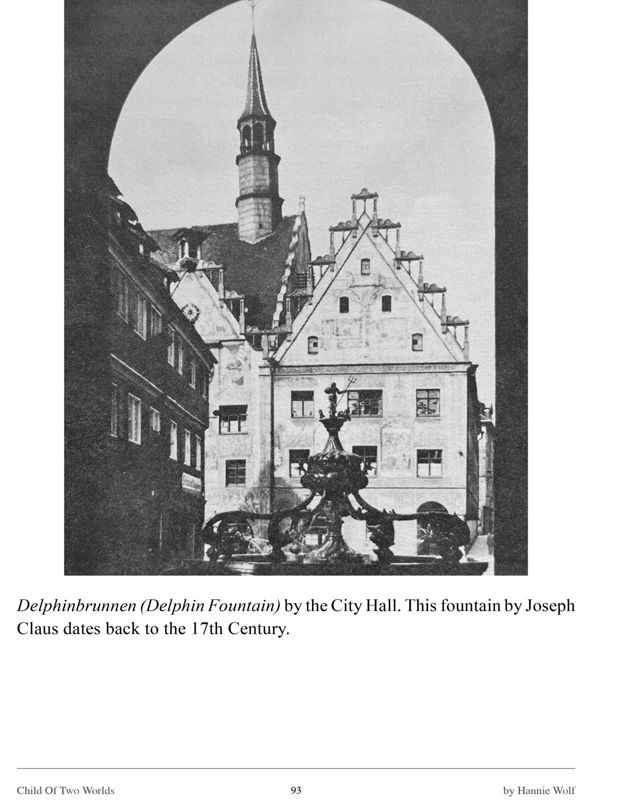
Delphinbrunnen (Delphin Fountain) by the City Hall. This fountain by Joseph Claus dates back to the 17th Century.
Child Of Two Worlds 93 by Hannie Wolf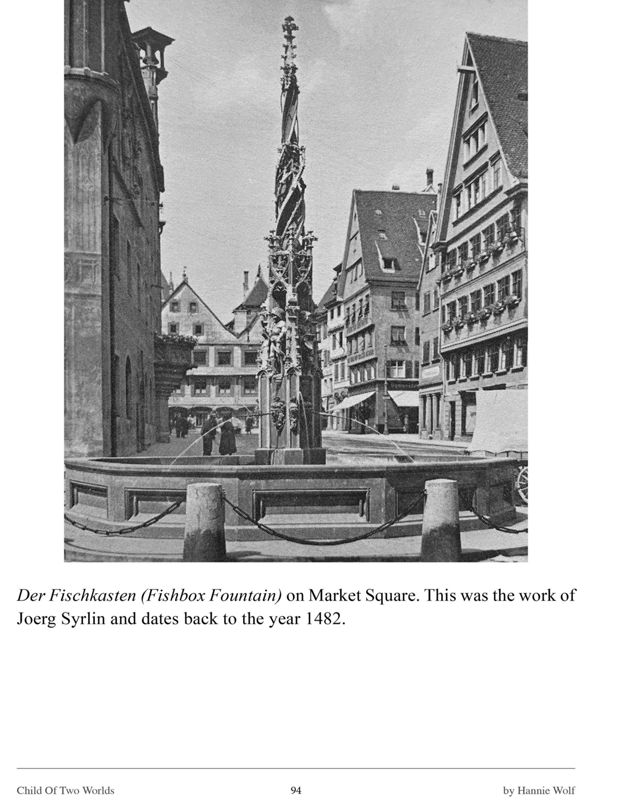
Der Fischkasten (Fishbox Fountain) on Market Square. This was the work of Joerg Syrlin and dates back to the year 1482.
Child Of Two Worlds 94 by Hannie Wolf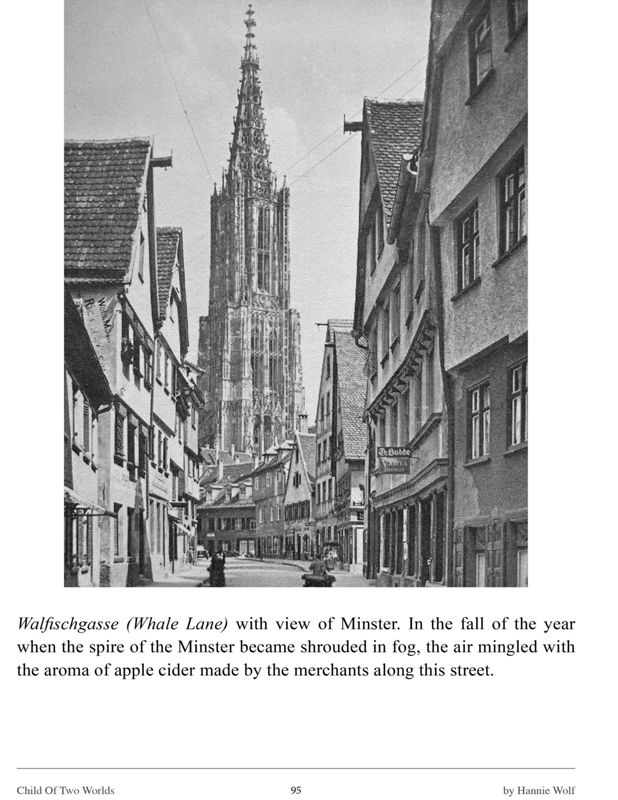
Walfischgasse (Whale Lane) with view of Minster. In the fall of the year when the spire of the Minster became shrouded in fog, the air mingled with the aroma of apple cider made by the merchants along this street.
Child Of Two Worlds 95 by Hannie Wolf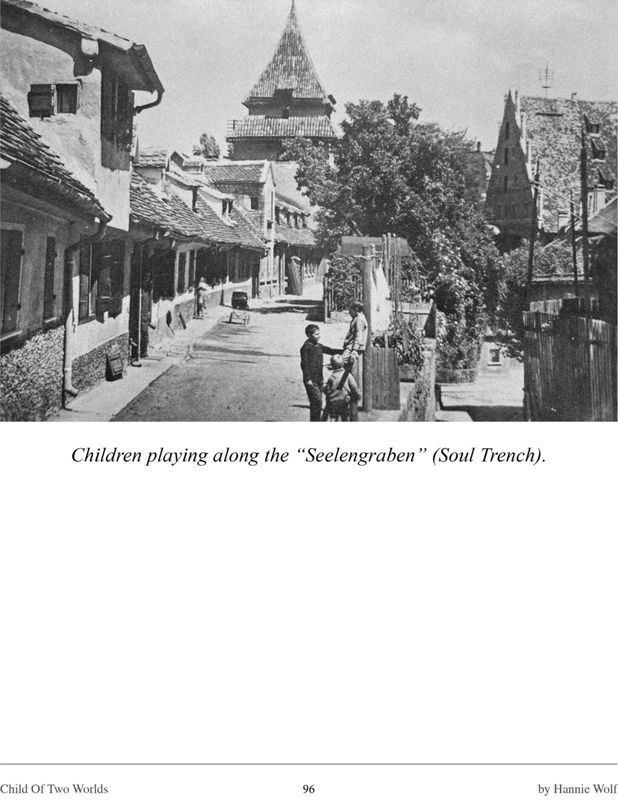
Children playing along the “Seelengraben” (Soul Trench).
Child Of Two Worlds 96 by Hannie Wolf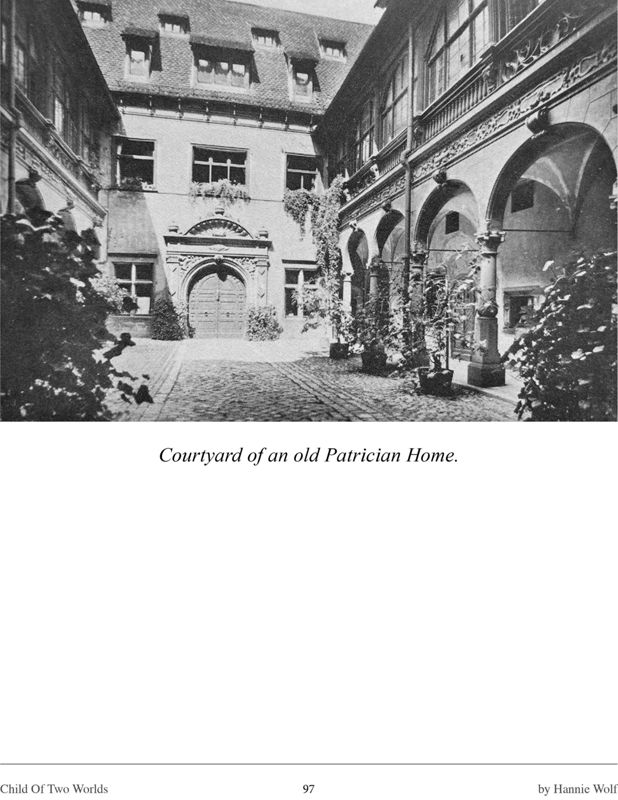
Courtyard of an old Patrician Home.
Child Of Two Worlds 97 by Hannie Wolf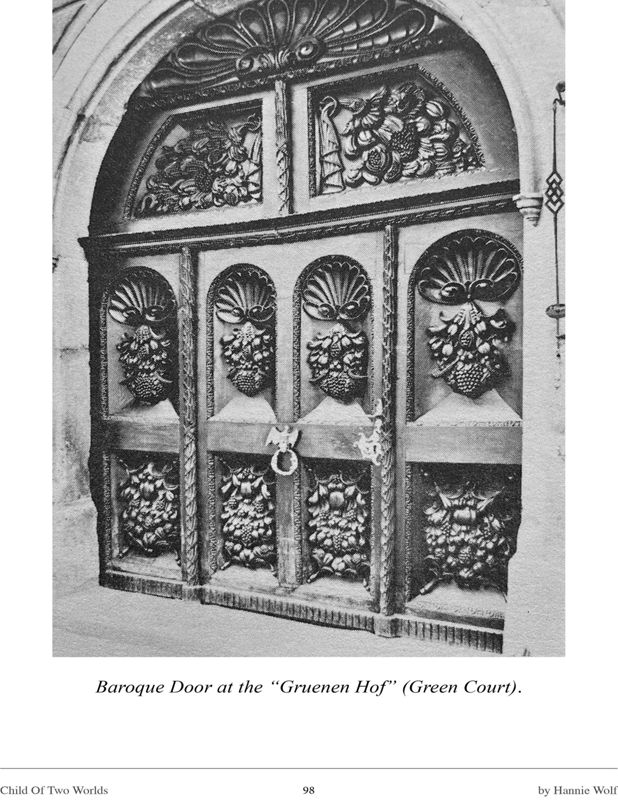
Baroque Door at the “Gruenen Hof” (Green Court).
Child Of Two Worlds 98 by Hannie Wolf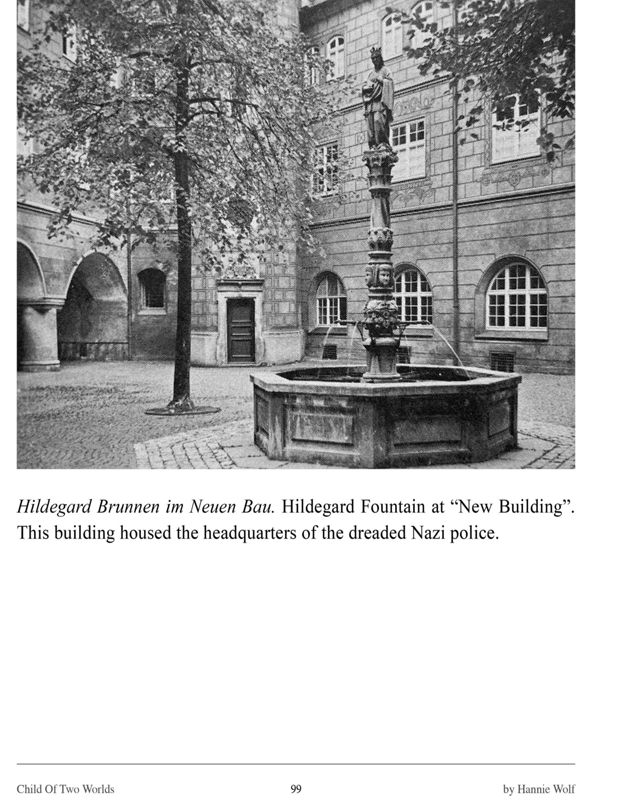
Hildegard Brunnen im Neuen Bau. Hildegard Fountain at “New Building”. This building housed the headquarters of the dreaded Nazi police.
Child Of Two Worlds 99 by Hannie Wolf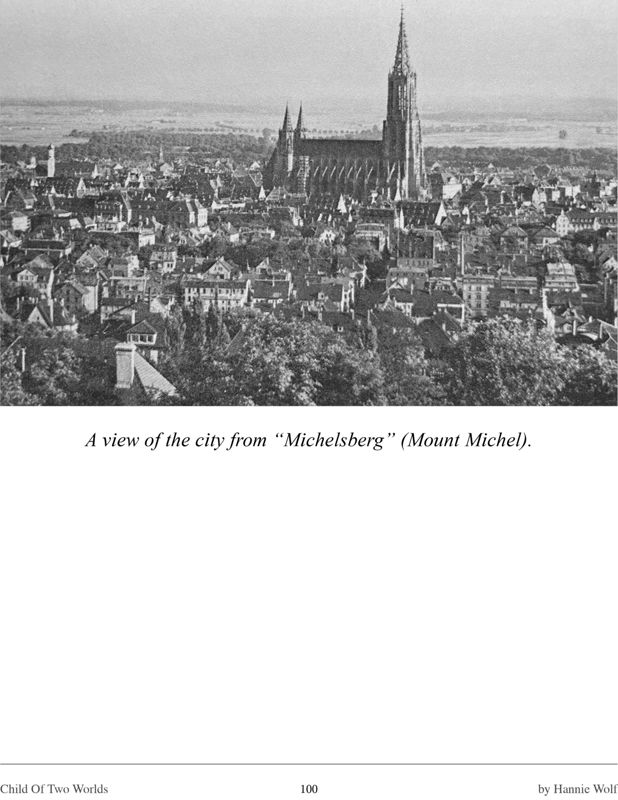
A view of the city from “Michelsberg” (Mount Michel).
Child Of Two Worlds 100 by Hannie Wolf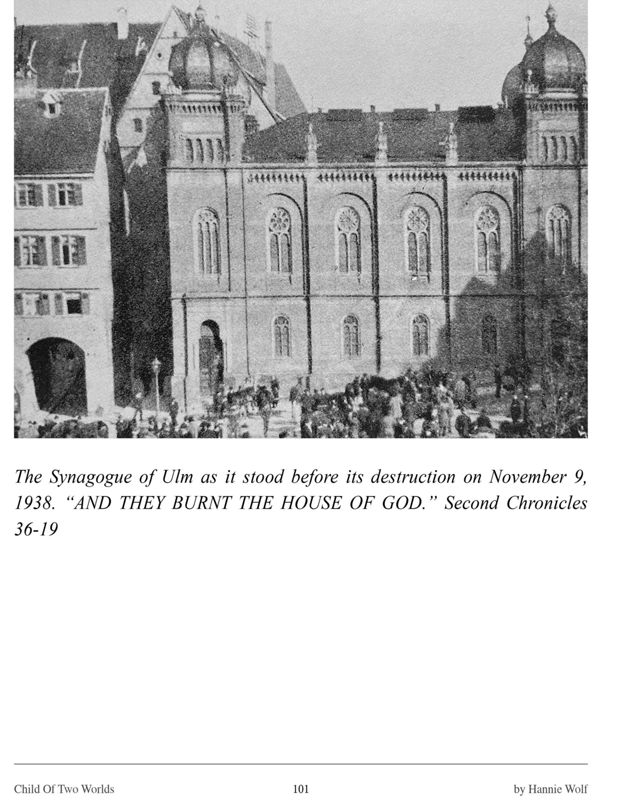
The Synagogue of Ulm as it stood before its destruction on November 9, 1938. “AND THEY BURNT THE HOUSE OF GOD.” Second Chronicles 36-19
Child Of Two Worlds 101 by Hannie Wolf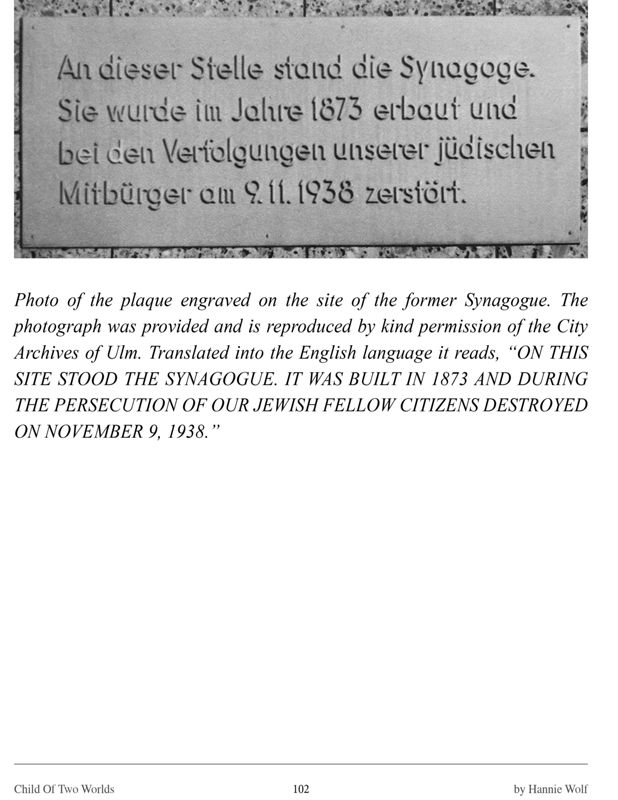
Photo of the plaque engraved on the site of the former Synagogue. The photograph was provided and is reproduced by kind permission of the City Archives of Ulm. Translated into the English language it reads, “ON THIS SITE STOOD THE SYNAGOGUE. IT WAS BUILT IN 1873 AND DURING THE PERSECUTION OF OUR JEWISH FELLOW CITIZENS DESTROYED ON NOVEMBER 9, 1938.”
Child Of Two Worlds 102 by Hannie Wolf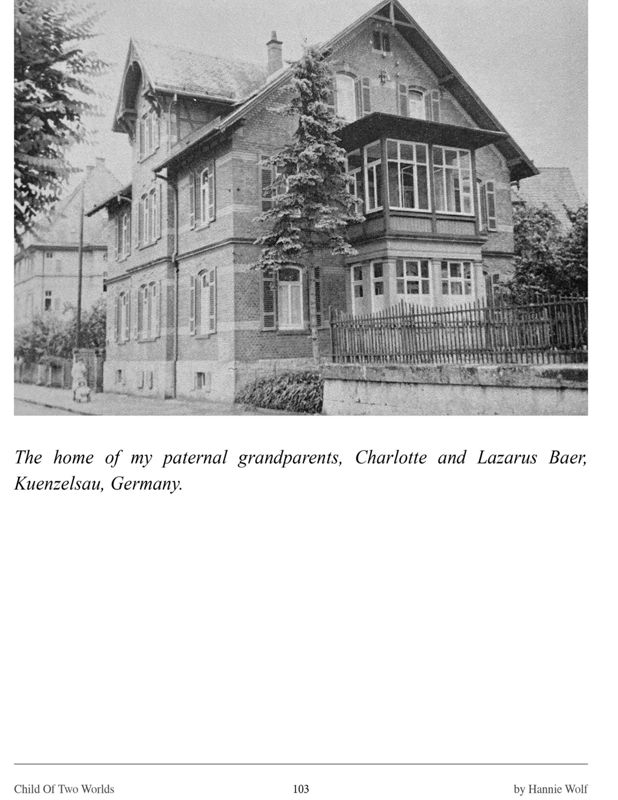
The home of my paternal grandparents, Charlotte and Lazarus Baer, Kuenzelsau, Germany.
Child Of Two Worlds 90 by Hannie Wolf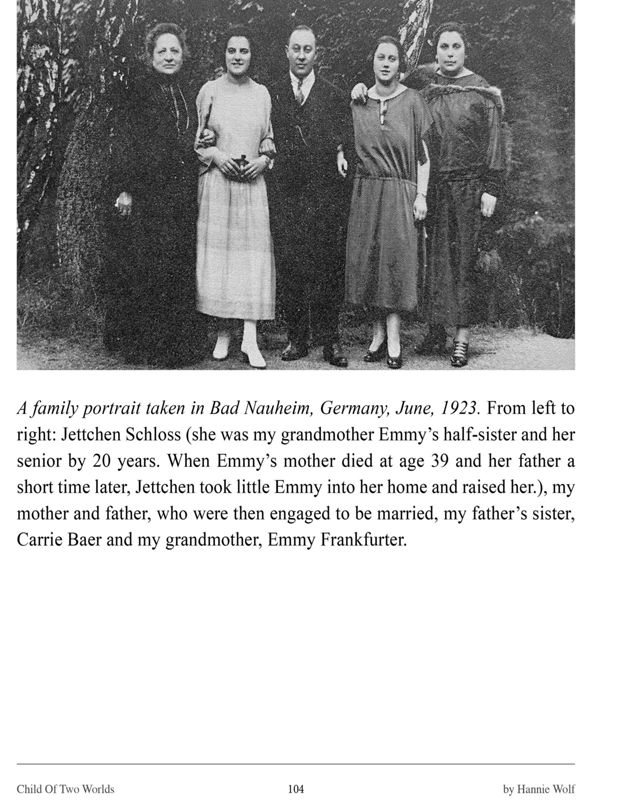
A family portrait taken in Bad Nauheim, Germany, June, 1923. From left to right: Jettchen Schloss (she was my grandmother Emmy’s half-sister and her senior by 20 years. When Emmy’s mother died at age 39 and her father a short time later, Jettchen took little Emmy into her home and raised her.), my mother and father, who were then engaged to be married, my father’s sister, Carrie Baer and my grandmother, Emmy Frankfurter.
Child Of Two Worlds 104 by Hannie Wolf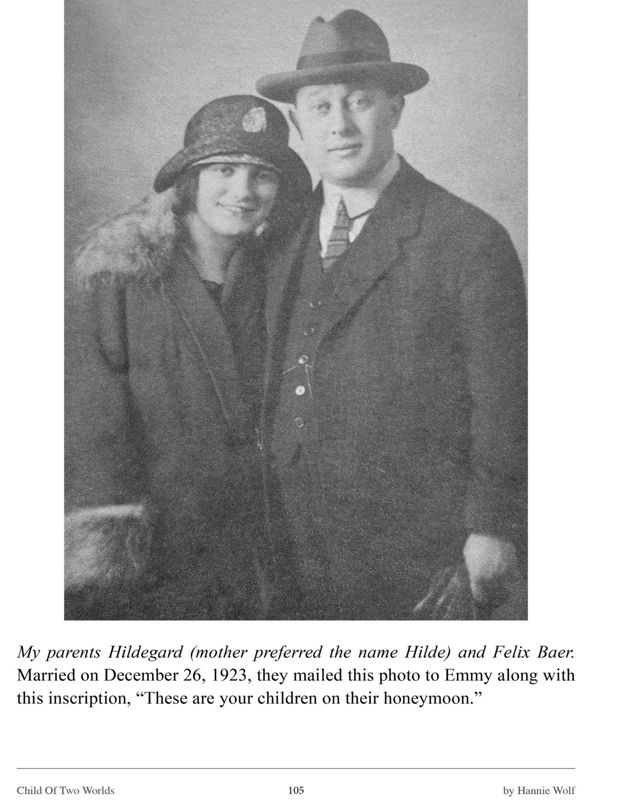
My parents Hildegard (mother preferred the name Hilde) and Felix Baer. Married on December 26, 1923, they mailed this photo to Emmy along with this inscription, “These are your children on their honeymoon.”
Child Of Two Worlds 105 by Hannie Wolf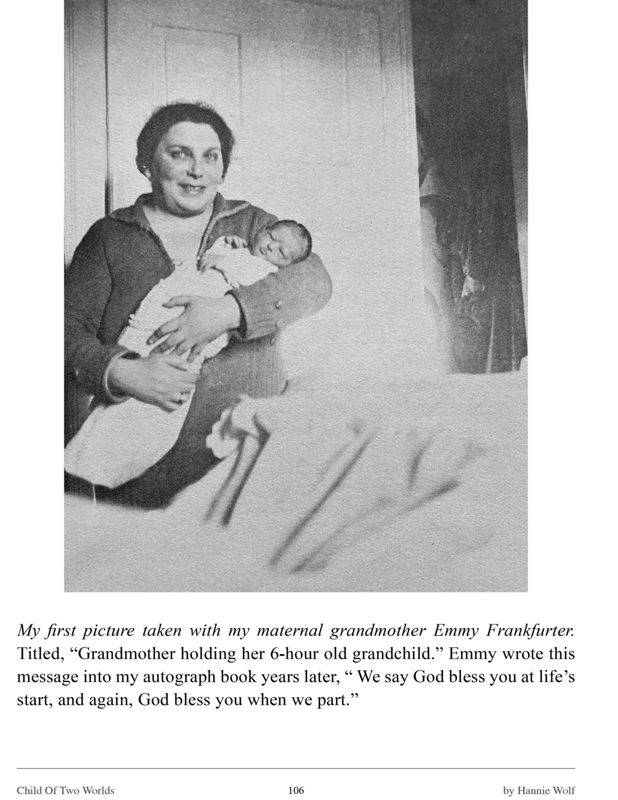
My first picture taken with my maternal grandmother Emmy Frankfurter. Titled, “Grandmother holding her 6-hour old grandchild.” Emmy wrote this message into my autograph book years later, “ We say God bless you at life’s start, and again, God bless you when we part.”
Child Of Two Worlds 106 by Hannie Wolf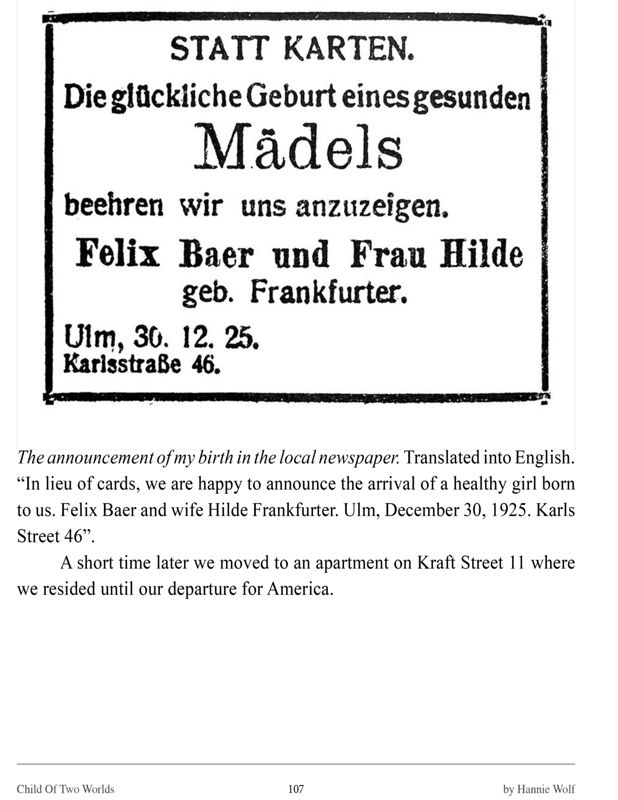
The announcement of my birth in the local newspaper. Translated into English. “In lieu of cards, we are happy to announce the arrival of a healthy girl born to us. Felix Baer and wife Hilde Frankfurter. Ulm, December 30, 1925. Karls Street 46”.
A short time later we moved to an apartment on Kraft Street 11 where we resided until our departure for America.
Child Of Two Worlds 107 by Hannie Wolf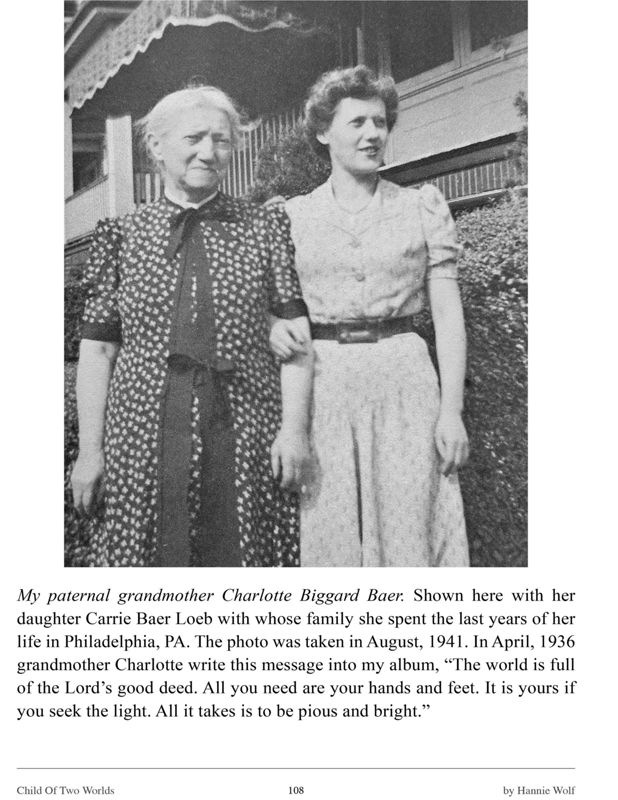
My paternal grandmother Charlotte Biggard Baer. Shown here with her daughter Carrie Baer Loeb with whose family she spent the last years of her life in Philadelphia, PA. The photo was taken in August, 1941. In April, 1936 grandmother Charlotte write this message into my album, “The world is full of the Lord’s good deed. All you need are your hands and feet. It is yours if you seek the light. All it takes is to be pious and bright.”
Child Of Two Worlds 108 by Hannie Wolf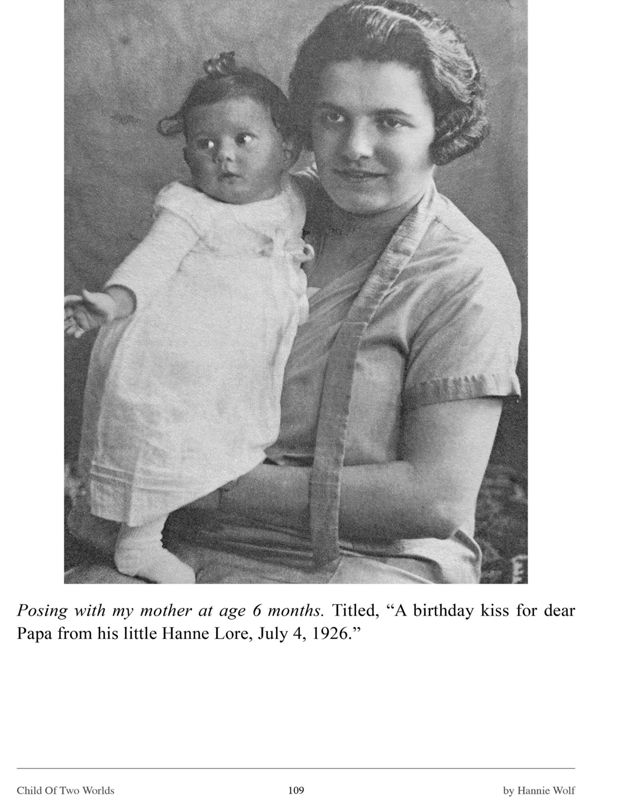
Posing with my mother at age 6 months. Titled, “A birthday kiss for dear Papa from his little Hanne Lore, July 4, 1926.”
Child Of Two Worlds 109 by Hannie Wolf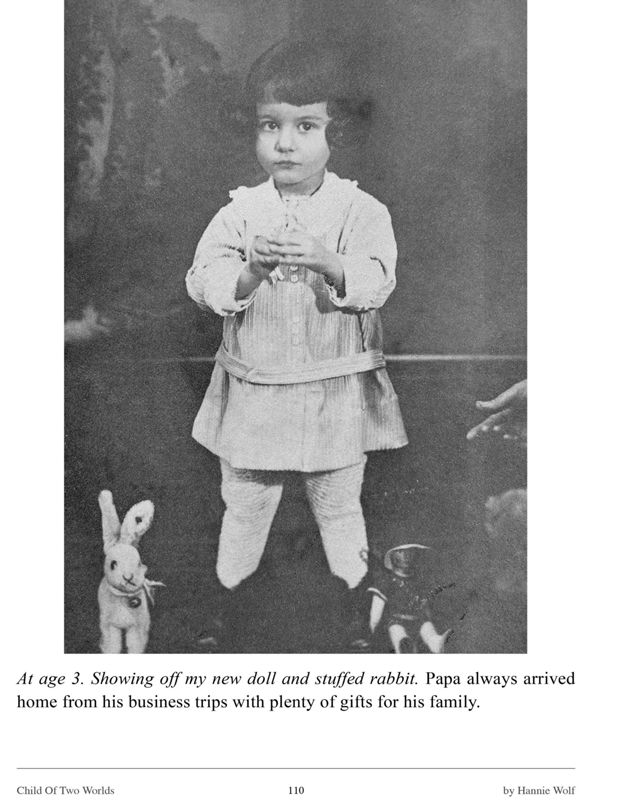
At age 3. Showing off my new doll and stuffed rabbit. Papa always arrived home from his business trips with plenty of gifts for his family.
Child Of Two Worlds 110 by Hannie Wolf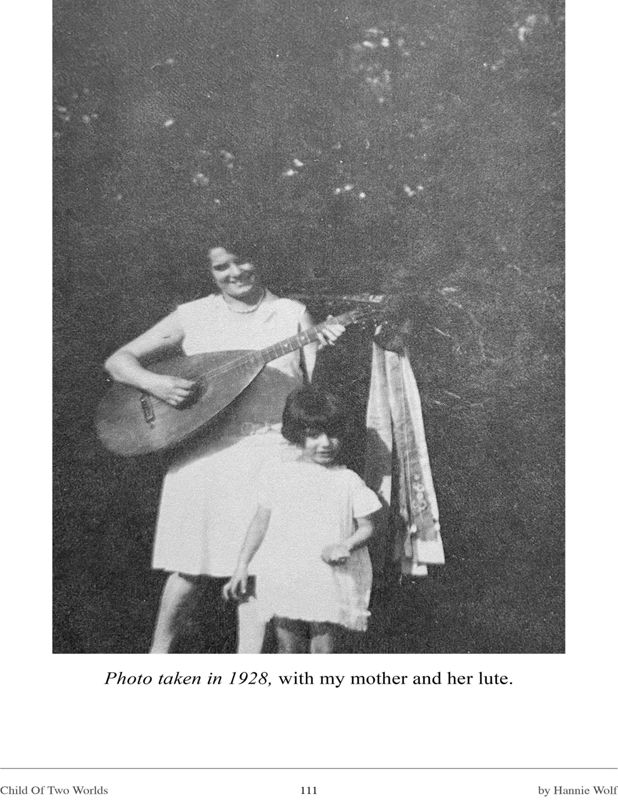
Photo taken in 1928, with my mother and her lute.
Child Of Two Worlds 111 by Hannie Wolf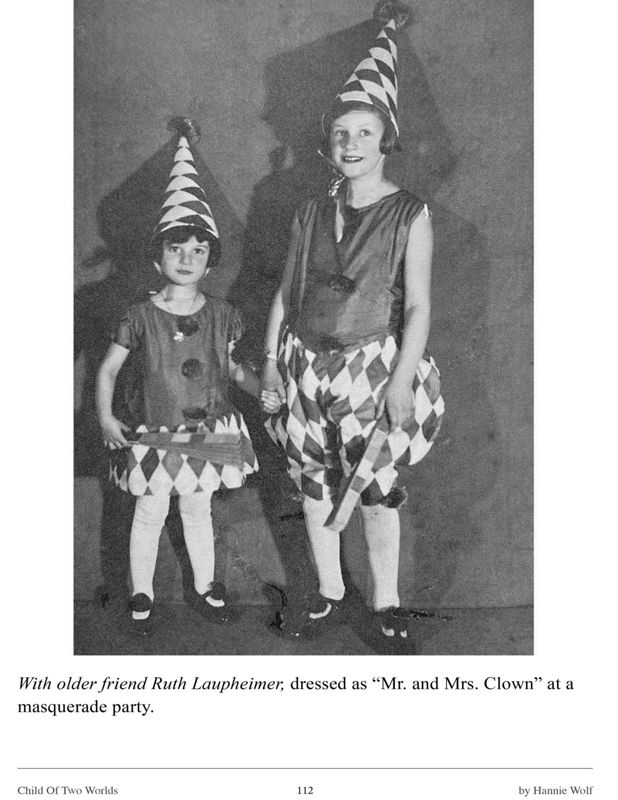
With older friend Ruth Laupheimer, dressed as “Mr. and Mrs. Clown” at a masquerade party.
Child Of Two Worlds 112 by Hannie Wolf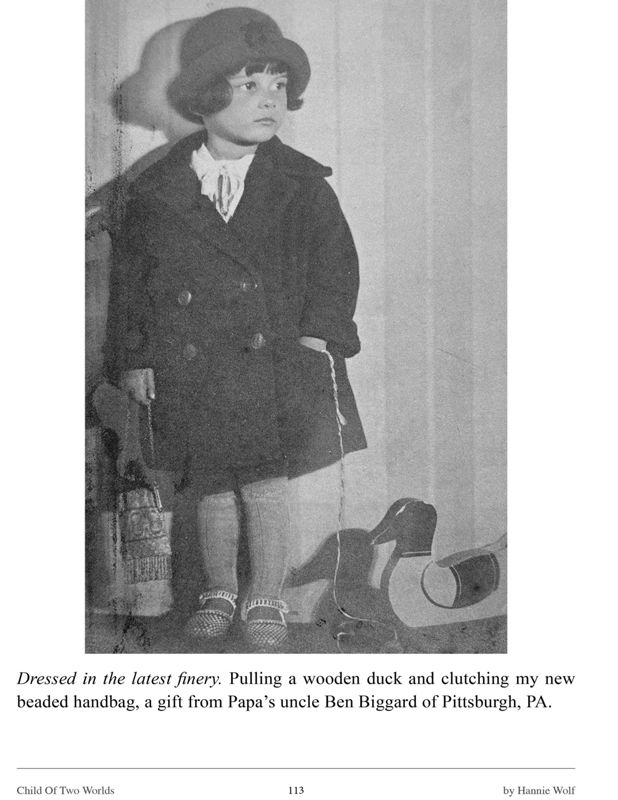
Dressed in the latest finery. Pulling a wooden duck and clutching my new beaded handbag, a gift from Papa’s uncle Ben Biggard of Pittsburgh, PA.
Child Of Two Worlds 113 by Hannie Wolf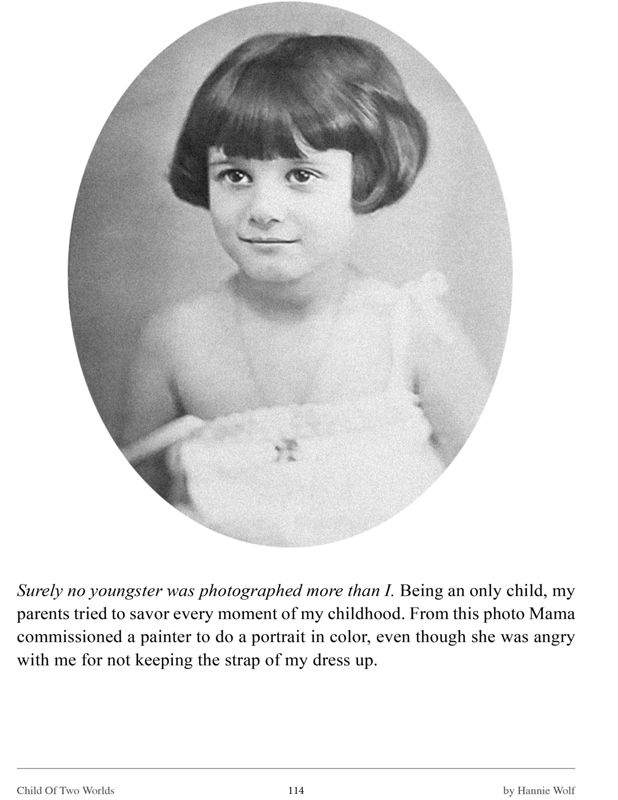
Surely no youngster was photographed more than I. Being an only child, my parents tried to savor every moment of my childhood. From this photo Mama commissioned a painter to do a portrait in color, even though she was angry with me for not keeping the strap of my dress up.
Child Of Two Worlds 114 by Hannie Wolf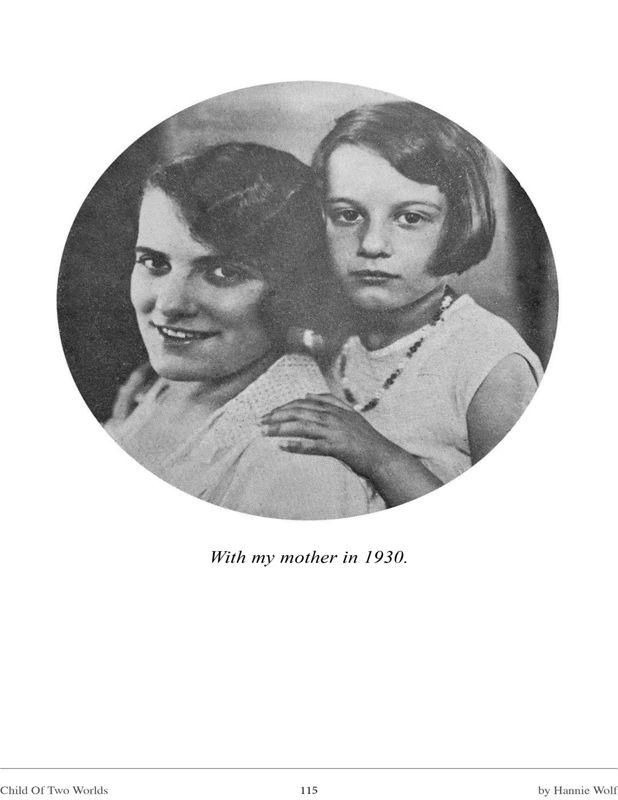
With my mother in 1930.
Child Of Two Worlds 115 by Hannie Wolf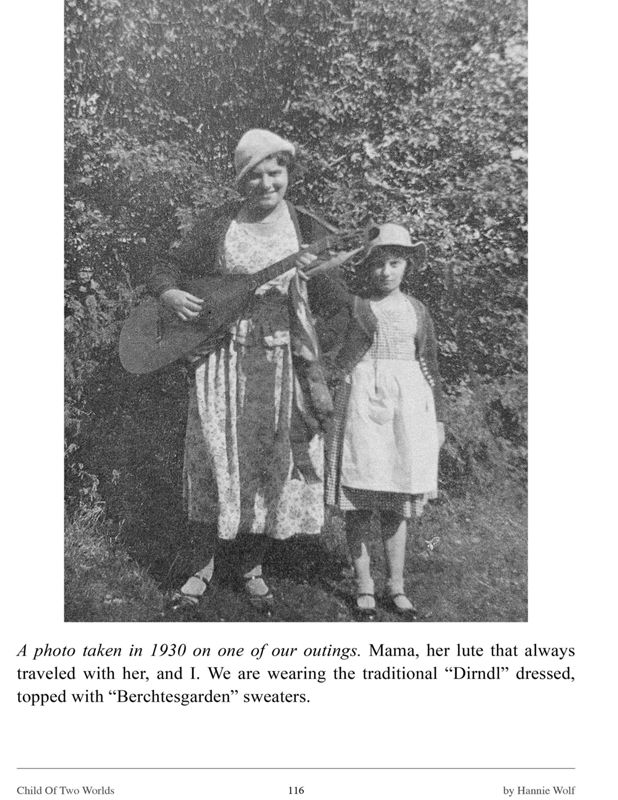
A photo taken in 1930 on one of our outings. Mama, her lute that always traveled with her, and I. We are wearing the traditional “Dirndl” dressed, topped with “Berchtesgarden” sweaters.
Child Of Two Worlds 116 by Hannie Wolf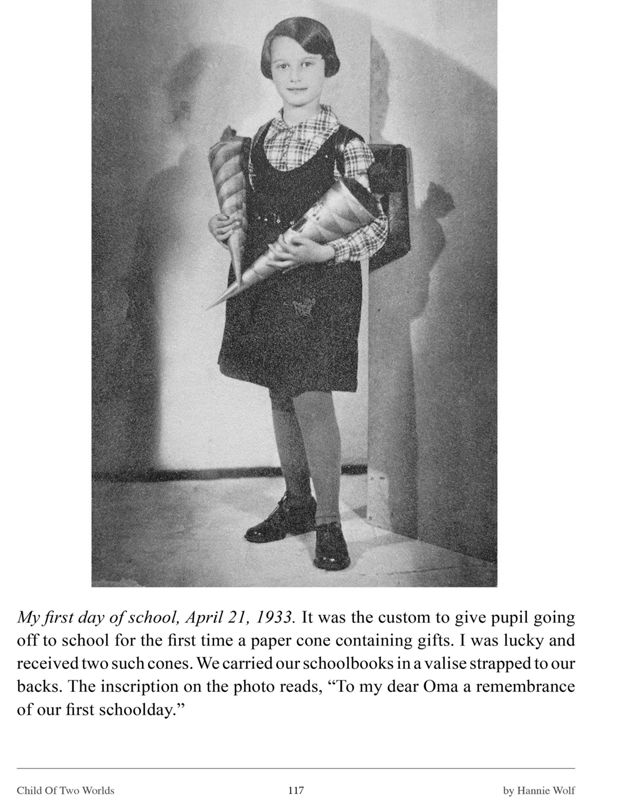
My first day of school, April 21, 1933. It was the custom to give pupil going off to school for the first time a paper cone containing gifts. I was lucky and received two such cones. We carried our schoolbooks in a valise strapped to our backs. The inscription on the photo reads, “To my dear Oma a remembrance of our first schoolday.”
Child Of Two Worlds 117 by Hannie Wolf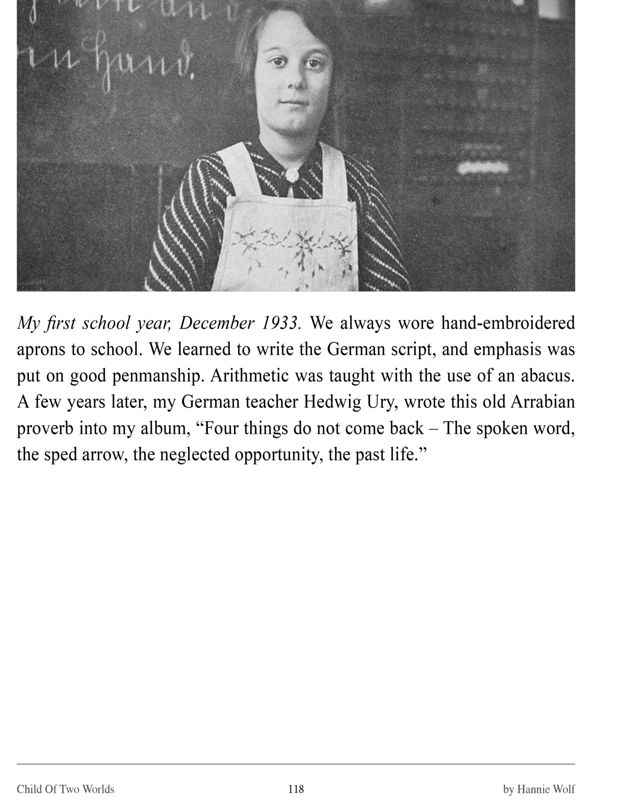
My first school year, December 1933. We always wore hand-embroidered aprons to school. We learned to write the German script, and emphasis was put on good penmanship. Arithmetic was taught with the use of an abacus. A few years later, my German teacher Hedwig Ury, wrote this old Arrabian proverb into my album, “Four things do not come back – The spoken word, the sped arrow, the neglected opportunity, the past life.”
Child Of Two Worlds 118 by Hannie Wolf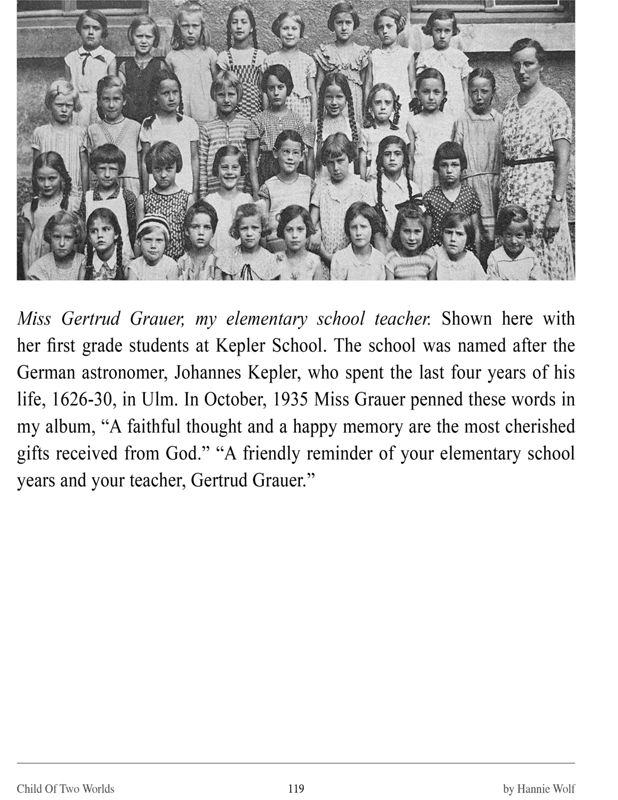
Miss Gertrud Grauer, my elementary school teacher. Shown here with her first grade students at Kepler School. The school was named after the German astronomer, Johannes Kepler, who spent the last four years of his life, 1626-30, in Ulm. In October, 1935 Miss Grauer penned these words in my album, “A faithful thought and a happy memory are the most cherished gifts received from God.” “A friendly reminder of your elementary school years and your teacher, Gertrud Grauer.”
Child Of Two Worlds 119 by Hannie Wolf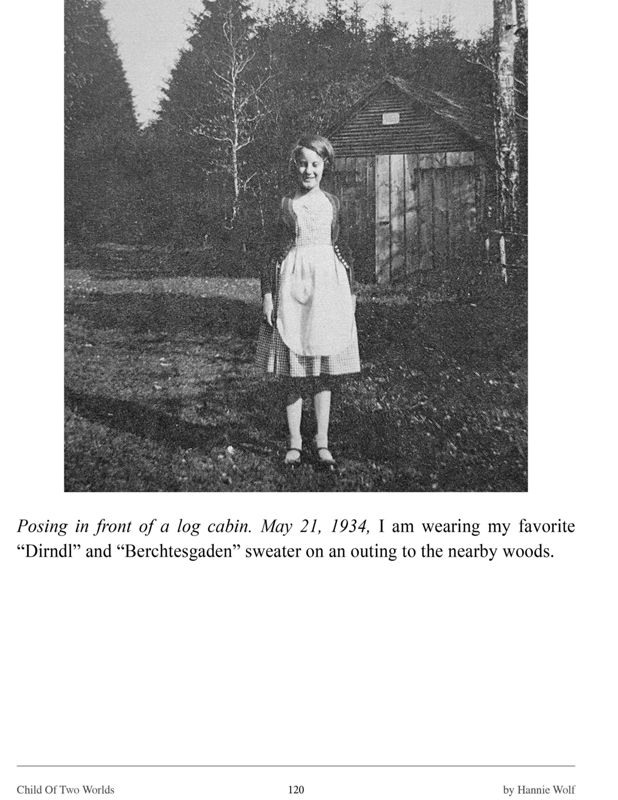
Posing in front of a log cabin. May 21, 1934, I am wearing my favorite “Dirndl” and “Berchtesgaden” sweater on an outing to the nearby woods.
Child Of Two Worlds 120 by Hannie Wolf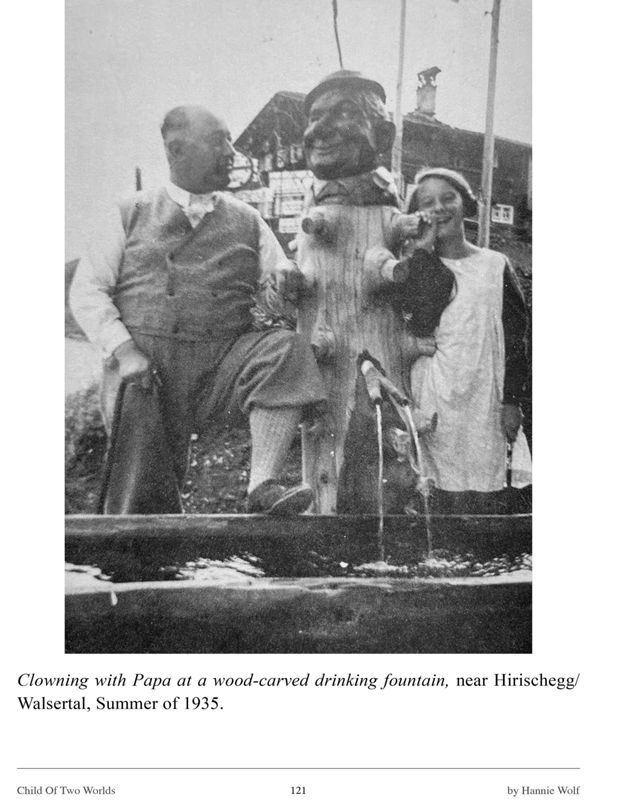
Clowning with Papa at a wood-carved drinking fountain, near Hirischegg/ Walsertal, Summer of 1935.
Child Of Two Worlds 121 by Hannie Wolf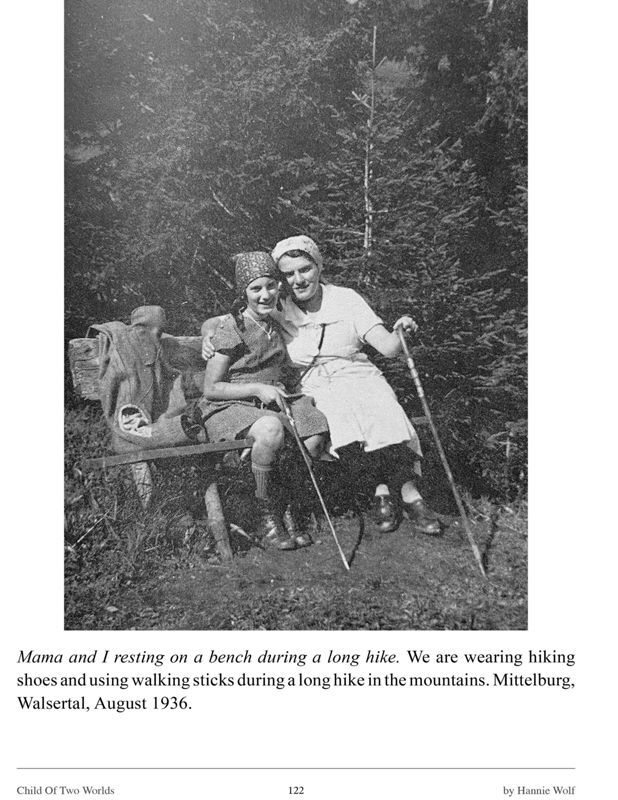
Mama and I resting on a bench during a long hike. We are wearing hiking shoes and using walking sticks during a long hike in the mountains. Mittelburg, Walsertal, August 1936.
Child Of Two Worlds 122 by Hannie Wolf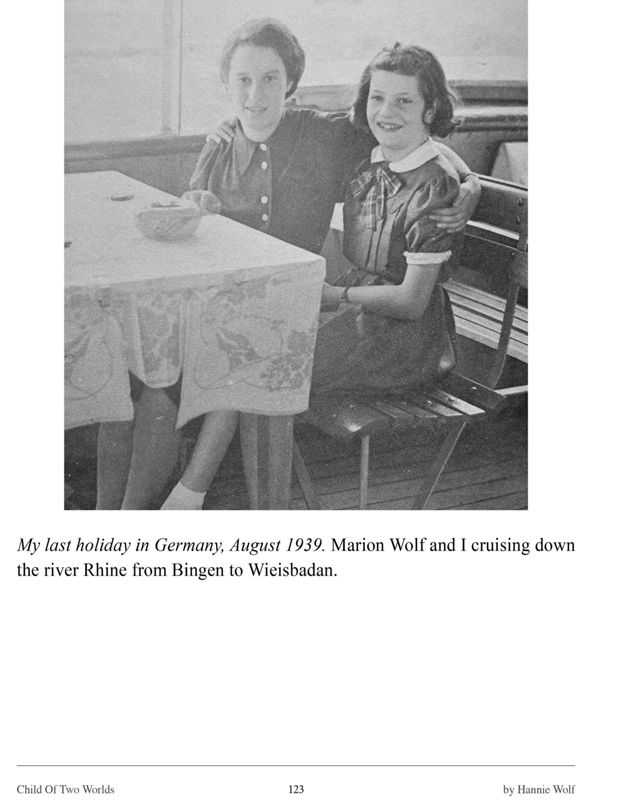
My last holiday in Germany, August 1939. Marion Wolf and I cruising down the river Rhine from Bingen to Wieisbadan.
Child Of Two Worlds 123 by Hannie Wolf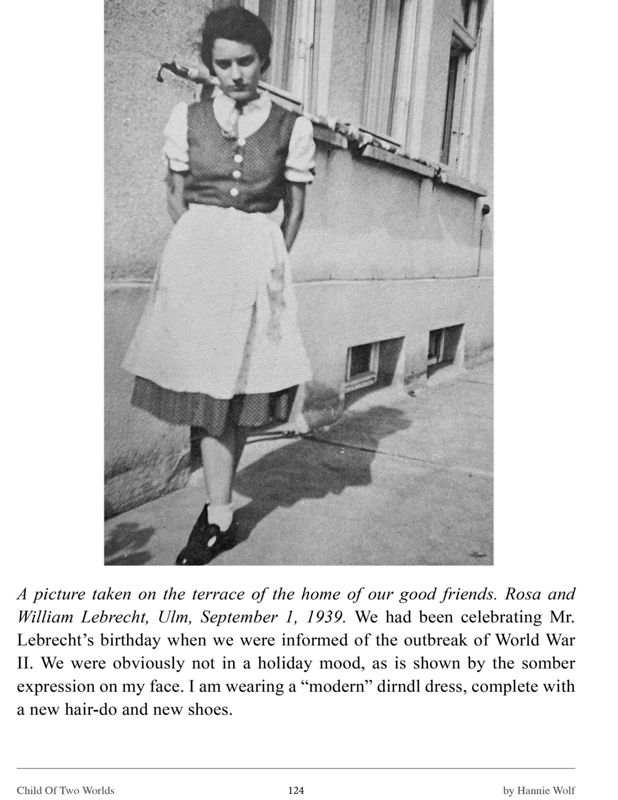
A picture taken on the terrace of the home of our good friends. Rosa and William Lebrecht, Ulm, September 1, 1939. We had been celebrating Mr. Lebrecht’s birthday when we were informed of the outbreak of World War II. We were obviously not in a holiday mood, as is shown by the somber expression on my face. I am wearing a “modern” dirndl dress, complete with a new hair-do and new shoes.
Child Of Two Worlds 124 by Hannie Wolf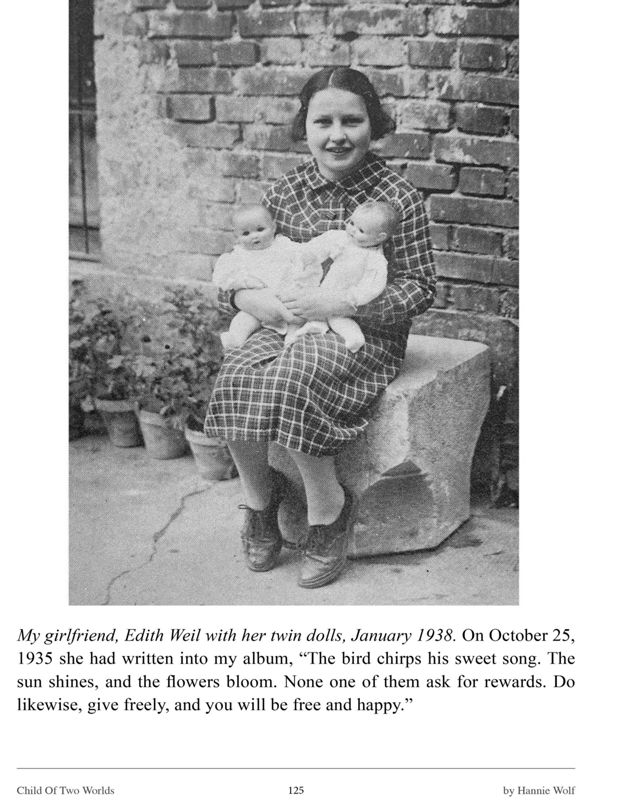
My girlfriend, Edith Weil with her twin dolls, January 1938. On October 25, 1935 she had written into my album, “The bird chirps his sweet song. The sun shines, and the flowers bloom. None one of them ask for rewards. Do likewise, give freely, and you will be free and happy.”
Child Of Two Worlds 125 by Hannie Wolf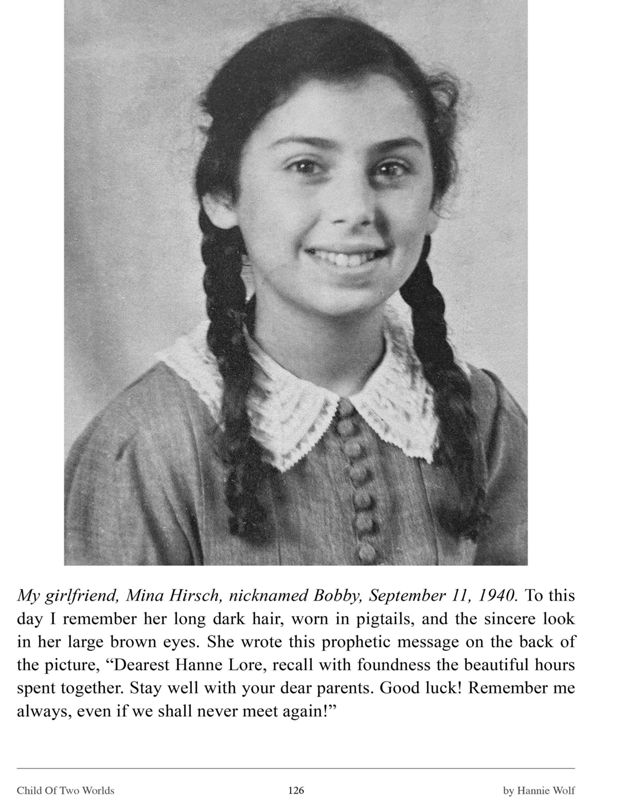
My girlfriend, Mina Hirsch, nicknamed Bobby, September 11, 1940. To this day I remember her long dark hair, worn in pigtails, and the sincere look in her large brown eyes. She wrote this prophetic message on the back of the picture, “Dearest Hanne Lore, recall with foundness the beautiful hours spent together. Stay well with your dear parents. Good luck! Remember me always, even if we shall never meet again!”
Child Of Two Worlds 126 by Hannie Wolf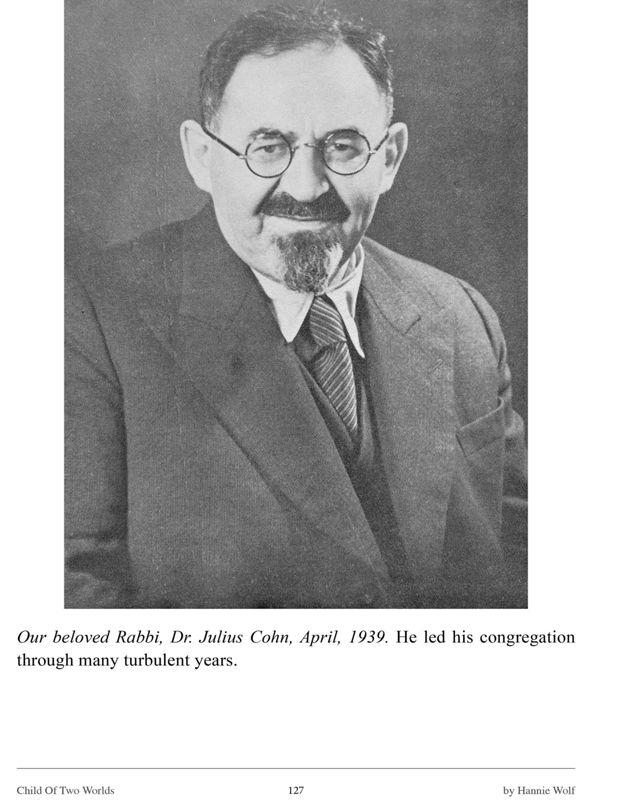
Our beloved Rabbi, Dr. Julius Cohn, April, 1939. He led his congregation through many turbulent years.
Child Of Two Worlds 127 by Hannie Wolf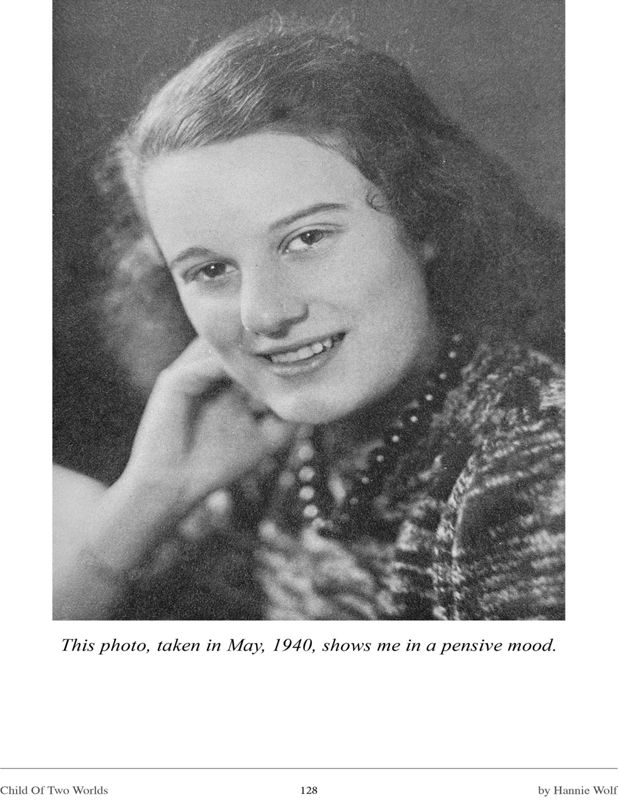
This photo, taken in May, 1940, shows me in a pensive mood.
Child Of Two Worlds 128 by Hannie Wolf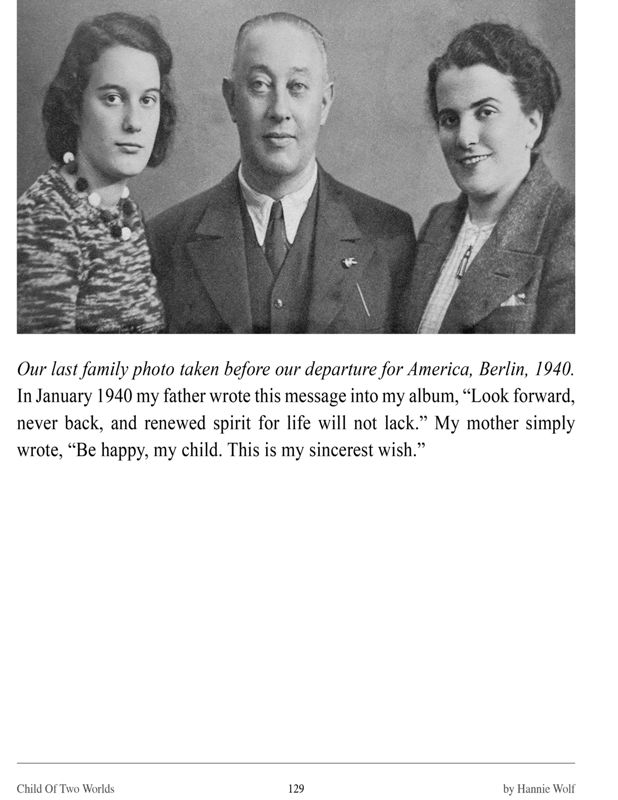
Our last family photo taken before our departure for America, Berlin, 1940. In January 1940 my father wrote this message into my album, “Look forward, never back, and renewed spirit for life will not lack.” My mother simply wrote, “Be happy, my child. This is my sincerest wish.”
Child Of Two Worlds 129 by Hannie Wolf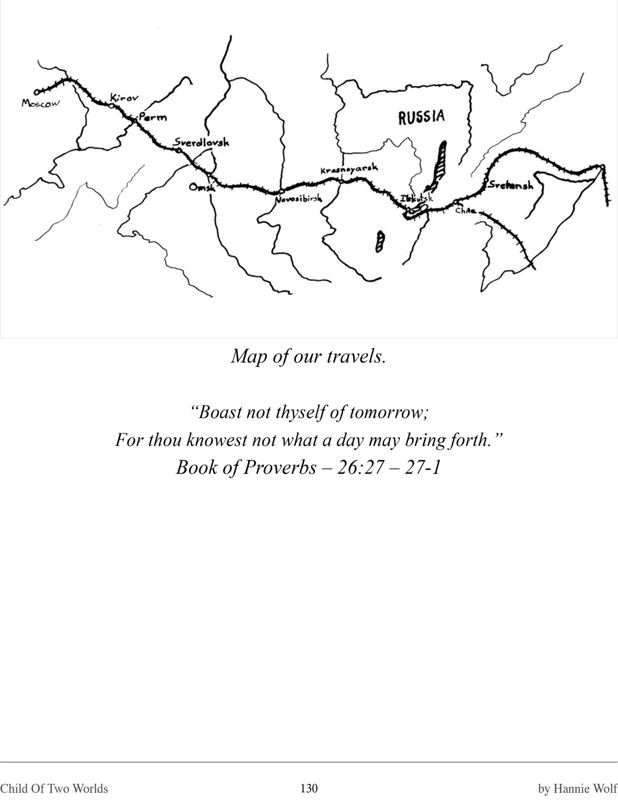
Map of our travels.
Child Of Two Worlds 130 by Hannie Wolf“Boast not thyself of tomorrow; For thou knowest not what a day may bring forth.”
Book of Proverbs – 26:27 – 27-1
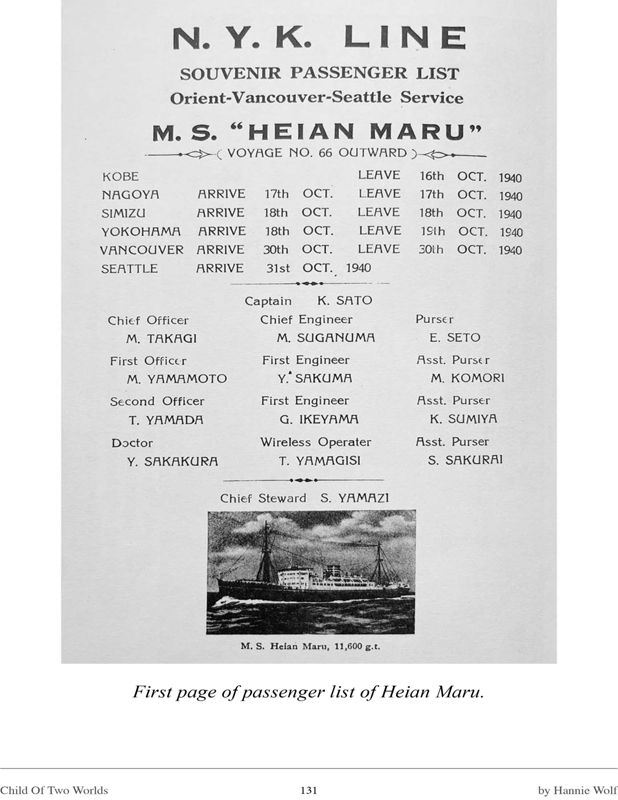
First page of passenger list of Heian Maru.
Child Of Two Worlds 131 by Hannie Wolf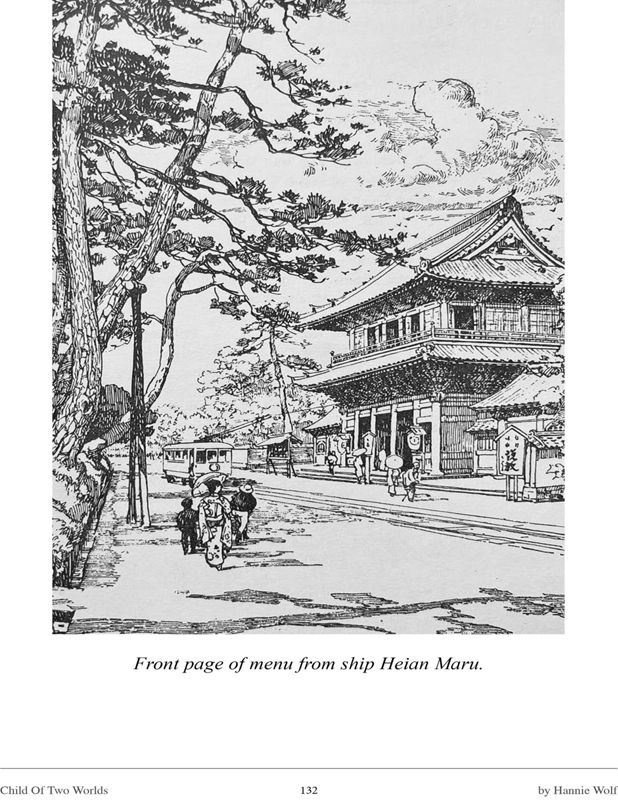
Front page of menu from ship Heian Maru.
Child Of Two Worlds 132 by Hannie Wolf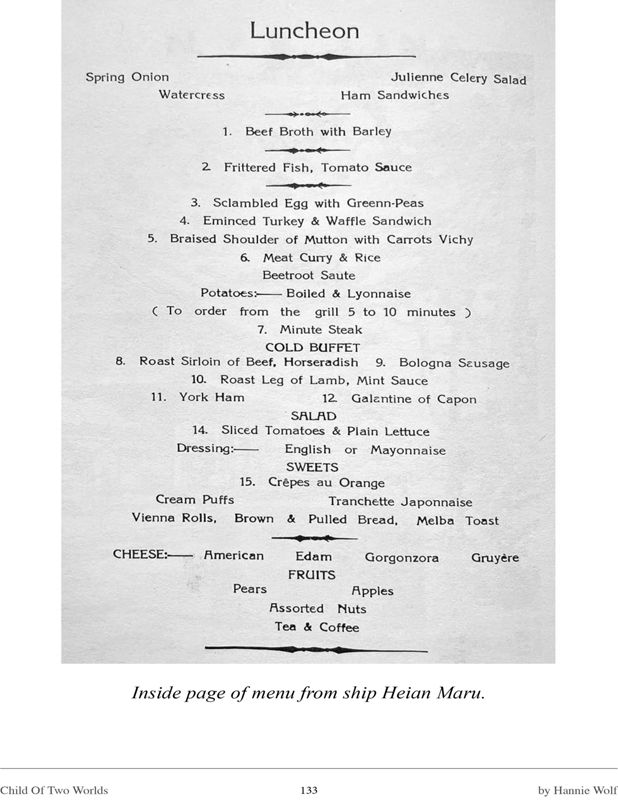
Inside page of menu from ship Heian Maru.
Child Of Two Worlds 133 by Hannie Wolf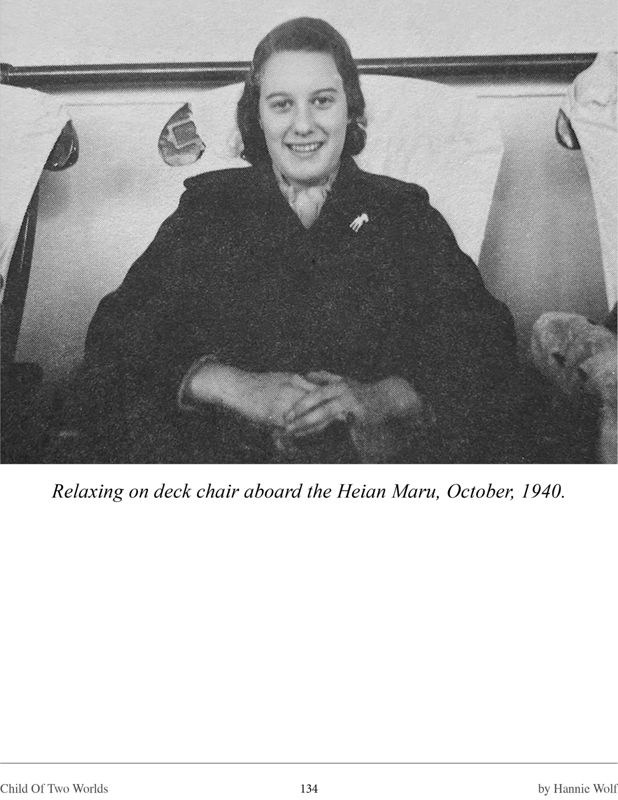
Relaxing on deck chair aboard the Heian Maru, October, 1940.
Child Of Two Worlds 134 by Hannie Wolf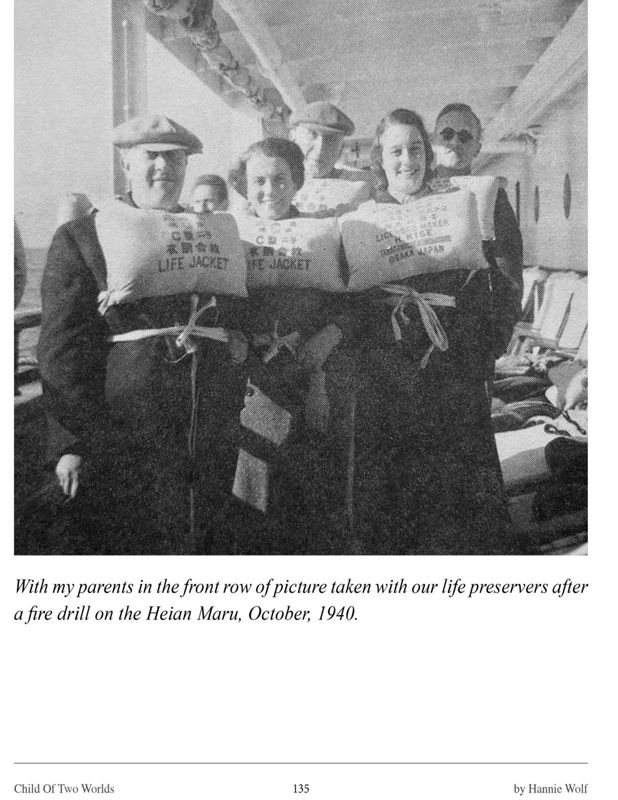
With my parents in the front row of picture taken with our life preservers after a fire drill on the Heian Maru, October, 1940.
Child Of Two Worlds 135 by Hannie Wolf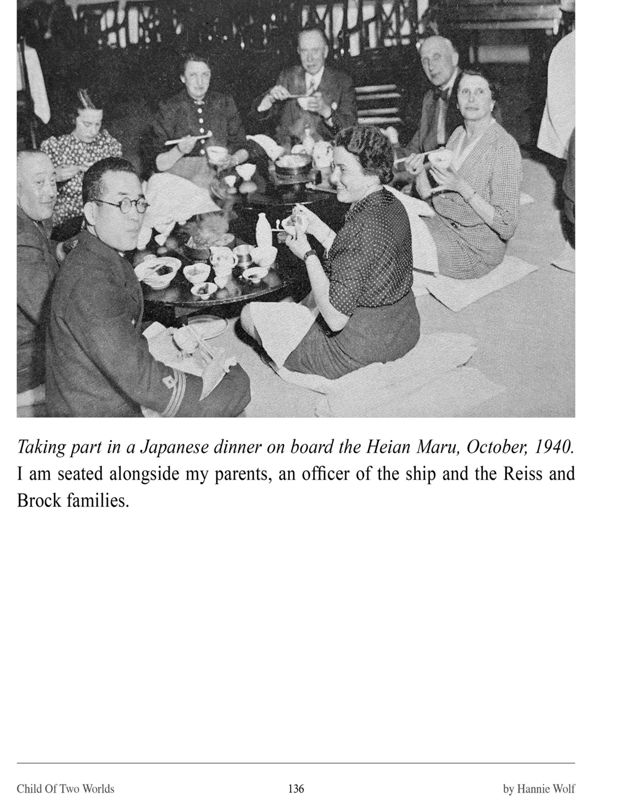
Taking part in a Japanese dinner on board the Heian Maru, October, 1940. I am seated alongside my parents, an officer of the ship and the Reiss and Brock families.
Child Of Two Worlds 136 by Hannie Wolf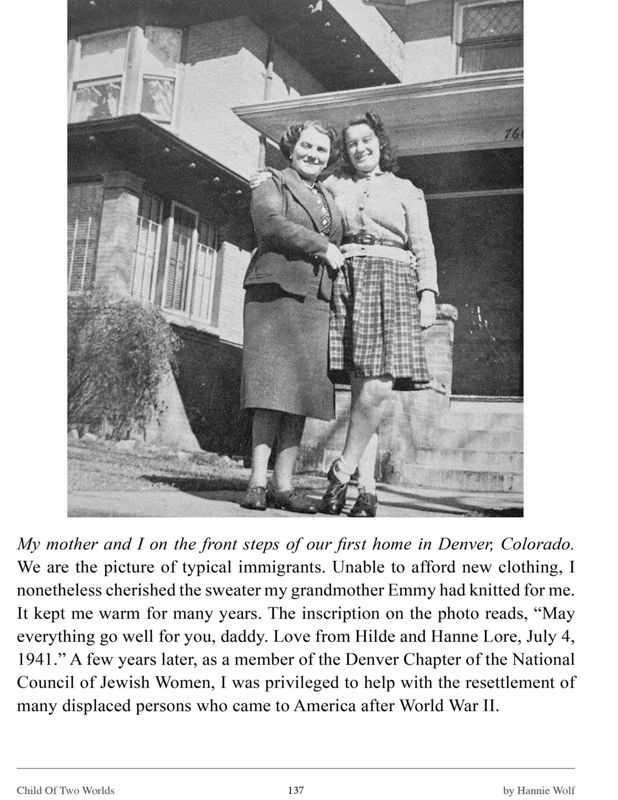
My mother and I on the front steps of our first home in Denver, Colorado. We are the picture of typical immigrants. Unable to afford new clothing, I nonetheless cherished the sweater my grandmother Emmy had knitted for me. It kept me warm for many years. The inscription on the photo reads, “May everything go well for you, daddy. Love from Hilde and Hanne Lore, July 4, 1941.” A few years later, as a member of the Denver Chapter of the National Council of Jewish Women, I was privileged to help with the resettlement of many displaced persons who came to America after World War II.
Child Of Two Worlds 137 by Hannie Wolf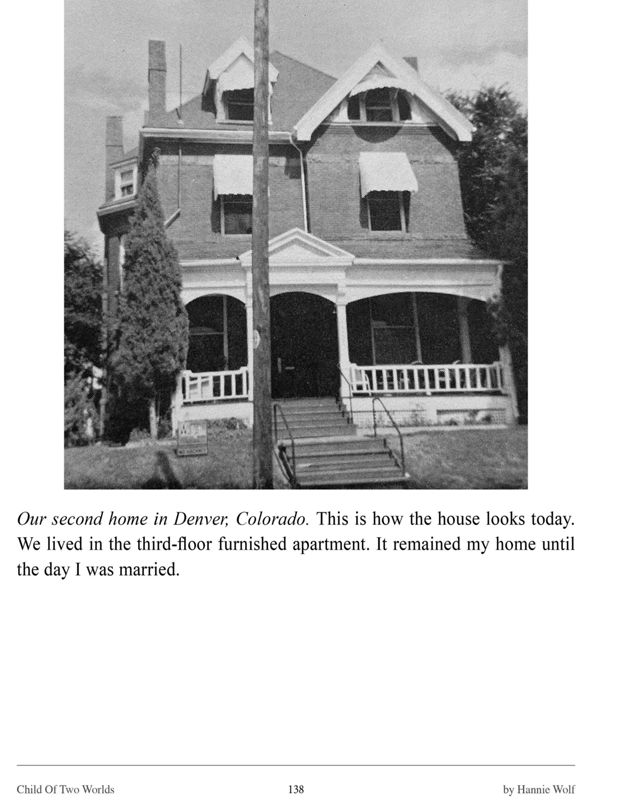
Our second home in Denver, Colorado. This is how the house looks today. We lived in the third-floor furnished apartment. It remained my home until the day I was married.
Child Of Two Worlds 138 by Hannie Wolf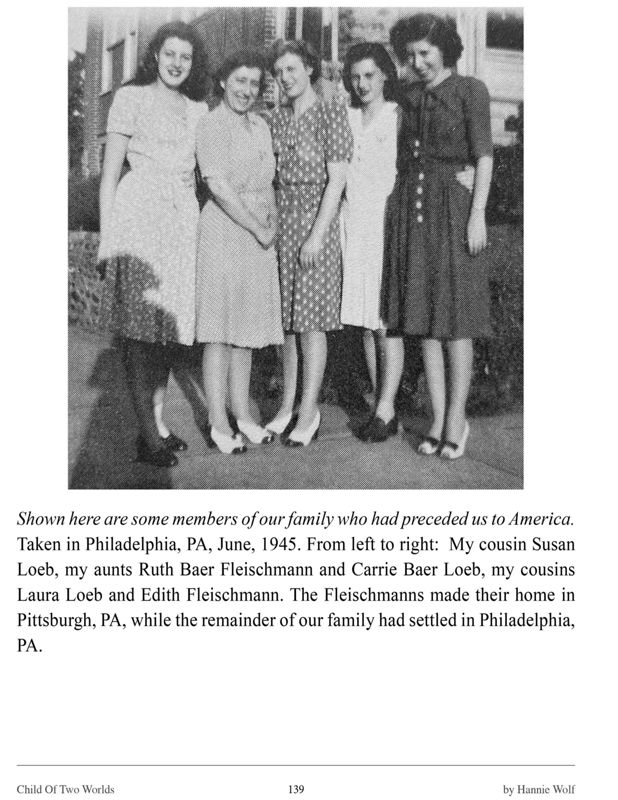
Shown here are some members of our family who had preceded us to America. Taken in Philadelphia, PA, June, 1945. From left to right: My cousin Susan Loeb, my aunts Ruth Baer Fleischmann and Carrie Baer Loeb, my cousins Laura Loeb and Edith Fleischmann. The Fleischmanns made their home in Pittsburgh, PA, while the remainder of our family had settled in Philadelphia, PA.
Child Of Two Worlds 139 by Hannie Wolf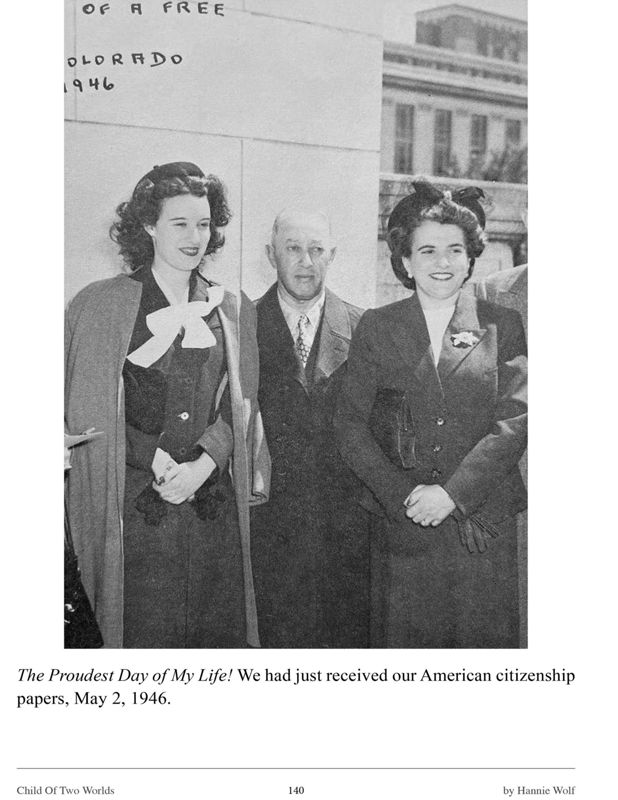
The Proudest Day of My Life! We had just received our American citizenship papers, May 2, 1946.
Child Of Two Worlds 140 by Hannie Wolf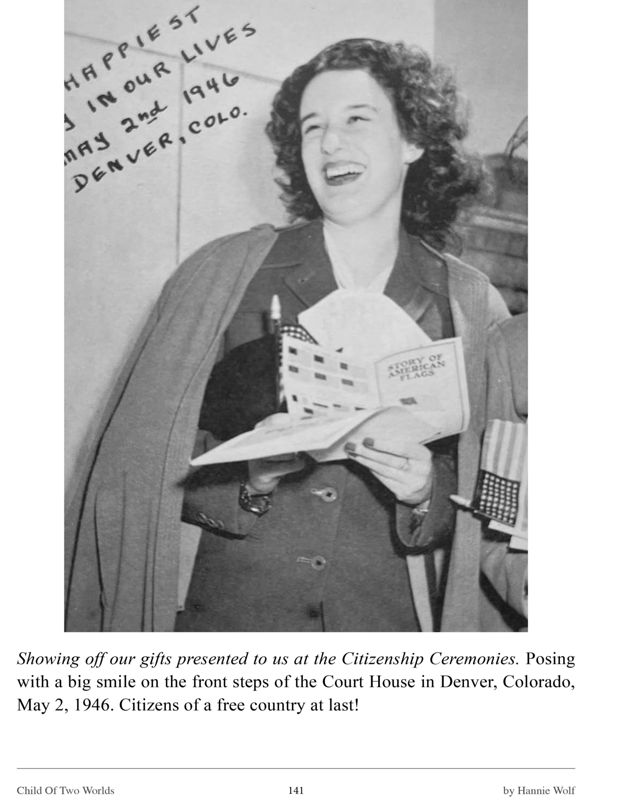
Showing off our gifts presented to us at the Citizenship Ceremonies. Posing with a big smile on the front steps of the Court House in Denver, Colorado, May 2, 1946. Citizens of a free country at last!
Child Of Two Worlds 141 by Hannie Wolf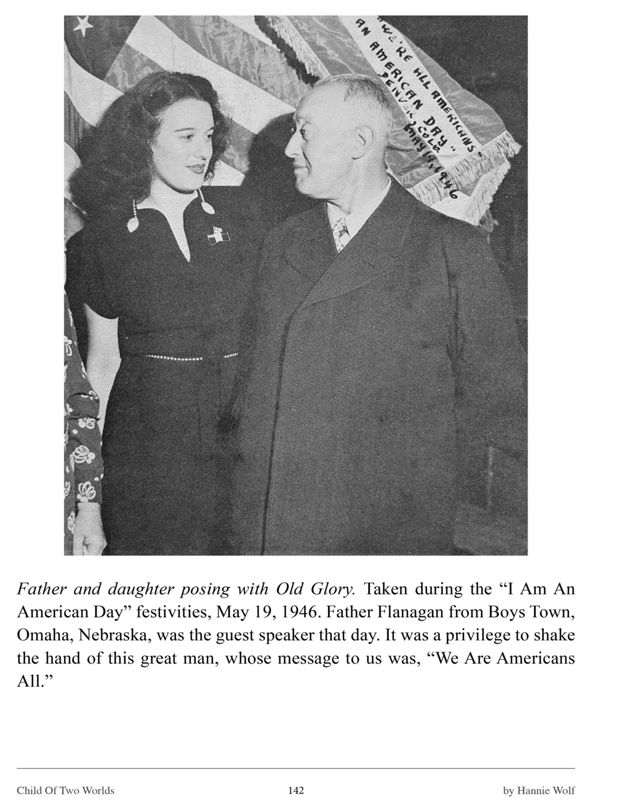
Father and daughter posing with Old Glory. Taken during the “I Am An American Day” festivities, May 19, 1946. Father Flanagan from Boys Town, Omaha, Nebraska, was the guest speaker that day. It was a privilege to shake the hand of this great man, whose message to us was, “We Are Americans All.”
Child Of Two Worlds 142 by Hannie Wolf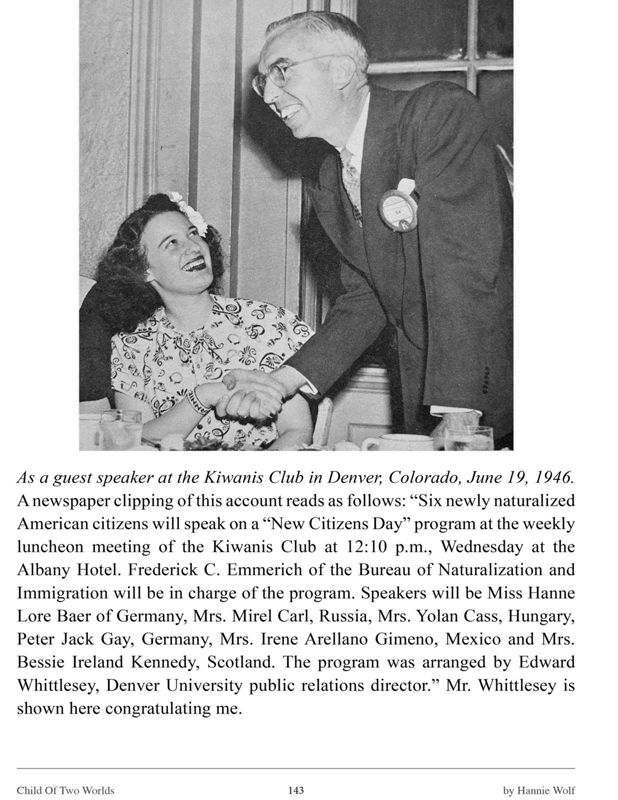
As a guest speaker at the Kiwanis Club in Denver, Colorado, June 19, 1946. A newspaper clipping of this account reads as follows: “Six newly naturalized American citizens will speak on a “New Citizens Day” program at the weekly luncheon meeting of the Kiwanis Club at 12:10 p.m., Wednesday at the Albany Hotel. Frederick C. Emmerich of the Bureau of Naturalization and Immigration will be in charge of the program. Speakers will be Miss Hanne Lore Baer of Germany, Mrs. Mirel Carl, Russia, Mrs. Yolan Cass, Hungary, Peter Jack Gay, Germany, Mrs. Irene Arellano Gimeno, Mexico and Mrs. Bessie Ireland Kennedy, Scotland. The program was arranged by Edward Whittlesey, Denver University public relations director.” Mr. Whittlesey is shown here congratulating me.
Child Of Two Worlds 143 by Hannie Wolf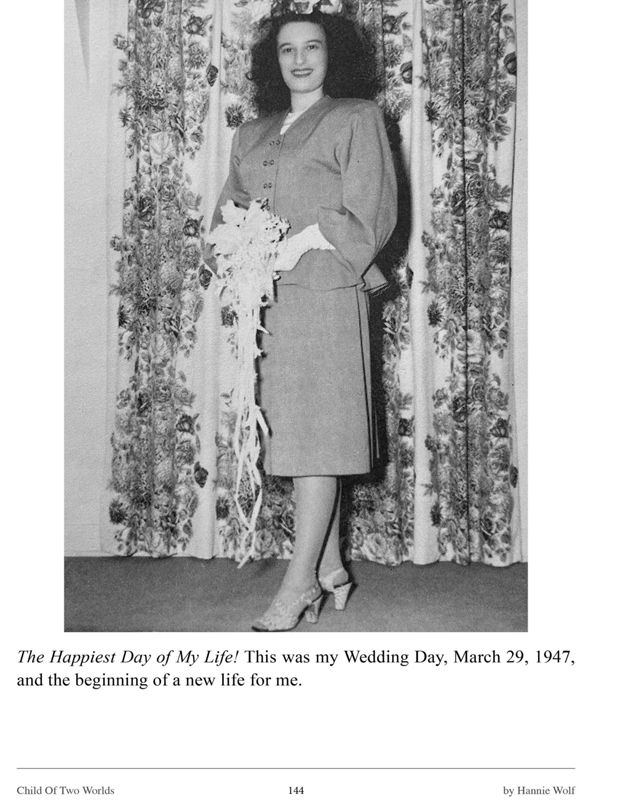
The Happiest Day of My Life! This was my Wedding Day, March 29, 1947, and the beginning of a new life for me.
Child Of Two Worlds 144 by Hannie Wolf
ABOUT THE BOOK
Hannie Wolf is the wife of a farmer-rancher from Albion, Nebraska and is the mother of a married son. Keenly interested in civic affairs, she has served as president of the Albion Woman’s Club, the VFW Auxiliary, and the American Legion Auxiliary.
A number of years ago the Wolfs hosted an AFS (American Field Service) exchange student from the Philippines, whom they consider their “other” son.
Mrs. Wolf enjoys traveling, art, music, and the theatre. Her hobbies include bridge, knitting, needlepoint, and above all else, writing.
ABOUT THE ARTIST
Marilyn Wolf, daughter-in-law of the author, sketched the cover and inside illustrations. She and her husband Bill farm and ranch near Albion, Nebraska.
She graduated from Wayne State College in 1974. She taught art and home ec for two years at Stromsburg, Nebraska, and taught K-12 art for three years at Newman Grove, Nebraska. She now teaches elementary art at St. Michael’s School in Albion.
Her hobbies include pottery, painting and drawing.