Arie Bucheister and Annie Mass Interview (Part 1), July 13, 2025
- Date
- Format
- testimony
- Category
- Stories
- Subcategory
- Testimony
- People
- Glass, Morton
- Sarah
- Abe
- Tiefenbrunner, Lila
- Amster, Roman
- Mass, Annie Bucheister
- Schindler, Oskar
- Lola
- Louise
- Moshe
- Leah
- Tiefenbrunner, Rosalie
- Moses, Solomon (Shlomech)
- Amster, Pola
- Max
- Spielhagen, Otto
- Bucheister, Freda
- Katz, Dora
- Tiefenbrunner, Gabriel
- Bucheister, Arie
- Schuchart, Paul A.
- Richtman, Dave
- Benjamin
- Josh
- Betty
- Bucheister, Paula
- Kinstlinger, Sol
- Tiefenbrunner, Herman
- Dotan, Beth
- Tiefenbrunner, Hannah
- Richtman, Annie
- Greenberg, Joseph
- Katz, Esther
- Glass, Alf A
- Diamond, Abr I.
- Guss, Joe
- Jacob
- Nathan
- Katz, Arie
- Margie
- Frankl, Viktor
- Bucheister, Joseph
- Tiefenbrunner, Pepche
- Moses, Malwina
- Places
- Krakow ghetto
- Israel
- Seym river
- Poland
- Beth El Synagogue, Omaha
- Wroclaw, Poland
- Germany
- Siberia
- Colorado, Chicago
- Soviet Union
- Peony Park, Omaha
- Galicia
- Haifa, Israel
- Omaha
- New York, New York
- Pleasantville, New York
- St. Louis, Missouri
- New Orleans, Louisiana
- Beth Israel Synagogue, Omaha
- Myślenice, Poland
- Auschwitz concentration camp
- Data URI
- soh.sto020.00001.01.xml
- Note
- https://mediahub.unl.edu/media/26373

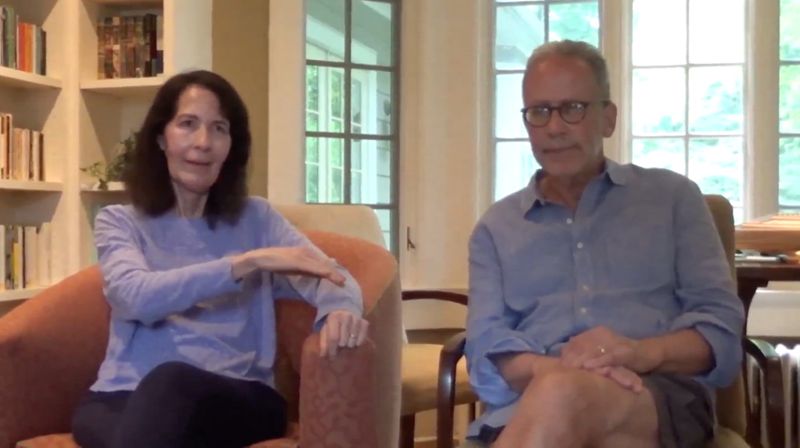 Beth Dotan
I'm Beth Dotan. Today is Sunday, July 13th, 2025 and I am here at the Bucheister home in Pleasantville, New York and I will let our dear friends introduce themselves and tell us a little bit about why we're here.
Arie BucheisterLadies first.
Annie MassMy name is Annie Mass I am Annie Bucheister Mass actually that's my Bucheister is my maiden name and I can introduce you or why don't introduce yourself.
Arie BucheisterI'm Arie Bucheister, I am Annie's brother and we're here because the name Bucheister really isn't the original family name of Annie's father, my stepfather the original family name was Tiefenbrunner, and the Tiefenbrunner family story is a pretty interesting one and I think that's what captured Beth's imagination and so on the early the early stages the early steps of a long journey I think to to learn about that family.
Beth DotanSo of course I sent you some questions but we'll back up a little bit and why don't you both tell us about your intention to perhaps gather information about your family and and how and why this is an important beginning for talking about that history of your family?
Arie BucheisterI'll start. I felt I've always wanted to collect the story because on the surface by itself it's intriguing. Joe Bucheister I'm gonna refer to him as my father although he's my stepfather, Annie's father, had four brothers who survived the Shoah, the Holocaust but they all have different names - they all have different last names, all of the same mother and father. So that on the surface is pretty interesting as the beginning as the loose thread that you want to pull to find out what's going on but I had a particularly difficult time in following through because mine is an even more complicated story.
I learned when I was a mid-teen that the person that I knew as my father was my stepfather and I learned only about that by chance so not to get into that story because I don't know whether we want to or not. My biological father who was married to my mother, Freda Bucheister, died when I was very young and that was a story I didn't know. as I say until I was in junior high school and I found out by chance, you know visiting our it's not really our family lawyer the guy who did taxes for my my father's butcher shop. He mentioned as I was looking for a summer job mentioned my stepfather well that led me to go home and ask my mother what's that about and her response was an eloquent cry she just couldn't talk about it I learned a little bit about that over time but not as much as I would have wanted to but it was difficult to talk in the family about that because clearly it was it was a third wire for my mother and I really didn't talk about my father's story my stepfather's story because he to me was very quiet, very upbeat, but very quiet about it. So I felt I couldn't go one way and learn about my biological father and I felt hesitant to go into the other story as fascinating as it was about the Tiefenbrunners, because of the general kind of keeping things quiet. So let me let me just start with that leave with that.
Annie MassThat's true, they, they never wanted to talk about what happened, well actually that's not true my dad he was quiet but he loved telling stories, and he and Arie said he's upbeat and he told -you know my dad used to make a joke out of things like he could -I could do this here but he would talk about how he had to deal with the with the Nazis and he would he didn't talk about shooting them or doing like that. He'd say, "yeah we would catch the the wives and the girlfriends of the of the soldiers and they would tie them up and shave their head, and just leave them there. Now that sounds awful but you know if you're fighting for your life you have to do what you have to do but he again, he would make a joke out of things whereas my mother was very serious and didn't want to talk about it at all. But my dad -what's interesting is these stories of my father, he's such a, he was such a sweet man. I can't imagine him hurting anybody but I think the way he dealt with it himself was the fact that he did sort of joke around about it. My you know my cousins and I, we would talk about, you know, all the brothers. They, you know, we have Tiefenbrunners, the original, we have Bucheister, we have Amster, Kinstlinger, and who did I forget?
Arie BucheisterRichtman.
Annie MassRichtman right.
Beth DotanAnd Moses is married into the family.
Annie MassMoses yes that's the next generation.
Arie BucheisterSecond generation.
Annie MassThat's this that's the child of the Herman Tiefenbrunner. And Rose from Herman and Rosalie Tiefenbrunner had Malwina or we call them Mala and Lila that was the other daughter. Then they had two children Malwina and was married to Schlamic — this is hard to remember the names — and they had Sarah and Betty that's their family. So that's the Tiefenbrunner were that they did not change their names right? They, Herman, the patriarch, kept his name and the other the other brothers all changes of the names I just mentioned. I was gonna say they I lost my train of thought.
Beth DotanYou'll think of it.
Arie BucheisterLet me pick up on a couple things that I think might be themes to my - my father was very interested in talking about what happened if you asked him. Wasn't like he sat down at dinner or came home from work and just talked about it but he would talk about it. My mother did not want to talk about it, her whole thing was, "Why? Why did- why do you want to go back and hear about that," and as a matter of fact when I switched my careers from practicing law to you know kind of doing volunteer work for survivor organizations and then working for an organization that negotiates with Germany for for benefits for survivors she just didn't understand it. One she didn't understand the difference the money made, you know she couldn't understand why someone would do that but two she didn't under- at least in talking to me why would I want to go back and do that. So there was a difference in the same family in the attitude toward the Holocaust. We talk about it, do not want to talk about it.
And I'd say two things about my father- stepfather. One is kind of I'm reminded of a story and it's in I think it's in Viktor Frankl's In Search of Meaning and Frankl talks about it was a Persian story about a king in the forest with his servant. They're walking in the forest and the servant gets lost. The king's wondering where he was, where he went. Eventually the servant comes running toward him. The king asked him, "Where were you - what'd you do," and the servant said, "I met death." And the king had the fastest horse in the kingdom and the servant asked the king, "can I borrow your horse, I want to ride away - I want to ride away from death and go to Tehran." The king says, "I'm not sure what that's about but okay." So the servant goes off riding the king's horse, and the king continues walking in the forest and he too comes across death. And the king says, "well what are you doing here?" He says, "I don't know, I just met someone. It surprised me because I've got a meeting with him in Tehran later tonight." So the first story to me is about destiny, right? And you can't beat your destiny. It is what it is and my father- stepfather never lamented what happened to him. He just dealt with it. He dealt with his destiny he accepted his fate but did the best he could.
The second thing I want to say about him was he cherished - he cherished everything he had in that destiny. I don't know of a person who loved his wife, loved his kids, loved his car as much as he did. It was the best to him of everything, so I just want to kind of set that out as this kind of themes, at least for our father.
Annie MassThat's true dad was grate- he was so grateful. That, that always surprised me. You know, he was- he was grateful for again, his house, his car, his children, etc. He loved his family. He didn't come to this country expecting a handout. He was gonna come to this country and he's gonna work, I mean he worked in a packing house to start with. I guess - I guess I can't remember the organization that, do you remember? That brought immigrants in and sort of distributed them across the country, depending on their occupation.
Arie BucheisterThat's probably Hebrew Immigrant Aid Society or some version of.
Beth DotanProbably Hebrew or Joint.
Annie MassSo the brothers interesting
Arie Bucheisterwe hope to find out. What that, what that was.
Annie MassThe brothers did not all go to the same place to begin with. The one was sent to Omaha, which was my dad, and the other - like it was Colorado, Chicago, maybe one in the South. I know they were distributed depending on what they said the profession was. And then my father convinced them to all the brothers to move to Omaha and they did and they were very close so they loved each other dearly. They talked on the phone every night they're becoming on calling their brothers which -which is very sweet and wonderful.
Arie BucheisterIt was the early version of Husker Nation.
Annie MassInteresting I know we're talking supposed to be talking about my dad. My mom when I asked her if she ever talked to anybody about what she went through, she says nobody was interested. Like in the synagogue, she would actually - she says she tried to talk to people, but they just weren't interested. Which I thought that's an interesting sort of path to go down. I'm just trying to think of any . . .
Arie BucheisterYeah I know I didn't I didn't know that she said people weren't interested.
Annie MassI asked her.
Arie BucheisterYeah. I'm not surprised I mean it's it's certainly a stereotype and she went to Israel after the war and certainly at least one narrative of what went on Israel is, Israelis wanted to have Halutzim young pioneers looking to the future. They didn't want to hear about - they didn't want to bother with those old Europeans who came over. I don't know if that's entirely true but it's certainly a narrative that you know has been written about and we know about and maybe maybe she picked it up then. But also you know in a more general way, you know survivors were busy, busy trying to put their lives together, busy trying to find their families. They really didn't have time you know to talk about what had happened to them. That there would be time in the future to do that, but I think both my mother you know having you know a young child living with her mother in Israel her -her -her recently married husband having died, had to get on with the business of doing things. And certainly my father -stepfather felt that way in finding and gathering those that were left of his family which was I think you know 12 other brothers and sisters you know 13 kids in the family and building a life again after what had been shattered during during the war.
You know the future would come and people became interested in what happened but yeah my mom was not interested. It was even from what you told me that it sounds like was pulling teeth, to get her to tell - to tell stories of what had happened.
Beth DotanSo let's do this, let's we'll do a little bit more order this is a great beginning and we'll fill in all these places where you started to think about other things and pulled it back a little bit.
Why don't you tell us the names of your parents, if you remember their birth dates I know Arie you've sent me some materials well, and where they were born, and then what their families were - how large their families were? So the name, the where they were born, what year, the town, I don't know if one of you want to talk about your mom one about your dad, however you'd like to do this.
Arie BucheisterOkay so you are better with dates.
Annie MassNot today I'm not. So my dad is Joe Buchheister, Straga, with his Hebrew name Felik, was this Polish or Yiddish name, I'm not sure.
Arie BucheisterYeah, it's I think it's useful to remember they had a Hebrew name, which we really didn't discuss in Synagogue yes, but not kind of day-to-day and then they had their Polish name.
Beth DotanSo can you repeat those again please.
Annie MassSure. So that's Joseph was obviously the English name. Shraga was the Hebrew name and Felik is the Yiddish or Polish name, and he was born in April... April... Okay this is the problem because of it-
Arie BucheisterYeah well we I sent you I sent you their their gravestones so use that in the 19-
Annie MassIn 1910 or 19-.
Arie BucheisterYeah, I think the gravestone says 1910.
Beth DotanSo tell us why you why you have this discrepancy, that's part of the story right?
Annie MassAgain I think it's the idea they they wanted to escape after -after the war I think when they were imprisoned, there's there's a photo which I can't find of the Tiefenbrunner brothers Wanted. You know, Wanted. They were considered criminals because they didn't want to be communists. They escaped, they actually were in prison, escaped and they came, my dad came to America and he changed the date of his birthday and his name because he didn't want it - he didn't want to be caught and sent back to Europe. So that's why right?
Arie BucheisterMy sense is my sense is that either they changed their names during the war to make it harder to trace them and they pick people who they knew had been killed or after the war you know you had communist control of parts of Germany and Poland where kind of they moved around and they could have changed it then again to make it harder to trace where they were. And I don't know the real story.
Annie MassI asked dad that too and he said it was after the war and the communists wrapped him he he wanted to use a name that he could remember easily Bucheister go figure that's an easy name but it's a difficult name but it was the name of his neighbor who, I think I don't know if he knew he was away or he's dead but it was a name he could remember easily and that's why I picked that name and I think that's why all the brothers except for Herman, the oldest who kept his name, but he was in Siberia during all this. So his situation is slightly different. Do you want my mom's?
Arie BucheisterLet me stay with that a little bit and let me kind of try to reprise what we talked about before we started filming, and -and in changing their names and in picking birth dates, that may or may not have been their actual birthday, which a number of them did. It created a shadow, I think somewhere in the deep recesses of who they were. All of the brothers because they did what they had to do to live, to survive and they never changed it back the the four brothers of the five who survived never changed their name back to the original Tiefenbrunner right they kept this different name that they picked. I have no idea whether they did anything anywhere that said this is my legal name now you know they were Tiefenbrunner one day and then they became Amster, Kinstlinger, Richtman, Bucheister. Now in this country you want to change your name you can do it, but you got to go through a legal process. No idea what they did ever, don't know when they came to this country if they said here are the papers that said I was a Tiefenbrunner but now I want to be a Kinstlinger, or a Bucheister, or an Amster, Richtman. I think that's who they were in other words the name change was who they were when they came to this country and they stayed that way as were the dates, whatever they picked for whatever the cause was. And there was a fear certainly I think not worn on the sleeve but as I say in the shadow of our dad that if they ever were caught with that discrepancy, based on the countries they knew Germany and Poland because they didn't know the United States, they'd heard about it, that there would be some kind of sanction or punishment including being kicked out of the country and so that was always something that that I felt that was going on there with them when it came to. "Well what what really happened, who are you really?" So and that's and you know I guess I guess in your early life if you say something that isn't the case but then you keep saying it it becomes your truth but there's always a little nub deep, deep down that says. "I'm gonna be found out and I'm gonna get in trouble for it I'm gonna be found out," and that's a difficult thing to live with. In addition to trying to rebuild your whole life.
Beth DotanSo did you ever celebrate his birthday? I mean did you?
Annie MassYeah.
Beth DotanYeah. In April?
Annie MassIn April, April 13th and my mom is April 21st.
Beth DotanOh, okay.
Arie Bucheister1926?
Annie MassWell there is a discrepancy, with my mom because she told me that her birthday was in what is it, 25, 20-, 1925? We're talking about dad- way no that's...
Arie BucheisterI just know the one on the tzeva
Annie MassYes.
Arie BucheisterThat is 26.
Annie MassYep and my mom said it was 19- should have been 1925 but dad made a mistake, he did all the paperwork and made a mistake and so he put down 1926. So we have this little thing here disagree - not a disagreement but there's the question "Was it 1925, was it 1926?" But the tombstone has the 1926 anyway but we did celebrate their birthdays definitely acknowledged them. Absolutely.
I forgot to say what dad was born in Myślenice. Don't ask me how to spell it.
Beth DotanWe found a couple of different ways, yes.
Arie BucheisterYeah and just to kind of round the story up but you'll you'll hear this from others. Dad was Joseph, I don't know how it came to be Joseph, and Felik and when he spoke with his brothers he was Felik sometimes Joe in the in the butcher shop. But typically Felik. Dave Richtman was Benek right?
Annie MassRight.
Arie BucheisterSol Kinstlinger was a Zygmunt.
Annie MassRight.
Arie BucheisterWhich is Polish but he was Zygmunt and Roman Amster was Poldek. So this those were the names they referred to each other as not so much, Roman, Joe, Sol and Dave. But they knew each other I guess growing up in Poland.
Beth DotanWere all the brothers born in the same town?
Arie BucheisterI have their photo for I don't think I've shown this one to you, the one in the thing so that's that's like outside. We'll yeah, we'll take a photo.
Annie MassWhat is that picture?
Arie BucheisterThat's one in, looks like near their house it's not all of them but it's it's a number well let me take a copy of this.
Beth DotanHow did you get a copy of that photo?
Arie BucheisterI think I got it from from my dad I got it from him so it's a picture of his mother Hannah, his father Gabriel, and some of the brothers and sisters, some of which we can identify, some maybe as you go through this journey, you know we can get someone who's not only confident but actually knows what they're talking about to identify the rest.
Beth DotanSo at the end we'll do a zoom in and I'll take a yeah.
Arie BucheisterIt looks like the two girls at the bottom there were twins among the 13 kids it looks like they're close to being you know twins we can do.
Beth DotanYou want me to hold it up?
Amnon DotanNot now.
Annie MassDad was engaged. Before the war, his girlfriend?
Arie BucheisterNo...
Annie MassDid he not talk about it?
Arie BucheisterNo.
Beth DotanGo ahead, tell, tell the story.
Annie MassYeah I know that just reminded me of that remind me of a photo of my dad. He was holding hands with a woman and I was told that was his girlfriend before the war.
Arie BucheisterIn Poland?
Annie MassYeah.
Arie BucheisterFirst I heard it.
Annie MassYeah I asked dad all the juicy questions.
Arie BucheisterGood for him
Annie MassMy dad was a flirt, oh he loved women, in a nice way. He really he just - he was just like our upbeat happy person he loved children and he loved dogs.
Arie BucheisterI think no it was interesting our social life was basically hanging out with my dad's brother's family wasn't like we invite people from the synagogue over or customers over or kind of people in a neighborhood. I mean we had Annie and I both have friends, kids in the neighborhood, but the social life of where we go to eat, to hang out, to visit was if I said 98-99% with our cousins and aunts and uncles, I probably be short-changing it. That's who we hung out with and in in that I mean I don't know what they spoke to each other about, I mean I think they spoke Polish with each other. Annie and I both spoke and understood Yiddish but I say that only to say one, I don't know the substance of what they talked about if they talked a lot about the war but the feeling that I got from it was not somber or sad it was. "We're here we're doing what we have to do we're not lawyers and doctors and the elite kind of layer of what goes on in this country but we're happy, we're happy with what we have and happy with what we're doing." There was a real embrace of life in a positive way when you know when theirs was a life for each of them, their mother and father were murdered and eight of their siblings were murdered and they didn't know what home was from 1939 to 1945 that's pretty extraordinary.
Beth DotanWe'll continue to talk about this incredible part of the family let's go back to your mom tell us where she was born and give us a little bit of her story before the war, even though we do have it on the Shoah Foundation tape and we've got a short version in the book but tell us from your memory about your mom's history before the war.
Annie MassShe was born in the Yaraslav and she went to all I know she told me this just wearing a uniform she says that's what they had to wear to school particularly uniform it's a photo that stands out to me and you know she said you know she had friends and went to school the gymnasium they called it she said there was this is an interesting sort of observation of hers she would hear sort of anti-semitic remarks here and there and she said that she could get away with sort of walking you know they never really bothered her she's because she had blue eyes but she didn't look Jewish that's that's what she said to me which I thought was sort of interesting. Her, her mother, her mother. Oh, she had a sister Dora who had, how many kids did Dora have? Leah?
Arie BucheisterFour
Annie MassFour children, her sister was older than she was, and her mother was Esther, and her father was, what was her father's name? Arie of course oh my god my brain.
Arie BucheisterArie - Mr. Katz were her parents.
Annie MassThat's what, Katz was their last name. And I think he had it, they had a store, I think a grocery store of some sort I think the father had. You know there's not a huge history on mom before the war because she just didn't reveal things, she didn't talk about them. If I asked her a specific question she would answer and then after that you know, she she talked about when things started getting heated up in Poland and how she was, you'll probably know this story better, but she was taken away they had to take they were on a train to Siberia basically, and so she was in this labor camp during the war she was like 12? 12 maybe
Arie BucheisterWell depending on when she was born the Nazis invaded Poland in September of 39 so she was 13 or 14.
Annie MassOkay, so this interestingly she told me, oh she was concerned on the train ride, they think that they gave her soup and she wouldn't eat it because she thought there was a lobster in it so I thought that was sort of a fun story.
Arie BucheisterThey didn't follow Kashrut tehoria, Soviet trains to Siberia.
Annie MassWell you think she'd know that, but anyway she said you know she'd get up in which was Siberia she'd get up and you know they had jobs for them. It was very cold but she said it didn't bother her, she was young she said didn't bother her the cold.
Beth DotanI remember her telling a story-